

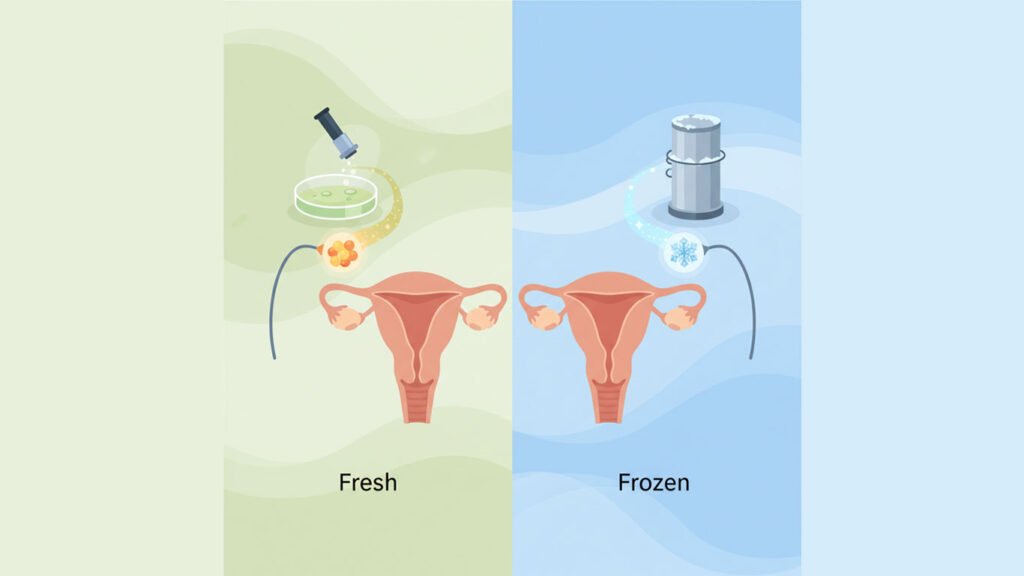
In the world of IVF, one of the most important decisions you’ll make with your doctor is when to transfer your embryos. You have two main options: a Fresh Embryo Transfer (done days after egg retrieval) or a Frozen Embryo Transfer (FET) (done weeks, months, or even years later).
Neither is “better” for everyone—the right choice depends on your body’s response to treatment. Here is a breakdown of the pros and cons for each.
1. Fresh Embryo Transfer
A fresh transfer occurs in the same cycle as your egg retrieval, typically 3 to 5 days after fertilization.
The Pros
- Faster Timeline: You don’t have to wait an extra month or more to start your pregnancy journey.
- Lower Initial Cost: Since there are no freezing or storage fees involved for that first transfer, it can be more budget-friendly upfront.
- Fewer Medications: You avoid the extra hormones sometimes needed to “re-prepare” the lining for a frozen cycle.
The Cons
- Hormonal “Storm”: During egg retrieval, your estrogen levels are often much higher than normal. This can sometimes make the uterine lining less receptive to implantation.
- OHSS Risk: If you have many eggs retrieved, you may be at risk for Ovarian Hyperstimulation Syndrome. A fresh transfer can worsen this condition if you become pregnant.
- No Genetic Testing: Because PGT-A (genetic screening) takes about a week for results, it is generally not possible during a fresh cycle.
2. Frozen Embryo Transfer (FET)
In an FET, the embryos are flash-frozen (vitrified). Your body is given a “break” to return to its natural state before the transfer happens.
The Pros
- Uterine Environment: Your hormones return to “baseline,” which many studies suggest creates a more natural and receptive environment for the embryo.
- Genetic Testing (PGT-A): This is the biggest advantage. You can screen embryos for chromosomal health before the transfer, which can significantly reduce the risk of miscarriage.
- Timing Control: You can schedule the transfer for a time that works best for your life, rather than being at the mercy of your body’s immediate response to meds.
The Cons
- The Wait: You must wait at least one full menstrual cycle after retrieval before the transfer, which can be emotionally difficult for couples eager to start.
- Freezing/Thawing Risks: While modern “vitrification” has a 95–99% survival rate, there is a very small risk that an embryo may not survive the thaw.
- Additional Costs: FET involves fees for cryopreservation, annual storage, and the thawing procedure.
Comparison at a Glance
| Feature | Fresh Transfer | Frozen Transfer (FET) |
| Timeline | Immediate (3–5 days) | Delayed (4+ weeks) |
| Hormone Levels | High/Stimulated | Natural/Stable |
| Success Rates | Slightly lower for “high responders” | Slightly higher for many patients |
| Genetic Testing | Not possible | Fully compatible |
| OHSS Risk | Higher | Nearly Zero |
Which One is Right for You?
- Choose Fresh If: You are a “normal responder” (not too many eggs), have a perfectly thick uterine lining, and are not planning on genetic testing.
- Choose Frozen If: You have PCOS (higher risk of OHSS), your progesterone levels rose too early during stimulation, or you want to ensure the embryo is genetically healthy before transfer.
