
In the world of reproductive medicine, age is often discussed as the single most critical factor in determining the success of In Vitro Fertilization (IVF). While modern science has made leaps in technology—from ICSI to PGT-A—the biological clock remains a primary driver of outcomes.
For patients at Prarambh IVF, understanding the “why” and the “how” behind the data is essential. This guide breaks down the clinical realities of age-related fertility, the statistical benchmarks for success, and the strategies available to overcome age-related challenges.
1. The Biological Reality: Why Age Matters
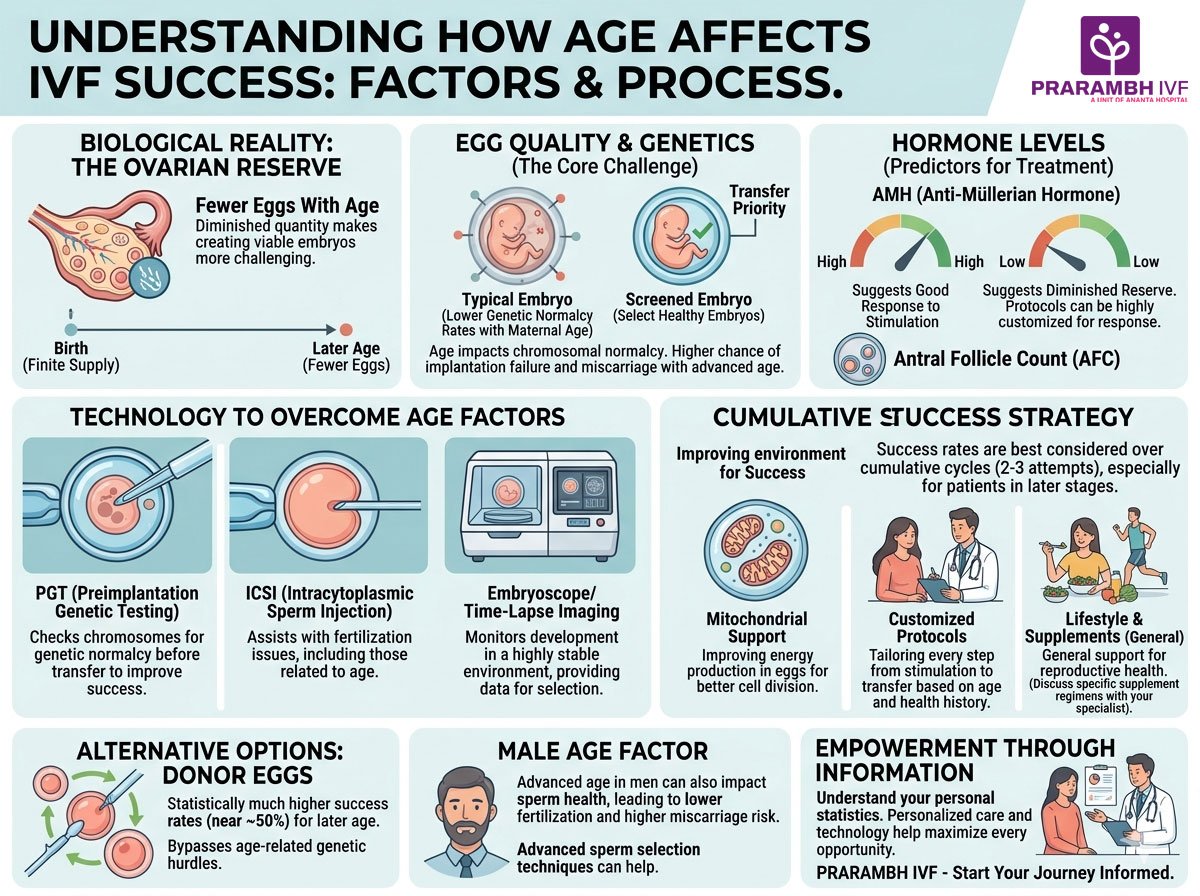
To understand IVF success rates, one must first understand the biological decline of the female reproductive system. Unlike men, who produce new sperm throughout their lives, women are born with a finite number of eggs.
The Ovarian Reserve
At birth, a female has approximately 1 to 2 million eggs. By puberty, this number drops to about 300,000. By age 37, the reserve typically plummets to around 25,000. This quantitative decline is the first hurdle in IVF, as fewer eggs mean fewer chances to create a viable embryo.
Egg Quality and Aneuploidy
Quantity is only half the story; quality is the other. As eggs age, they are more prone to errors during meiosis (cell division). This leads to aneuploidy—an abnormal number of chromosomes.
An aneuploid embryo is the leading cause of:
- Failure of the embryo to implant.
- Early-stage miscarriage.
- Genetic conditions such as Down Syndrome.
By age 40, clinical data suggests that upwards of 60-70% of a woman’s remaining eggs may be chromosomally abnormal.
2. Deciphering the Data: IVF Success Rates by Age Group
When looking at “Success Rates,” it is important to distinguish between Clinical Pregnancy Rates and Live Birth Rates. The following data reflects global benchmarks (SART/HFEA) and clinical observations.
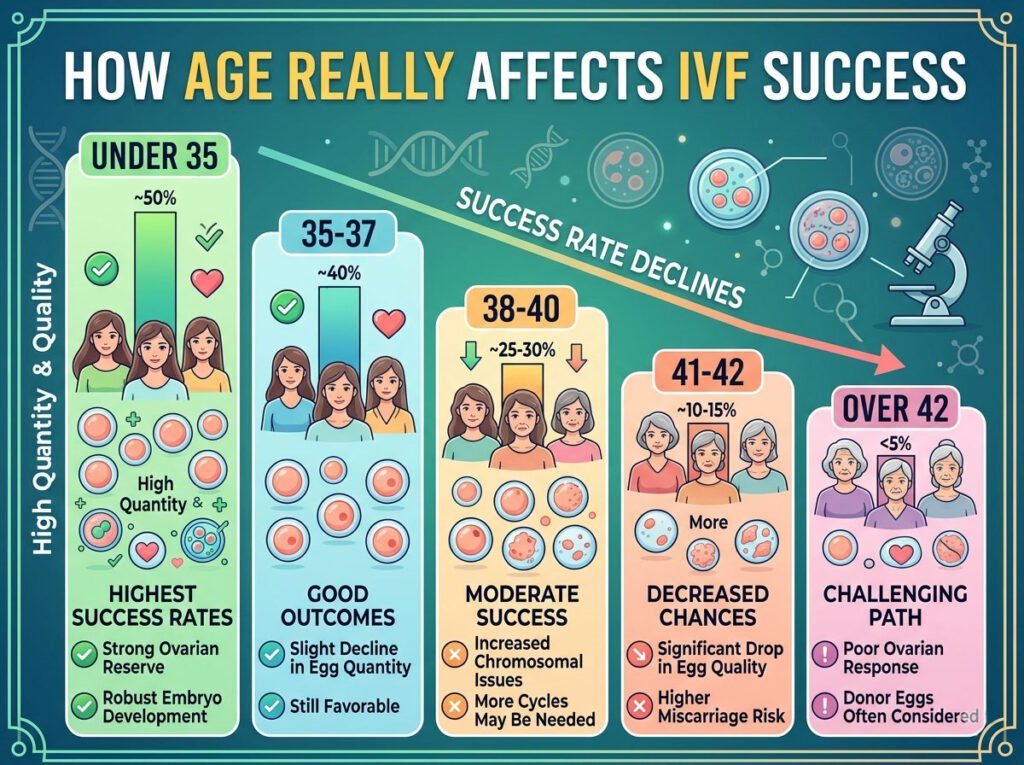
Age Under 35: The Peak Window
For women under 35, IVF success rates are at their highest.
- Success Rate: Approximately 45% to 55% live birth rate per egg retrieval.
- The Data Explained: At this age, the primary reasons for IVF are often tubal factors, endometriosis, or male factor infertility. The eggs themselves are generally robust and “euploid” (genetically normal).
Age 35–37: The Gradual Decline
Fertility begins to dip more noticeably after 35.
- Success Rate: Approximately 35% to 40%.
- The Data Explained: This is often the “tipping point” where ovarian reserve testing (AMH and Antral Follicle Count) starts to show a downward trend.
Age 38–40: The Critical Threshold
This age group sees a sharper decline in both egg quantity and quality.
- Success Rate: Approximately 20% to 25%.
- The Data Explained: In this bracket, the “Cumulative Success Rate” (the chance of success over multiple cycles) becomes more important than the success of a single cycle.
Age 40–42: The Biology of Persistence
- Success Rate: Approximately 10% to 15%.
- The Data Explained: Miscarriage rates increase significantly here due to the aforementioned aneuploidy. Doctors often recommend PGT-A (Preimplantation Genetic Testing) to screen embryos before transfer.
Age Over 42: The Role of Donor Eggs
- Success Rate: Below 5% using own eggs; 50%+ using donor eggs.
- The Data Explained: For many women over 42, the biological reality of the eggs makes natural conception or IVF with own eggs statistically difficult.
3. The Role of AMH and Antral Follicle Count (AFC)
Age is the best predictor of quality, but AMH (Anti-Müllerian Hormone) is the best predictor of quantity.
- High AMH: Suggests a good response to stimulation drugs, meaning more eggs can be retrieved.
- Low AMH: Suggests “Diminished Ovarian Reserve” (DOR). While it doesn’t mean you can’t get pregnant, it means the IVF protocol must be highly customized.
At Prarambh IVF, we use these markers to set realistic expectations and design protocols that maximize every single follicle available.
4. How Technology Mitigates Age Factors
While we cannot reverse the age of an egg, IVF technology provides tools to “filter” the best chances for success.
PGT-A (Preimplantation Genetic Testing for Aneuploidies)
PGT-A allows embryologists to biopsy a few cells from a blastocyst (Day 5 embryo) to check for the correct number of chromosomes.
- Why it helps: By only transferring “euploid” embryos, we can bring the success rate of a 40-year-old woman closer to that of a 30-year-old for that specific transfer.
ICSI (Intracytoplasmic Sperm Injection)
In older couples, male factor infertility can compound age-related female factors. ICSI ensures that the egg is fertilized by the best-moving sperm, removing the “barrier to entry.”
Advanced Culture Media
Older eggs are more sensitive to their environment. Using time-lapse incubators (like EmbryoScope) allows us to monitor development without disturbing the embryos, providing a stable environment that mimics the fallopian tube.
5. The Cumulative Success Rate Strategy
A common mistake in interpreting IVF data is looking only at a single cycle. For patients aged 38+, the Cumulative Success Rate is the most relevant metric. This refers to the chance of a live birth after 2 or 3 cycles of IVF.
Data shows that for women aged 40, the chance of success may be 15% in the first cycle, but after three cycles, the cumulative probability can rise to over 35-40%. Persistence and financial planning for multiple rounds are key components of the journey.
6. Lifestyle, Supplements, and Egg Quality
Can you improve egg quality after 35? While you cannot create new eggs, you can improve the environment in which the remaining eggs mature.
- CoQ10 (Ubiquinol): Research suggests this helps the mitochondria (the battery of the cell) in the egg, potentially aiding in better cell division.
- DHEA: Often used for women with diminished ovarian reserve to improve the follicular environment.
- Dietary Impact: An anti-inflammatory diet (Mediterranean style) has been shown in various studies to correlate with better IVF outcomes.
7. When to Consider Donor Eggs: The Data on Success
One of the most empowering pieces of data in fertility is the “Donor Egg Success Curve.”
When a woman over 43 uses eggs from a donor in her 20s, her success rate jumps from <5% to over 50%. This proves that the uterus does not age nearly as fast as the eggs. For many families, donor eggs represent a path to parenthood that bypasses the genetic hurdles of age.
8. Male Age and IVF
While the focus is often on the woman, the “Advanced Maternal Age” (AMA) has a counterpart: “Advanced Paternal Age” (APA).
- Men over 45 see a decline in sperm DNA integrity.
- Data suggests a slightly higher risk of miscarriage and certain neurodevelopmental conditions when paternal age is advanced.
- The Prarambh Solution: We utilize advanced sperm selection techniques (like MACS or Zymot) to ensure the healthiest sperm are used.
9. Conclusion: Empowerment Through Information
At Prarambh IVF, we believe that “Data is Power.” Age affects IVF success, but it does not define your entire journey. By understanding the statistics, we can:
- Choose the right protocol early.
- Incorporate genetic testing to avoid heartbreak.
- Set realistic timelines for success.
The journey to parenthood is a marathon, not a sprint. Whether you are 25 or 45, our goal is to provide the clinical expertise and the honest data you need to make the best decision for your future family.
