
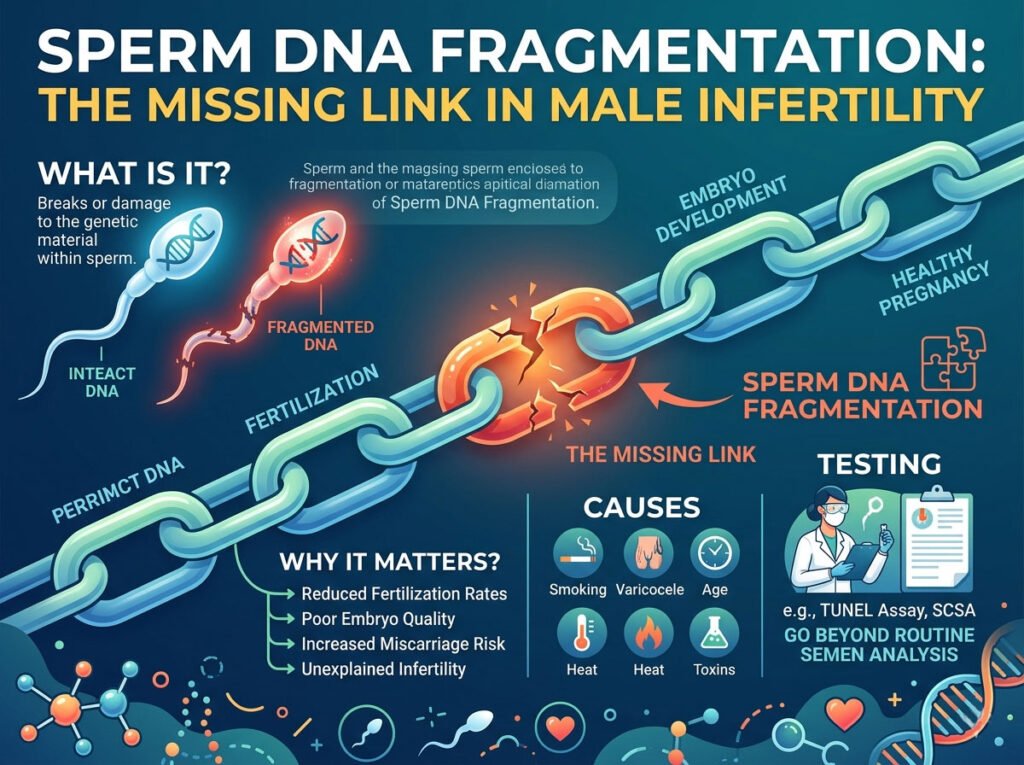
For decades, the evaluation of male fertility was confined to a standard semen analysis—counting numbers, observing movement, and checking shapes. However, many couples faced “unexplained infertility” or recurrent miscarriages despite having a “normal” sperm count. Today, reproductive medicine has identified a deeper culprit: Sperm DNA Fragmentation (SDF).
At Prarambh IVF, we believe that understanding the integrity of paternal genetic material is the “missing link” that transforms a frustrating journey into a successful pregnancy. This comprehensive guide explores everything you need to know about SDF, from its biological roots to the advanced solutions available today.
1. Beyond the Count: What is Sperm DNA Fragmentation?
A standard semen analysis measures the “quantity” and “external quality” of sperm. But sperm is essentially a delivery vehicle for DNA. If the cargo (DNA) is damaged, the vehicle may reach the egg, but the blueprint for life will be flawed.
Sperm DNA fragmentation refers to breaks, lesions, or physical damage in the DNA strands within the sperm head. While the egg has a limited capacity to repair some DNA damage after fertilization, extensive fragmentation often leads to:
- Failure of the embryo to develop.
- Poor blastocyst formation.
- Implantation failure.
- Early pregnancy loss (miscarriage).
2. Why Standard Semen Analysis Isn’t Enough
You might have a “normal” sperm report with 50 million sperm/ml and 40% motility, yet still struggle to conceive. This is because standard tests do not look inside the sperm.
Studies show that up to 25% of men with normal semen parameters have high levels of DNA fragmentation. Conversely, men with poor semen parameters often have even higher rates of DNA damage. This discrepancy is why SDF testing is now considered a vital tool for couples facing persistent fertility challenges.
3. The Causes of Sperm DNA Fragmentation
Understanding what causes DNA damage is the first step toward fixing it. The primary driver of SDF is Oxidative Stress.
Oxidative Stress and ROS
Reactive Oxygen Species (ROS) are unstable molecules that, in small amounts, help sperm function. However, when ROS levels exceed the body’s antioxidant defenses, they attack the sperm membrane and cause “nicks” in the DNA strands.
Lifestyle and Environmental Factors
- Smoking and Alcohol: Toxins in cigarettes and excessive alcohol directly increase systemic oxidative stress.
- Obesity: Adipose tissue increases inflammation and scrotal heat.
- Heat Exposure: Frequent saunas, hot baths, or even sitting for long periods (truck driving, sedentary office work) can overheat the testes.
- Environmental Toxins: Exposure to pesticides, heavy metals (lead/mercury), and air pollution.
Medical Conditions
- Varicocele: This is the most common reversible cause of male infertility. It involves enlarged veins in the scrotum that cause blood to pool, leading to increased heat and oxidative stress.
- Infections: STIs or urinary tract infections (UTIs) trigger an immune response that produces high levels of ROS.
- Age: While men produce sperm throughout their lives, DNA integrity significantly declines after age 40-45.
4. When Should You Test for DNA Fragmentation?
At Prarambh IVF, we don’t recommend SDF testing for everyone immediately, but it is highly indicated for:
- Unexplained Infertility: When all standard tests for both partners come back normal.
- Recurrent Miscarriage: Especially when the losses occur in the first trimester.
- Failed IUI or IVF Cycles: If embryos stop growing or fail to implant despite good egg quality.
- Advanced Paternal Age: Men over 40.
- Clinical Varicocele: To assess the extent of the damage before surgery.
5. Diagnostic Methods: Measuring the Damage
Standard labs cannot see DNA breaks under a regular microscope. Specialized tests are required:
- Sperm Chromatin Structure Assay (SCSA): Uses a flow cytometer to measure the susceptibility of DNA to denaturation.
- TUNEL Assay: Tags DNA breaks with fluorescent markers; the more “glow,” the more damage.
- Sperm Chromatin Dispersion (SCD) / Halo Test: Normal sperm create a “halo” of DNA loops around the head; fragmented sperm do not.
The DFI Threshold: * <15% DFI: High fertility potential.
- 15% to 30% DFI: Moderate/Fair fertility potential.
- >30% DFI: Poor fertility potential; significant risk for IVF failure or miscarriage.
6. Treatment and Management Strategies
The good news? Sperm DNA fragmentation is often treatable or bypassable.
Lifestyle Modifications
Since sperm take about 75–90 days to develop (spermatogenesis), a man can improve his DNA quality in just three months by:
- Quitting smoking and reducing alcohol.
- Eating a diet rich in antioxidants (Vitamin C, E, Zinc, Selenium, L-carnitine).
- Wearing loose underwear and avoiding laptop use on the lap.
Medical Interventions
- Varicocele Repair: A simple surgical procedure (Varicocelectomy) can significantly lower DFI levels within 3 to 6 months.
- Antibiotics: To clear up underlying infections.
Advanced ART Techniques at Prarambh IVF
If natural conception or IUI fails, we utilize specialized laboratory techniques to select the healthiest sperm:
- ICSI (Intracytoplasmic Sperm Injection): Direct injection of a single sperm into the egg.
- MACS (Magnetic Activated Cell Sorting): This technique filters out apoptotic (dying) sperm that are likely to have fragmented DNA.
- Microfluidic Sperm Selection (Sperm Chips): A gentle way to mimic the natural barrier of the cervix, allowing only the most motile and DNA-intact sperm to swim through.
- TESA/TESE (Testicular Sperm Aspiration): In severe cases, sperm taken directly from the testes often have significantly lower DNA fragmentation than ejaculated sperm, as most DNA damage occurs during the journey through the epididymis.
7. The Role of the Egg: The “Repair” Factor
An interesting facet of SDF is the role of the female partner. Young, healthy eggs have the remarkable ability to repair a certain amount of DNA damage in the sperm after fertilization. However, as maternal age increases, the egg’s repair capacity diminishes. This explains why a couple might struggle more as they age—the “double hit” of increasing sperm DNA damage and decreasing egg repair capacity.
8. Conclusion: A New Dawn in Male Fertility
Sperm DNA Fragmentation is no longer a “missing link.” It is a visible, measurable, and often treatable factor in the complex puzzle of human reproduction. By looking deeper than the standard count and motility, we empower men to take charge of their reproductive health and provide couples with a clearer roadmap to parenthood.
At Prarambh IVF, we combine state-of-the-art diagnostics with compassionate care to ensure that every “Prarambh” (beginning) is a healthy one. If you have been struggling with unexplained infertility or repeated losses, it may be time to look inside the DNA.
