
The journey toward parenthood through In-Vitro Fertilization (IVF) is often paved with a mix of hope, scientific precision, and emotional resilience. Among the many variables that specialists monitor during an IVF cycle, the “endometrial thickness” stands as one of the most critical factors for success.
When a patient is told they have a “thin endometrium,” it often triggers a wave of concern. Is pregnancy still possible? Will the embryo stick? Does this mean the IVF cycle will fail?
At Prarambh IVF, we believe that information is the first step toward successful treatment. This guide explores the complexities of the uterine lining, the challenges of a thin endometrium, and the innovative strategies used to achieve successful pregnancies despite it.
Part 1: Understanding the Endometrium and Its Role in IVF
What is the Endometrium?
The endometrium is the mucous membrane lining the inside of the uterus. It is a dynamic tissue that changes throughout the menstrual cycle in response to hormones like estrogen and progesterone. Its primary job is to prepare for the arrival of a fertilized egg (embryo).
Why Thickness Matters
For a successful pregnancy, the embryo must “implant” into this lining. Think of the endometrium as the “soil” and the embryo as the “seed.” Even the highest-quality embryo (the seed) will struggle to grow if the soil is not nutrient-rich and deep enough to provide support.
What is Considered “Thin”?
In the context of IVF, endometrial thickness is measured via transvaginal ultrasound.
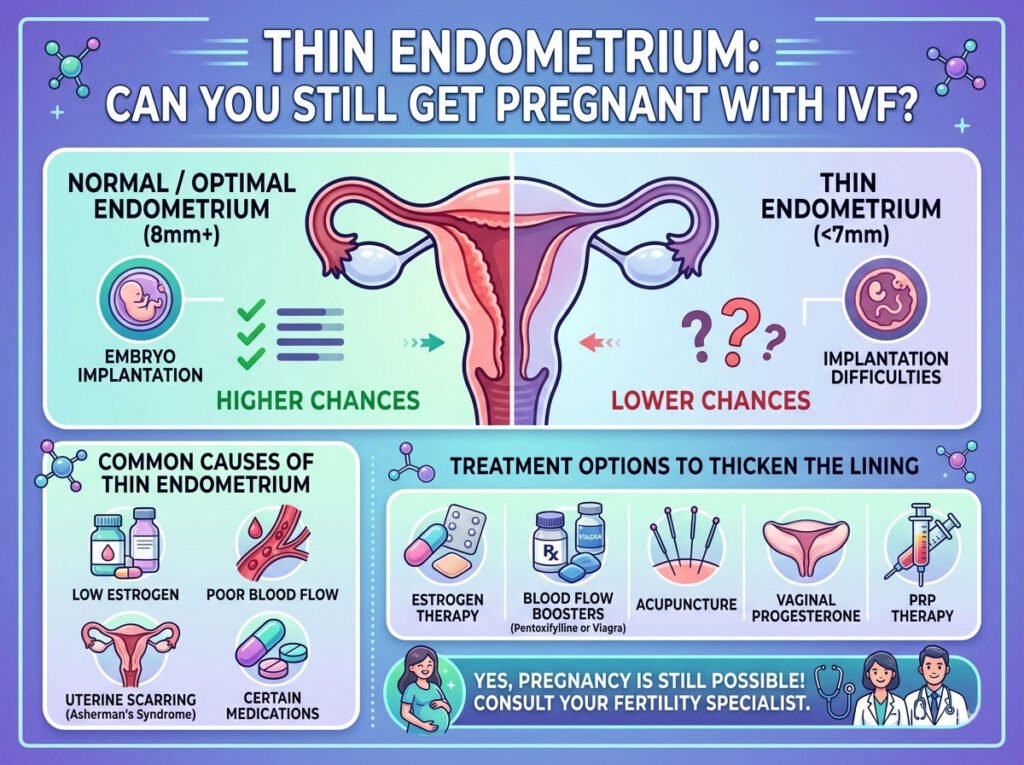
- Ideal Thickness: Most fertility specialists look for a thickness between 8mm and 12mm during the “implantation window.”
- Thin Endometrium: Generally defined as a lining under 7mm at the time of embryo transfer.
While a lining of 7mm or 8mm is preferred, clinical studies have shown that pregnancies can and do occur with linings as thin as 5mm or 6mm, though the statistical probability may be lower.
Part 2: Causes of a Thin Endometrium
Understanding why the lining is thin is the first step in fixing it. Several factors can contribute to an unresponsive or thin uterine lining:
1. Low Estrogen Levels
Estrogen is the primary hormone responsible for thickening the lining during the follicular phase of the cycle. If the body doesn’t produce enough estrogen, or if the receptors in the uterus aren’t responding to it, the lining remains thin.
2. Poor Blood Flow
The uterus requires a robust blood supply to build tissue. Factors like a sedentary lifestyle, uterine fibroids, or previous surgeries can restrict blood flow to the uterine arteries.
3. Uterine Scarring (Asherman’s Syndrome)
Previous surgical procedures, such as a D&C (Dilation and Curettage) or surgery to remove fibroids, can sometimes cause scarring (adhesions) within the uterine cavity. This scar tissue prevents the healthy lining from growing.
4. Chronic Endometritis
Not to be confused with endometriosis, endometritis is a silent inflammation or infection of the uterine lining. This chronic irritation can prevent the lining from thickening and interfere with implantation.
5. Prolonged Use of Certain Medications
Long-term use of certain medications, such as Clomiphene Citrate (Clomid), can sometimes have an “anti-estrogenic” effect on the lining, causing it to remain thin despite successful ovulation.
Part 3: Can You Get Pregnant with a Thin Endometrium?
The short answer is yes.
While a thickness of 8mm+ is the “gold standard,” modern reproductive medicine has evolved. At Prarambh IVF, we focus on more than just the millimeter measurement. We also look at the “Pattern” and “Vascularity” of the lining.
The Trilaminar Pattern
A “triple-line” or trilaminar appearance on an ultrasound is often a better predictor of success than thickness alone. A 6.5mm lining with a perfect triple-line pattern often has a higher success rate than a 9mm lining that looks “shaggy” or irregular.
Quality over Quantity
The health of the embryo (blastocyst) is equally important. In many cases, a high-quality, genetically screened embryo (PGT-A tested) can overcome the challenges of a slightly thinner lining.
Part 4: Clinical Strategies to Improve Endometrial Thickness
If your lining isn’t reaching the desired thickness, your fertility specialist has several “tools in the shed” to encourage growth.
1. Advanced Hormonal Support
- High-Dose Estrogen: Administered orally, vaginally, or via transdermal patches to maximize receptor uptake.
- Pentoxifylline and Vitamin E: This combination is often prescribed for several months to improve mucosal thickness and blood flow.
2. Improving Uterine Blood Flow
- Sildenafil (Viagra) Vaginal Suppositories: Research suggests that Sildenafil can help dilate uterine arteries, increasing blood flow to the endometrium.
- L-Arginine: An amino acid that helps improve nitric oxide levels, which aids in vasodilation.
3. Platelet-Rich Plasma (PRP) Therapy
PRP is one of the most exciting advancements in IVF. A patient’s own blood is processed to concentrate growth factors, which are then infused directly into the uterine cavity. This can “jumpstart” tissue regeneration in women with refractory thin endometrium.
4. G-CSF (Granulocyte Colony-Stimulating Factor)
An intrauterine infusion of G-CSF has shown promise in clinical trials for thickening the lining in patients who have not responded to traditional estrogen therapy.
Part 5: Procedural Interventions
Sometimes, the “soil” needs more than just nutrients; it needs a physical “tilling.”
1. Hysteroscopy
A diagnostic hysteroscopy allows the doctor to look inside the uterus with a small camera. If scar tissue or small polyps are found, they can be removed, allowing for healthy lining growth in subsequent cycles.
2. Endometrial Scratch
Performing a “scratch” or minor injury to the lining in the cycle prior to the transfer can sometimes trigger a healing response that releases growth factors, making the lining more receptive.
3. Stem Cell Therapy
While still in the advanced research phases, stem cell therapy is being explored for severe cases of Asherman’s Syndrome where the basal layer of the endometrium is damaged.
Part 6: Lifestyle and Holistic Approaches
At Prarambh IVF, we advocate for a 360-degree approach to fertility. While clinical treatments are primary, lifestyle changes can support uterine health.
1. Movement and Exercise
Moderate exercise, like walking or yoga, improves overall circulation. Specifically, “Fertility Yoga” focuses on poses that open the pelvic area and increase blood flow to the reproductive organs.
2. Nutrition for the Lining
Focus on an anti-inflammatory diet:
- Beets and Pomegranates: Known for their ability to boost nitric oxide and improve blood flow.
- Whole Grains and Healthy Fats: Omega-3 fatty acids found in walnuts and flaxseeds support hormonal health.
- Hydration: Blood volume is essential for tissue growth; ensure you are drinking at least 2-3 liters of water daily.
3. Acupuncture
Some studies suggest that acupuncture can reduce uterine artery impedance, potentially helping the lining thicken more effectively during an IVF cycle.
Part 7: The “Frozen Embryo Transfer” (FET) Advantage
For patients with a history of thin endometrium, a Frozen Embryo Transfer (FET) is often superior to a “Fresh” transfer.
In a fresh cycle, the high levels of hormones used to stimulate the ovaries can sometimes negatively impact the lining. In an FET cycle:
- The ovaries are “quiet.”
- The doctor has total control over the hormonal environment.
- The transfer can be delayed or canceled without losing the embryos if the lining doesn’t meet the requirements, allowing the team to try a different protocol the following month.
Part 8: When the Lining Remains Thin – What are the Options?
It is important to be realistic. In a small percentage of cases, the endometrium may never reach 7mm or 8mm despite all interventions.
1. Proceeding with a 5mm-6mm Lining
If the lining is trilaminar and has good blood flow, many clinics will proceed with the transfer. While the rates are lower than a 10mm lining, many healthy babies have been born from a 6mm lining.
2. Surrogacy
If the endometrium is severely damaged (e.g., severe Asherman’s that doesn’t respond to surgery), Gestational Surrogacy remains a highly successful path. This allows the intended parents to be genetically related to the child while providing the embryo with a healthy “host” environment.
Part 9: Why Choose Prarambh IVF for Your Journey?
Dealing with a thin endometrium requires patience and a customized protocol. No two uteruses are the same. At Prarambh IVF, we specialize in:
- Personalized Protocols: We don’t believe in a one-size-fits-all approach to estrogen therapy.
- Advanced Diagnostics: Utilizing high-resolution ultrasound and hysteroscopy to find the root cause.
- Cutting-Edge Treatments: Offering PRP and G-CSF therapies for patients with resistant linings.
Conclusion: Hope Beyond the Numbers
A thin endometrium is a challenge, but it is not a dead end. With the right combination of medical intervention, technological advancement, and lifestyle adjustments, the dream of a successful pregnancy is still very much within reach.
If you have been told you have a thin lining, or if you have experienced failed IVF cycles in the past, don’t lose heart. Let’s look closer at the “soil” and find the strategy that works for you.
Contact Prarambh IVF today for a consultation. Website: www.prarambhivf.com
