
In the journey toward parenthood, many couples believe that if they are healthy, active, and young, conception should happen naturally within a few months. However, when the “two pink lines” remain elusive, the focus usually shifts to the obvious factors: ovulation cycles, sperm count, and age.
At Prarambh IVF, we have seen thousands of couples who have “perfect” test results on paper but still struggle to conceive. This is often because the standard fertility checklist misses the subtle, underlying, and “hidden” causes that disrupt the delicate biological harmony required for a successful pregnancy.
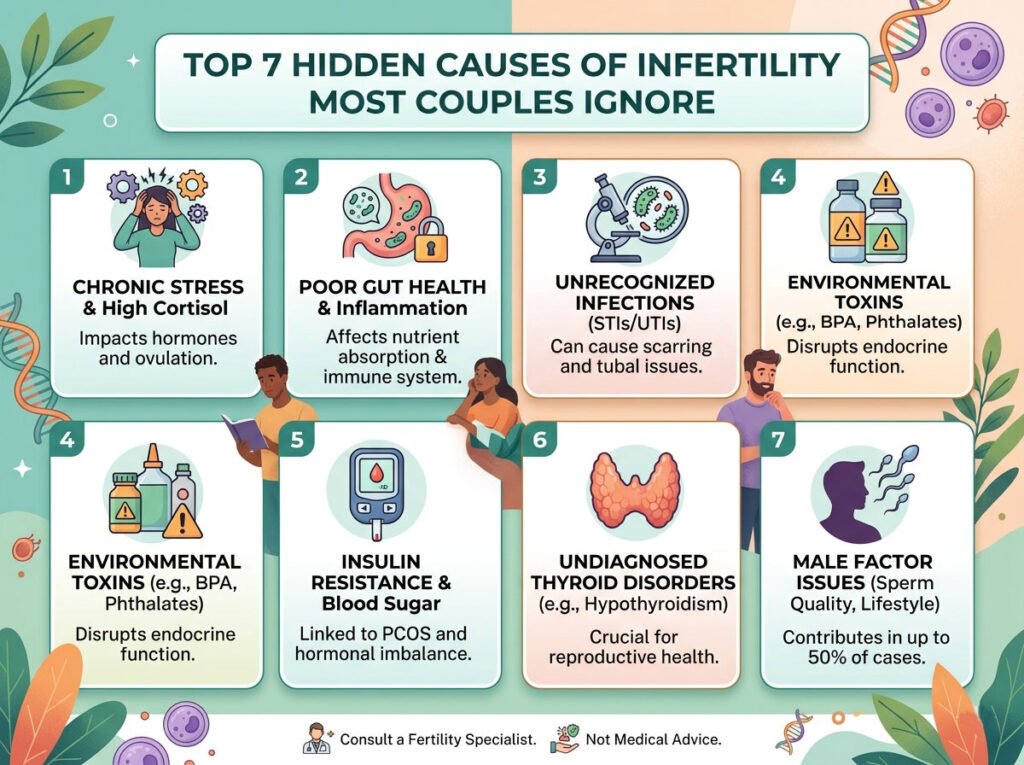
Here, we dive deep into the top seven hidden causes of infertility that most couples ignore.
1. Silent Inflammation and Autoimmune Disruptions
While many couples check for hormonal imbalances, few look at the immune system. Your immune system is designed to protect you from foreign invaders. However, in some cases, it can become “over-vigilant,” mistakenly identifying an embryo or sperm as a threat.
The Role of Natural Killer (NK) Cells
Natural Killer cells are a type of white blood cell. While they are essential for fighting viruses, an overabundance of NK cells in the uterine lining can prevent an embryo from implanting. This is often a silent cause of “unexplained infertility” or recurrent early miscarriages.
Antiphospholipid Syndrome (APS)
APS is an autoimmune disorder where the body creates antibodies that make blood more likely to clot. In the context of fertility, these tiny clots can form in the developing placenta, cutting off the blood supply to the fetus before the mother even knows she is pregnant.
Chronic Endometritis (Not Endometriosis)
Unlike endometriosis, chronic endometritis is a silent inflammation of the endometrial lining caused by bacteria. It often has no symptoms—no pain, no fever—but it changes the environment of the uterus, making it hostile to an embryo.
2. Environmental Endocrine Disruptors (The “Toxic Load”)
We live in a world of chemicals, and many of these act as “endocrine disruptors.” These substances mimic, block, or interfere with the body’s natural hormones.
Phthalates and Bisphenol A (BPA)
Found in plastic containers, receipts, and even some perfumes, these chemicals can lead to “estrogen dominance.” In men, BPA is linked to DNA fragmentation in sperm; in women, it can lead to poor egg quality and PCOS-like symptoms.
The Impact of “Forever Chemicals” (PFAS)
PFAS, found in non-stick cookware and water-resistant fabrics, can linger in the human body for years. Recent studies suggest that women with higher levels of PFAS in their blood take significantly longer to conceive.
Oxidative Stress in the Modern Environment
Radiation from mobile phones (carried in pockets near the reproductive organs) and high exposure to blue light at night can disrupt melatonin production. Melatonin isn’t just for sleep; it is one of the most potent antioxidants for protecting egg and sperm quality.
3. The Oral-Systemic Link: Gum Disease and Fertility
It may sound strange to suggest that your dentist could help you get pregnant, but the connection between oral health and reproductive health is scientifically proven.
Periodontal Disease and Conception Time
Studies have shown that women with gum disease take, on average, two months longer to conceive than those without. The bacteria responsible for gingivitis can enter the bloodstream and cause systemic inflammation, which triggers the body’s stress response and diverts energy away from the reproductive system.
Male Fertility and Oral Health
For men, poor oral hygiene is linked to Bacteriospermia (the presence of bacteria in semen) and decreased sperm motility. Treating dental infections has been shown to improve sperm parameters significantly.
4. Subclinical Thyroid Dysfunction and Progestogen Deficiencies
Most doctors check TSH (Thyroid Stimulating Hormone) levels, but they often use a “normal” range designed for the general population, not for women trying to conceive.
The “Subclinical” Trap
A TSH level of 4.0 might be considered normal for a 40-year-old woman not seeking pregnancy. However, for fertility, many experts at Prarambh IVF recommend a TSH level below 2.5. A sluggish thyroid (subclinical hypothyroidism) can prevent ovulation or cause a “Luteal Phase Defect.”
Luteal Phase Defect (LPD)
This occurs when the ovaries don’t produce enough progesterone after ovulation, or the uterine lining doesn’t respond to it. The result? The embryo has nothing to “stick” to, leading to a period that arrives on time, even though fertilization actually occurred.
5. Male Factor: DNA Fragmentation and Lifestyle Myths
Society often places the burden of infertility on women, but in 40-50% of cases, the male factor is involved. A standard semen analysis looks at count, shape, and movement, but it doesn’t look inside the sperm.
Sperm DNA Fragmentation
A man can have a “normal” sperm count, but if the DNA inside those sperm is broken (fragmented), the egg will either not fertilize, or the embryo will stop developing after a few days. High DNA fragmentation is often caused by heat (saunas, laptops, tight underwear), smoking, or varicocele (enlarged veins in the scrotum).
The “Dad-Bod” Myth
Obesity in men leads to the conversion of testosterone into estrogen. This hormonal flip-flop lowers sperm production and reduces libido, creating a biological barrier to conception that is often ignored.
6. Gut Health and the “Estrobolome”
Your gut microbiome does more than digest food; it regulates your hormones. The Estrobolome is a collection of bacteria in the gut specifically tasked with metabolizing and excreting estrogen.
Estrogen Recycling
If your gut health is poor (due to low fiber, high sugar, or antibiotic overuse), the “bad” bacteria can produce an enzyme called beta-glucuronidase. This enzyme unbinds used estrogen and sends it back into your bloodstream. This leads to estrogen dominance, which can cause endometriosis, fibroids, and irregular ovulation.
Nutrient Absorption
Even if you take the best prenatal vitamins, a leaky gut or Celiac disease (which can be silent) prevents the absorption of Zinc, Selenium, and B12—all of which are critical for egg maturation and sperm health.
7. Psychological Stagnation and “Silent” Stress
We’ve all heard the frustrating advice: “Just relax and it will happen.” While stress doesn’t directly “cause” infertility, the physiological response to chronic stress does.
The Cortisol-Progesterone Connection
Cortisol (the stress hormone) and Progesterone are made from the same precursor hormone (pregnenolone). When you are in a state of “fight or flight” due to work or the stress of infertility itself, your body performs a “Pregnenolone Steal.” It prioritizes making cortisol to “survive” the stress, leaving very little for progesterone to “reproduce.”
Sleep Apnea and Circadian Misalignment
Many people ignore snoring, but sleep apnea causes intermittent oxygen deprivation. For men, this crashes testosterone levels. For women, it disrupts the pulsatile release of GnRH (Gonadotropin-Releasing Hormone), which is the master switch for the entire reproductive system.
How Prarambh IVF Addresses These Hidden Causes
At Prarambh IVF, we believe in a “Root Cause” approach. We don’t just jump to IVF; we investigate why natural conception isn’t happening.
Our Diagnostic Edge:
- Advanced Semen Analysis: We go beyond the basics to look at DNA fragmentation.
- Immune Profiling: For couples with recurrent failures, we investigate the “silent” immune factors.
- Hormonal Optimization: We target “Fertility-Optimal” ranges, not just “Normal” ranges.
- Integrative Guidance: We provide counseling on nutrition, gut health, and toxin reduction to prepare your body for success.
Conclusion: Don’t Ignore the Whispers
Infertility is rarely the result of a single “broken” part. It is usually a combination of small, silent factors that create a barrier. By looking at the oral-systemic link, the gut microbiome, environmental toxins, and subtle hormonal shifts, we can clear the path to parenthood.
If you have been trying for a year (or six months if you are over 35) without success, it is time to look deeper. At Prarambh IVF, we are dedicated to uncovering these hidden causes and providing you with a clear, scientifically-backed path to holding your baby.
Visit us at www.prarambhivf.com to book a comprehensive fertility assessment today.
