
In the world of Assisted Reproductive Technology (ART), the ultimate goal of In Vitro Fertilization (IVF) is a healthy pregnancy and a successful live birth. One of the most critical decisions a patient and their fertility specialist must make is the timing of the embryo transfer.
Should the embryo be transferred back into the uterus just days after egg retrieval (Fresh Transfer), or should it be frozen and transferred in a later cycle (Frozen Embryo Transfer)?
At Prarambh IVF, we believe in personalized medicine. Understanding the nuances of both methods is essential to determining which path “works better” for your unique biological profile.
1. Defining the Procedures
What is a Fresh Embryo Transfer?
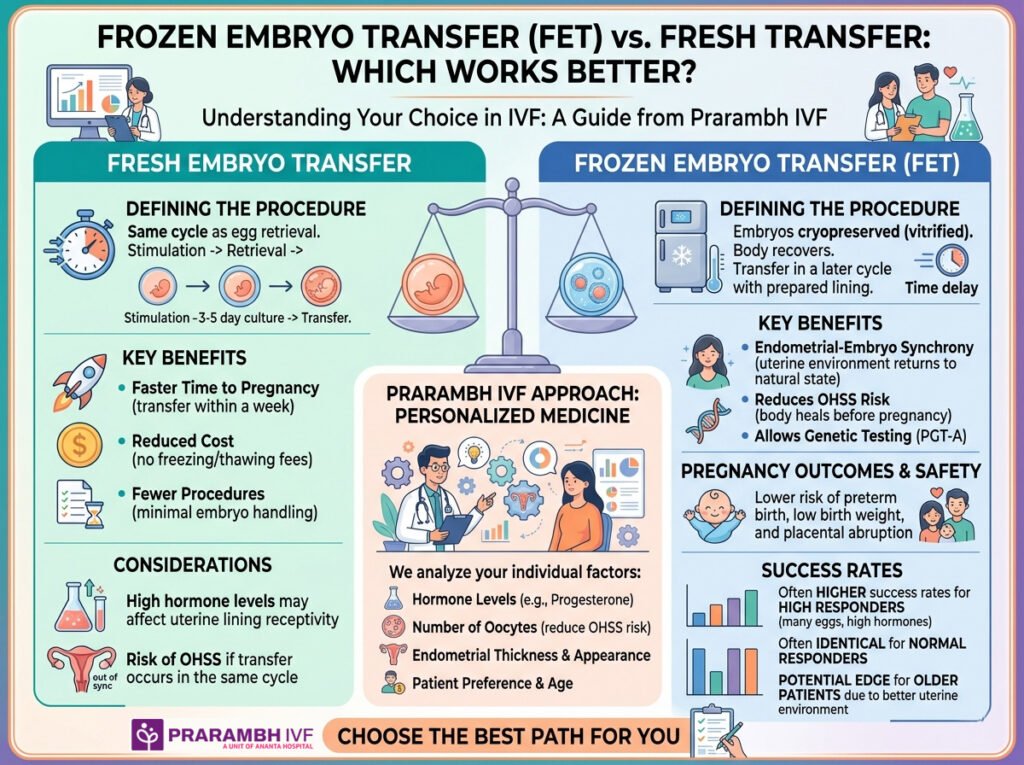
A fresh transfer occurs in the same menstrual cycle in which the eggs are harvested. After the ovaries are stimulated with hormones and eggs are retrieved, they are fertilized in the lab. The resulting embryos are cultured for 3 to 5 days. The “best” embryo is then selected and transferred into the uterus while the body is still under the influence of the stimulation medications.
What is a Frozen Embryo Transfer (FET)?
In an FET cycle, the embryos produced during the stimulation phase are cryopreserved (frozen) using a high-tech flash-freezing process called vitrification. The transfer does not happen immediately. Instead, the patient’s body is allowed to recover from the stimulation drugs. The transfer occurs months or even years later, once the uterine lining is prepared either naturally or through specific hormonal support.
2. The Case for Fresh Embryo Transfer
For many years, fresh transfers were the gold standard. They remain a popular choice for several reasons:
Faster Time to Pregnancy
The most obvious benefit is speed. Because the transfer happens within a week of egg retrieval, the “waiting period” is minimized. For patients eager to achieve a pregnancy as quickly as possible, this is often the preferred route.
Reduced Cost
Fresh transfers are generally less expensive because they eliminate the costs associated with embryo freezing, storage, and the subsequent “thaw” cycle medications and procedures.
Fewer Procedures
A fresh transfer avoids the additional step of freezing and thawing, which some patients prefer to minimize the handling of embryos, although modern vitrification techniques have made the risk of damage during freezing nearly negligible.
3. The Case for Frozen Embryo Transfer (FET)
In recent years, “Freeze-All” cycles have gained massive popularity. Many leading clinics, including Prarambh IVF, often recommend FET due to several physiological advantages.
Hormonal Environment and Endometrial Receptivity
During a fresh cycle, the high doses of stimulation hormones used to produce multiple eggs can cause the estrogen levels in the blood to skyrocket. This can sometimes make the uterine lining (endometrium) “out of sync” with the embryo. By freezing the embryo and waiting for a later cycle, the uterus returns to a more natural, receptive state. This “Endometrial-Embryo Synchrony” is a primary reason why many studies show higher implantation rates with FET.
Reducing the Risk of OHSS
Ovarian Hyperstimulation Syndrome (OHSS) is a complication where the ovaries become swollen and painful. If a patient becomes pregnant during a fresh cycle while suffering from OHSS, the symptoms can become severe and dangerous. FET allows the body to heal completely before pregnancy occurs, virtually eliminating the risk of late-onset OHSS.
Genetic Testing (PGT-A)
If a couple chooses to undergo Preimplantation Genetic Testing (PGT) to screen for chromosomal abnormalities, FET is a necessity. It takes time to biopsy the embryo and receive the genetic results; freezing the embryo allows the clinic to wait for these results and ensure only the healthiest embryo is transferred.
4. Success Rates: What Does the Data Say?
When asking “which works better,” we must look at the success rates.
Historically, fresh transfers were thought to be superior because freezing techniques (slow freezing) often damaged embryos. However, with the advent of Vitrification, embryo survival rates are now over 95-99%.
- For High Responders: Women who produce many eggs (and thus have high hormone levels) often see significantly higher success rates with FET.
- For Normal Responders: In many clinical trials, the success rates between fresh and frozen are nearly identical.
- For Older Patients: Some data suggests that FET may offer a slight edge by providing a more optimal uterine environment, which is crucial when embryo quality may be a concern.
5. Safety and Pregnancy Outcomes
Research has indicated that pregnancies resulting from FET may actually have lower risks of certain complications compared to fresh transfers. These include:
- Lower risk of preterm birth.
- Lower risk of low birth weight.
- Lower risk of placental abruption.
This is likely because the intrauterine environment in a frozen cycle more closely mimics a natural conception, free from the “hormonal storm” of ovarian stimulation.
6. How to Choose: The Prarambh IVF Approach
There is no “one size fits all” answer. The decision depends on several factors that our specialists evaluate:
- Hormone Levels: If your progesterone levels rise too early during stimulation, we will recommend FET, as a fresh transfer is unlikely to succeed in a premature lining.
- Number of Oocytes: If you produce more than 15-20 eggs, we usually recommend freezing to prevent OHSS.
- Endometrial Thickness: If the uterine lining does not look optimal on the day of trigger, we wait.
- Patient Preference and Age: We weigh the emotional desire for a quick transfer against the biological benefits of waiting.
7. Conclusion: The Verdict
Does FET work better than Fresh Transfer? For many modern patients, the answer is yes. While fresh transfers offer speed and lower initial costs, FET offers a safer physiological environment, better synchronization, and the opportunity for genetic screening.
At Prarambh IVF, our goal is not just a positive pregnancy test, but a healthy baby and a healthy mother. Whether we choose a fresh or frozen path, our decisions are backed by the latest science and a deep commitment to your success.
Ready to start your journey? [Contact Prarambh IVF today for a personalized consultation.] https://www.prarambhivf.com/contact-us/
