
Infertility affects millions of couples worldwide, and one of the most common reasons for difficulty conceiving is irregular or absent ovulation. For many women, the inability to release an egg regularly can make natural conception challenging. Fortunately, modern fertility treatments offer effective solutions, and one of the most commonly recommended options is ovulation induction.
Ovulation induction is often considered the first step in fertility treatment because it is less invasive, cost-effective, and highly successful for women who have ovulation-related fertility issues. At Prarambh IVF, we frequently recommend ovulation induction for suitable patients as part of a personalized fertility treatment plan.
In this comprehensive guide, we will explain what ovulation induction is, how it works, who may benefit from it, the treatment process, success rates, risks, and frequently asked questions.
Understanding Ovulation
Before discussing ovulation induction, it is important to understand the role of ovulation in conception.
Ovulation is the process during which a mature egg is released from one of the ovaries. This typically occurs once during each menstrual cycle. After release, the egg travels through the fallopian tube, where it may be fertilized by sperm.
For pregnancy to occur naturally:
- A healthy egg must be released.
- Sperm must reach the egg.
- Fertilization must occur.
- The fertilized embryo must implant in the uterus.
If ovulation does not occur regularly or does not occur at all, the chances of pregnancy are significantly reduced.
What Is Ovulation Induction?
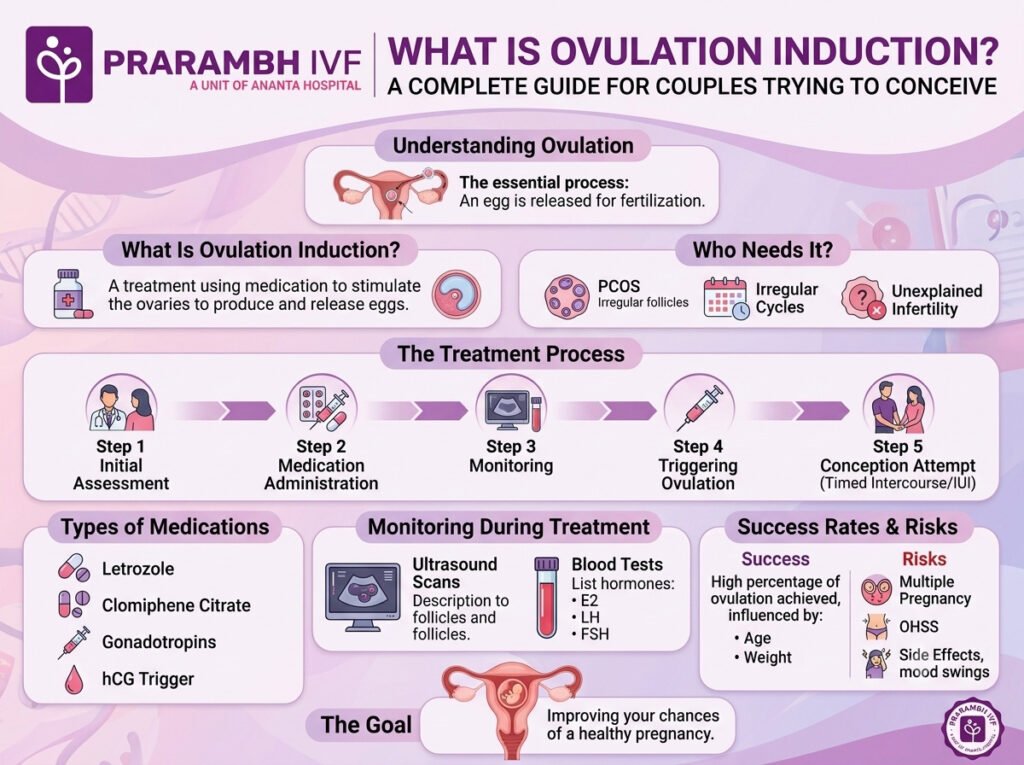
Ovulation induction is a fertility treatment that uses medications to stimulate the ovaries to produce and release one or more mature eggs.
The primary goal is to:
- Trigger ovulation in women who do not ovulate regularly.
- Improve egg development.
- Increase the chances of natural conception or assisted reproductive treatments.
Ovulation induction can be used alone or combined with fertility procedures such as:
- Timed intercourse
- Intrauterine Insemination (IUI)
- In Vitro Fertilization (IVF)
The treatment is carefully monitored to maximize pregnancy success while minimizing risks.
Who Needs Ovulation Induction?
Ovulation induction is commonly recommended for women experiencing ovulatory disorders.
You may be a candidate if you have:
1. Polycystic Ovary Syndrome (PCOS)
PCOS is one of the leading causes of infertility.
Women with PCOS often experience:
- Irregular periods
- Absent periods
- Hormonal imbalances
- Infrequent ovulation
Ovulation induction is frequently the first-line fertility treatment for women with PCOS.
2. Irregular Menstrual Cycles
Women whose menstrual cycles vary significantly from month to month may not be ovulating consistently.
Examples include:
- Cycles longer than 35 days
- Missed periods
- Highly unpredictable cycles
Ovulation induction helps regulate egg release and improve fertility.
3. Anovulation
Anovulation occurs when the ovaries fail to release an egg.
Common causes include:
- Hormonal disorders
- Thyroid dysfunction
- Elevated prolactin levels
- PCOS
- Extreme weight changes
Medication can help stimulate ovulation and restore reproductive function.
4. Unexplained Infertility
Sometimes all fertility tests appear normal, yet pregnancy does not occur.
In such cases, ovulation induction may be used alongside IUI to increase the chances of conception.
5. Mild Ovulatory Dysfunction
Even when ovulation occurs, the quality or timing of egg release may not be optimal.
Ovulation induction can improve follicle development and increase the likelihood of successful fertilization.
How Does Ovulation Induction Work?
The treatment works by stimulating the ovaries to produce mature follicles.
Follicles are fluid-filled sacs within the ovaries that contain eggs.
The process generally includes:
Step 1: Initial Fertility Assessment
Your fertility specialist will evaluate:
- Menstrual history
- Hormone levels
- Ovarian reserve
- Ultrasound findings
- Partner’s semen analysis
- Tubal patency
This helps determine whether ovulation induction is appropriate.
Step 2: Medication Administration
Fertility medications are prescribed to encourage follicle growth.
These medications help the ovaries mature and release eggs.
Step 3: Monitoring
Ultrasound scans and blood tests monitor:
- Follicle growth
- Hormone levels
- Endometrial thickness
Monitoring allows fertility specialists to adjust medication dosages if necessary.
Step 4: Triggering Ovulation
When follicles reach the ideal size, an injection may be given to trigger ovulation.
This helps ensure precise timing.
Step 5: Conception Attempt
Depending on the treatment plan, couples may proceed with:
The timing is carefully coordinated to maximize pregnancy chances.
Medications Used for Ovulation Induction
Several medications can be used depending on the patient’s diagnosis and fertility goals.
Letrozole
Letrozole is often considered the first-line treatment for women with PCOS.
Benefits include:
- Effective ovulation stimulation
- Lower risk of multiple pregnancy
- Better pregnancy outcomes in many PCOS patients
Many fertility specialists now prefer Letrozole for ovulation induction.
Clomiphene Citrate
Clomiphene citrate has been used successfully for decades.
It works by stimulating hormone production that encourages egg development.
Advantages include:
- Oral medication
- Easy administration
- Good success rates
However, some women may not respond adequately to Clomiphene.
Gonadotropins
These injectable hormones directly stimulate the ovaries.
They are often recommended when:
- Oral medications fail
- Stronger ovarian stimulation is required
- IUI or IVF is planned
Because gonadotropins can increase the risk of multiple pregnancies, close monitoring is essential.
hCG Trigger Injection
Human Chorionic Gonadotropin (hCG) may be administered when follicles reach maturity.
The injection triggers the final maturation and release of the egg.
This allows fertility specialists to accurately predict ovulation timing.
Monitoring During Ovulation Induction
Monitoring is one of the most important aspects of treatment.
Regular monitoring helps:
- Track follicle development
- Determine medication effectiveness
- Reduce complications
- Identify the best time for conception
Common monitoring methods include:
Ultrasound Scans
Transvaginal ultrasound evaluates:
- Number of follicles
- Follicle size
- Ovarian response
- Uterine lining
Blood Tests
Hormone levels may be checked to assess:
- Estradiol
- LH
- FSH
- Progesterone
These results help optimize treatment outcomes.
Ovulation Induction and Timed Intercourse
For many couples, ovulation induction is combined with timed intercourse.
The fertility specialist identifies the most fertile period and advises intercourse during that time.
Benefits include:
- Natural conception
- Lower treatment costs
- Less invasive approach
This option is particularly effective for couples with ovulation disorders and normal sperm parameters.
Ovulation Induction with IUI
Intrauterine Insemination (IUI) is often combined with ovulation induction.
During IUI:
- Prepared sperm is placed directly into the uterus.
- Fertilization occurs naturally inside the body.
Combining ovulation induction with IUI can improve pregnancy rates, especially in cases of:
- Mild male factor infertility
- Unexplained infertility
- Ovulation disorders
Ovulation Induction with IVF
Although IVF involves more advanced ovarian stimulation, ovulation induction principles are still used.
IVF may be recommended if:
- Multiple ovulation induction cycles fail
- Fallopian tubes are blocked
- Severe male infertility exists
- Advanced maternal age is a concern
At Prarambh IVF, fertility specialists determine whether ovulation induction alone or IVF offers the best chance of success.
Success Rates of Ovulation Induction
Success depends on several factors, including:
- Age
- Cause of infertility
- Ovarian reserve
- Body weight
- Sperm quality
- Overall reproductive health
Generally:
- Ovulation can be achieved in a high percentage of suitable patients.
- Pregnancy rates vary depending on the underlying condition and treatment combination.
Women under 35 with ovulation disorders often experience favorable outcomes when appropriately treated.
Factors That Affect Success
Age
Female fertility naturally declines with age.
Women under 35 generally have higher success rates than women over 40.
Body Weight
Both obesity and being underweight can affect hormonal balance and ovulation.
Maintaining a healthy weight can improve treatment outcomes.
Lifestyle Habits
Healthy habits support reproductive health.
Helpful practices include:
- Balanced nutrition
- Regular exercise
- Adequate sleep
- Stress management
- Avoiding smoking
- Limiting alcohol consumption
Underlying Fertility Conditions
The presence of additional fertility issues may impact success.
Examples include:
- Endometriosis
- Tubal damage
- Male factor infertility
- Diminished ovarian reserve
A comprehensive fertility evaluation helps identify these concerns.
Risks and Side Effects of Ovulation Induction
Ovulation induction is generally safe when supervised by experienced fertility specialists.
However, potential risks exist.
Multiple Pregnancy
Stimulating multiple follicles may increase the chance of:
- Twins
- Triplets
- Higher-order pregnancies
Careful monitoring helps reduce this risk.
Ovarian Hyperstimulation Syndrome (OHSS)
In some cases, the ovaries may over-respond to fertility medications.
Symptoms can include:
- Abdominal discomfort
- Bloating
- Nausea
- Fluid retention
Most cases are mild, but monitoring is essential.
Mood Changes
Hormonal medications may occasionally cause:
- Mood swings
- Irritability
- Emotional sensitivity
These effects are usually temporary.
Headaches and Hot Flashes
Some women may experience:
- Mild headaches
- Breast tenderness
- Hot flashes
- Fatigue
Most side effects resolve after treatment completion.
Preparing for Ovulation Induction Treatment
Patients can improve their fertility journey by taking proactive steps.
Follow Medical Instructions Carefully
Take medications exactly as prescribed.
Missing doses may affect treatment effectiveness.
Attend All Monitoring Appointments
Monitoring helps ensure safe and successful treatment.
Never skip scheduled scans or blood tests.
Maintain a Healthy Lifestyle
Focus on:
- Nutritious foods
- Hydration
- Exercise
- Weight management
These habits support reproductive health.
Manage Stress
Infertility treatment can be emotionally challenging.
Helpful strategies include:
- Meditation
- Yoga
- Counseling
- Support groups
- Open communication with your partner
When Should You Consider Ovulation Induction?
You may wish to consult a fertility specialist if:
- You have irregular periods.
- You have PCOS.
- You have not conceived after 12 months of trying.
- You are over 35 and have not conceived after 6 months.
- Ovulation predictor kits rarely show ovulation.
- You have been diagnosed with an ovulatory disorder.
Early evaluation can often improve treatment outcomes.
Frequently Asked Questions
Is ovulation induction painful?
Most oral medications are painless. Some injectable medications may cause mild discomfort at the injection site.
How many cycles are usually recommended?
The number of cycles varies depending on age, diagnosis, and treatment response. Your fertility specialist will create an individualized plan.
Can ovulation induction guarantee pregnancy?
No fertility treatment can guarantee pregnancy. However, ovulation induction can significantly improve conception chances in suitable patients.
Is ovulation induction suitable for PCOS?
Yes. Ovulation induction is one of the most effective first-line treatments for women with PCOS-related infertility.
Can I conceive naturally after successful ovulation induction?
Yes. Many women conceive naturally through timed intercourse after ovulation is successfully induced.
Conclusion
Ovulation induction is one of the most effective and widely used fertility treatments for women who struggle with irregular or absent ovulation. By stimulating the ovaries to produce and release mature eggs, this treatment can significantly improve the chances of conception, whether through natural intercourse, IUI, or as part of a broader fertility plan.
Success depends on accurate diagnosis, careful monitoring, appropriate medication selection, and individualized treatment strategies. For many couples, ovulation induction serves as the crucial first step toward achieving a healthy pregnancy.
At Prarambh IVF, we understand that every fertility journey is unique. Our experienced fertility specialists provide personalized evaluation, advanced diagnostic testing, and evidence-based treatment plans designed to maximize your chances of success. If you are facing challenges with ovulation or conception, professional fertility guidance can help you take the next step with confidence.
Website: www.prarambhivf.com
