
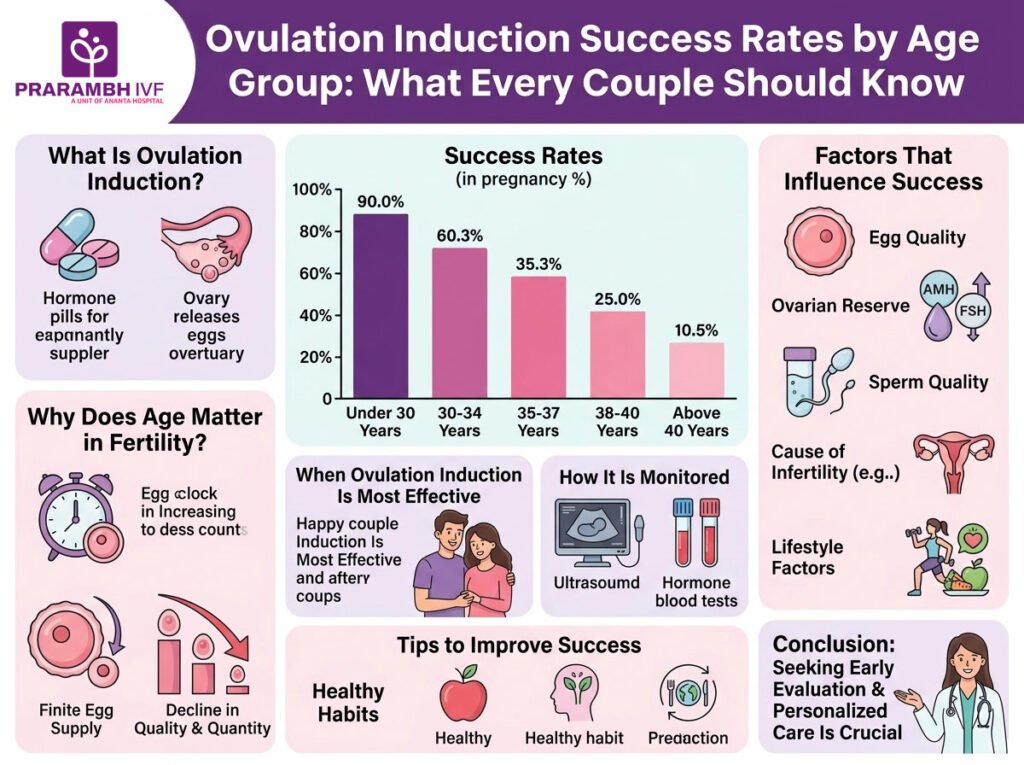
When couples begin their fertility journey, one of the first questions they often ask is, “What are our chances of getting pregnant with ovulation induction?” The answer depends on several factors, but age remains one of the most significant predictors of fertility treatment success.
Ovulation induction is a widely used fertility treatment that helps women who have irregular or absent ovulation release mature eggs, increasing their chances of conception. However, the success of this treatment varies from person to person, with age playing a crucial role alongside overall reproductive health.
At Prarambh IVF, we believe that understanding how age influences fertility outcomes helps couples make informed decisions and seek treatment at the right time. In this comprehensive guide, we’ll explain how ovulation induction works, success rates across different age groups, the factors that influence outcomes, and ways to improve your chances of achieving a healthy pregnancy.
What Is Ovulation Induction?
Ovulation induction is a fertility treatment that uses medications to stimulate the ovaries to produce and release one or more mature eggs during a menstrual cycle.
This treatment is commonly recommended for women who:
- Have irregular menstrual cycles
- Do not ovulate consistently
- Have Polycystic Ovary Syndrome (PCOS)
- Experience unexplained infertility
- Need fertility support before Intrauterine Insemination (IUI)
Ovulation induction may involve oral medications such as Letrozole or Clomiphene Citrate, or injectable fertility hormones, depending on the patient’s condition. Throughout the treatment, fertility specialists monitor follicle growth using ultrasound scans and hormone tests to determine the optimal time for conception.
Why Does Age Matter in Fertility?
A woman is born with a finite number of eggs, known as her ovarian reserve. As she ages, both the quantity and quality of these eggs naturally decline.
This decline affects:
- Egg quality
- Ovulation consistency
- Fertilization rates
- Embryo development
- Implantation success
- Pregnancy outcomes
Although ovulation induction can stimulate egg release, it cannot reverse the natural aging process or improve egg quality. This is why younger women generally experience higher pregnancy rates than older women undergoing the same treatment.
Factors That Influence Ovulation Induction Success
While age is a major factor, it is not the only one. Several aspects of reproductive health contribute to treatment outcomes.
1. Egg Quality
Healthy eggs are more likely to be fertilized and develop into healthy embryos. Egg quality gradually decreases with age, especially after the mid-30s.
2. Ovarian Reserve
Ovarian reserve refers to the number of eggs remaining in the ovaries.
Tests that help evaluate ovarian reserve include:
- Anti-Müllerian Hormone (AMH)
- Follicle-Stimulating Hormone (FSH)
- Antral Follicle Count (AFC)
Women with a healthy ovarian reserve often respond better to ovulation induction medications.
3. Cause of Infertility
Ovulation induction works best when infertility is primarily caused by ovulation disorders.
Success may be lower if additional issues are present, such as:
- Blocked fallopian tubes
- Moderate to severe endometriosis
- Male factor infertility
- Uterine abnormalities
4. Sperm Quality
Even when ovulation is successfully induced, healthy sperm is essential for fertilization.
A semen analysis is typically recommended before beginning treatment.
5. Lifestyle Factors
Healthy lifestyle habits can improve reproductive health and treatment outcomes.
Important factors include:
- Maintaining a healthy weight
- Eating a balanced diet
- Regular physical activity
- Managing stress
- Avoiding smoking
- Limiting alcohol consumption
Ovulation Induction Success Rates by Age Group
Although every fertility journey is unique, age-related fertility trends provide valuable guidance.
Women Under 30 Years
Women under 30 generally experience the highest success rates with ovulation induction.
Reasons include:
- Excellent egg quality
- Strong ovarian reserve
- Higher fertilization potential
- Lower miscarriage risk
If ovulation problems are the primary cause of infertility, many women in this age group respond very well to treatment.
Women with PCOS often achieve successful ovulation after appropriate medication and monitoring.
Women Between 30 and 34 Years
Fertility remains relatively high during the early 30s.
Most women continue to have:
- Good ovarian reserve
- Healthy egg quality
- Strong response to fertility medications
Ovulation induction continues to be an effective first-line treatment, particularly when there are no significant additional fertility issues.
Women Between 35 and 37 Years
After age 35, fertility begins to decline more noticeably.
Common changes include:
- Reduced egg quality
- Slight decline in ovarian reserve
- Increased miscarriage risk
Many women still achieve successful pregnancies through ovulation induction, especially when treatment begins early and is carefully monitored.
Because fertility declines more rapidly after 35, couples are usually encouraged not to delay fertility evaluation.
Women Between 38 and 40 Years
Women in their late 30s often experience a more significant reduction in fertility.
Possible challenges include:
- Lower egg quality
- Fewer mature follicles
- Reduced response to medications
- Higher chromosomal abnormalities in eggs
Ovulation induction may still be appropriate for selected patients, but fertility specialists often evaluate whether additional treatments such as IUI or IVF may offer better chances of success.
Women Above 40 Years
After 40, natural fertility declines substantially.
Although ovulation induction can still stimulate ovulation, pregnancy rates become lower because egg quality decreases considerably.
Treatment recommendations become highly individualized and may include:
- Ovulation induction
- IUI
- IVF
- Advanced fertility options depending on ovarian reserve
Early consultation with a fertility specialist becomes especially important in this age group.
Age Is Important, But It Isn’t Everything
While age is one of the strongest predictors of fertility, many younger women may face fertility challenges, and many women in their late 30s or early 40s achieve healthy pregnancies with appropriate treatment.
Success depends on the complete fertility picture rather than age alone.
Your fertility specialist will evaluate:
- Hormone levels
- Ultrasound findings
- Medical history
- Menstrual cycle pattern
- Partner’s fertility
- Overall reproductive health
This individualized assessment helps determine the most suitable treatment plan.
How Ovulation Induction Is Monitored
Careful monitoring improves both safety and effectiveness.
Ultrasound Monitoring
Regular ultrasound scans allow fertility specialists to observe:
- Follicle growth
- Number of developing follicles
- Endometrial thickness
- Timing of ovulation
This information helps determine the ideal time for conception.
Hormone Testing
Blood tests may measure hormones such as:
- Estradiol
- LH
- Progesterone
These tests confirm that the ovaries are responding appropriately to medication.
Trigger Injection
Once follicles reach the desired size, a trigger injection may be administered to encourage final egg maturation and ovulation.
Timed intercourse or IUI is then planned accordingly.
When Is Ovulation Induction Most Effective?
Ovulation induction generally provides the best outcomes when:
- Ovulation disorders are the main cause of infertility
- Fallopian tubes are open
- Sperm quality is normal or mildly reduced
- Treatment begins without unnecessary delays
- Medication response is carefully monitored
Women with PCOS often benefit significantly from ovulation induction because the treatment directly addresses irregular ovulation.
Conditions That Respond Well to Ovulation Induction
Several medical conditions can be successfully managed with ovulation induction.
These include:
Polycystic Ovary Syndrome (PCOS)
PCOS is one of the most common causes of irregular ovulation.
Ovulation induction often restores regular egg release and improves pregnancy chances.
Hypothalamic Ovulatory Dysfunction
Stress, excessive exercise, or low body weight may disrupt hormone production and ovulation.
Appropriate treatment combined with lifestyle changes can restore fertility.
Mild Hormonal Imbalances
Certain hormonal disorders affecting ovulation may respond well to fertility medications after proper evaluation.
When Ovulation Induction Alone May Not Be Enough
Not every couple benefits from ovulation induction alone.
Additional fertility treatments may be recommended when:
- Fallopian tubes are blocked
- Severe male infertility exists
- Endometriosis is advanced
- Multiple ovulation induction cycles have failed
- Ovarian reserve is significantly diminished
In these situations, treatments such as IUI or IVF may provide better chances of pregnancy.
Tips to Improve Ovulation Induction Success
Although no treatment can guarantee pregnancy, several healthy habits may support fertility.
Maintain a Healthy Weight
Both obesity and being underweight can interfere with hormone balance and ovulation.
A healthy Body Mass Index (BMI) may improve treatment response.
Eat a Nutrient-Rich Diet
Include foods rich in:
- Whole grains
- Fresh fruits
- Vegetables
- Lean proteins
- Healthy fats
- Iron
- Folate
Proper nutrition supports reproductive health.
Exercise in Moderation
Regular physical activity promotes hormonal balance, but excessive exercise may negatively affect ovulation.
Moderate exercise is generally recommended.
Avoid Smoking
Smoking accelerates egg loss and negatively affects fertility.
Stopping smoking benefits both female and male reproductive health.
Reduce Alcohol Intake
Limiting alcohol supports overall fertility and improves pregnancy health.
Manage Stress
Infertility treatment can be emotionally demanding.
Helpful stress-management techniques include:
- Meditation
- Yoga
- Deep breathing
- Counseling
- Support groups
While stress alone does not cause infertility, emotional well-being can improve the treatment experience.
Common Myths About Ovulation Induction
Myth 1: Ovulation Induction Guarantees Pregnancy
Fact: The treatment improves the chance of ovulation and conception but cannot guarantee pregnancy.
Myth 2: Younger Women Always Conceive Immediately
Fact: Even younger women may require multiple treatment cycles depending on the underlying fertility condition.
Myth 3: Women Over 35 Cannot Benefit
Fact: Many women over 35 achieve successful pregnancies with individualized fertility treatment.
Myth 4: More Medication Means Better Results
Fact: Fertility medications must be carefully tailored. Excessive stimulation may increase the risk of complications without improving success.
When Should You See a Fertility Specialist?
Consider consulting a fertility specialist if:
- You are under 35 and have tried to conceive for 12 months without success.
- You are 35 or older and have tried for six months.
- Your menstrual cycles are irregular or absent.
- You have PCOS or another hormonal disorder.
- You have experienced recurrent pregnancy loss.
- You have undergone previous fertility treatments without success.
Early diagnosis often leads to more treatment options and better outcomes.
Why Personalized Fertility Care Matters
No two fertility journeys are the same.
At Prarambh IVF, every treatment plan is developed based on the individual’s medical history, reproductive health, age, hormone profile, and fertility goals.
Rather than using a one-size-fits-all approach, personalized care helps determine:
- Whether ovulation induction is appropriate
- Which medications are most suitable
- How closely treatment should be monitored
- When to consider other fertility options if needed
This patient-centered approach supports safe, evidence-based fertility care.
Frequently Asked Questions
Does ovulation induction work after age 35?
Yes. Many women over 35 successfully conceive with ovulation induction, although pregnancy chances naturally decline with age due to reduced egg quality.
Can ovulation induction improve egg quality?
No. Ovulation induction stimulates the release of eggs but does not improve egg quality. Age and ovarian health remain important factors.
How many ovulation induction cycles are usually recommended?
The number of cycles depends on your diagnosis, age, treatment response, and overall fertility evaluation. Your fertility specialist will recommend an individualized plan.
Is ovulation induction safe?
When performed under the supervision of an experienced fertility specialist, ovulation induction is generally considered safe. Regular monitoring helps minimize potential risks such as multiple pregnancy or ovarian hyperstimulation.
Can lifestyle changes improve treatment success?
Yes. Maintaining a healthy weight, eating a balanced diet, exercising moderately, avoiding smoking, limiting alcohol, and managing stress can support overall reproductive health and complement medical treatment.
Conclusion
Ovulation induction is one of the most effective first-line fertility treatments for women with ovulation-related infertility. While age has a significant impact on treatment success, it is only one part of the fertility equation. Factors such as ovarian reserve, egg quality, underlying medical conditions, sperm health, and lifestyle all contribute to the chances of achieving pregnancy.
The best outcomes are often achieved through early evaluation, accurate diagnosis, individualized treatment planning, and careful monitoring throughout the process. Seeking fertility care sooner rather than later—especially after age 35—can expand your treatment options and improve the likelihood of success.
At Prarambh IVF, we are committed to providing compassionate, evidence-based fertility care tailored to every couple’s unique needs. Our experienced fertility specialists use advanced diagnostic tools and personalized treatment strategies to help couples take confident steps toward parenthood.
Whether you are just beginning your fertility journey or exploring treatment options after months of trying to conceive, expert guidance can make a meaningful difference.
Visit: www.prarambhivf.com
