
For many couples, the dream of holding a baby in their arms feels natural, expected, and straightforward. However, the reality of conception can sometimes tell a different story. Current data indicates that in India, 1 out of every 6 couples faces difficulty in conceiving a baby.
Perhaps the most heartbreaking part of this statistic is that a vast majority of these couples suffer in silence, completely unaware that a highly reliable scientific solution exists.
That solution is In Vitro Fertilization (IVF).
While most people have heard the acronym “IVF” mentioned on television, across social media, or in hushed conversations among relatives, very few truly understand what the process entails. Misconceptions, outdated labels, and a lack of open dialogue often shroud this beautiful medical advancement in unnecessary mystery.
At Prarambh IVF and Women’s Hospital, we believe that the right knowledge has the power to change lives. This comprehensive guide is designed to strip away the confusion, debunk the lingering myths, and give you a transparent, step-by-step understanding of how IVF works, who it helps, and how it can become your ray of hope.
De-Mystifying IVF: What Does It Actually Mean?
To understand IVF, it helps to look at the words themselves. “In Vitro” is Latin for “in glass,” referring to the laboratory glassware where biological processes take place outside a living organism. “Fertilization” refers to the union of a female egg and a male sperm to create life.
In the simplest terms, IVF is an assisted reproductive technology (ART) where the fertilization process is carefully facilitated by expert clinical embryologists in a specialized laboratory environment, rather than inside the woman’s fallopian tubes.
Here is the basic blueprint of the IVF process:
- Egg Retrieval: Mature eggs are gently collected from the mother’s ovaries.
- Sperm Collection: A healthy sperm sample is provided by the father (or a donor).
- Lab Fertilization: The egg and sperm are brought together in a controlled laboratory incubator to create an embryo.
- Embryo Transfer: The healthiest resulting embryo is carefully placed back into the mother’s uterus.
Once the embryo is safely transferred, medicine steps back, and nature takes over. The embryo must implant into the uterine lining naturally, leading to a normal, healthy pregnancy.
Who is IVF For? Identifying the Triggers for Assisted Reproduction
Fertility struggles can stem from a wide variety of biological factors. IVF is rarely the absolute first line of defense; rather, it is a highly effective solution when other conservative methods have not yielded results, or when specific anatomical barriers exist.
You and your partner should consider consulting a fertility specialist about IVF if you meet any of the following criteria:
1. Unexplained Infertility (Trying for 2–3 Years Without Success)
If you are under the age of 35 and have been actively trying to conceive through unprotected intercourse for more than a year (or six months if you are over 35) without success, it is time to seek answers. When diagnostic tests show normal results but pregnancy still doesn’t occur, it is categorized as unexplained infertility. IVF bypasses many unseen functional barriers to conception.
2. Blocked or Damaged Fallopian Tubes
In a natural conception cycle, the fallopian tube is the meeting point where sperm fertilizes the egg. If these tubes are bilaterally blocked, scarred from past infections, or removed due to an ectopic pregnancy, natural conception becomes physically impossible. IVF completely bypasses the fallopian tubes, collecting the egg directly from the ovary and placing the fertilized embryo straight into the uterus.
3. Severe Male Factor Infertility (Low Sperm Count or Poor Motility)
Infertility is not strictly a female health issue; it affects men and women equally. Issues such as low sperm count (oligospermia), poor sperm movement (asthenozoospermia), or abnormal sperm shape (teratozoospermia) make it incredibly difficult for sperm to make the long journey to the egg naturally. Through advanced IVF techniques like ICSI (Intracytoplasmic Sperm Injection), a single healthy sperm can be selected and injected directly into the egg, resolving severe male fertility challenges.
4. Advanced Maternal Age and Diminished Ovarian Reserve
A woman is born with a finite number of eggs, and both the quantity and quality of these eggs decline naturally with age, particularly after the age of 35. IVF allows fertility specialists to maximize the potential of the remaining eggs through targeted ovarian stimulation protocols, helping women achieve healthy pregnancies later in life.
5. Advanced Reproductive Disorders (Endometriosis and PCOS)
Conditions like severe endometriosis (where uterine tissue grows outside the uterus) or Polycystic Ovary Syndrome (PCOS) can drastically impair ovulation and egg quality. IVF provides a structured medical environment to stimulate healthy egg development and shield the delicate fertilization process from the inflammatory environments caused by these conditions.
The Step-by-Step IVF Journey: What to Expect
Embracing the decision to begin IVF can feel overwhelming. Understanding the detailed, clinical steps of the process can replace anxiety with confidence. Here is a breakdown of what a typical cycle looks like at a premier facility like Prarambh IVF.
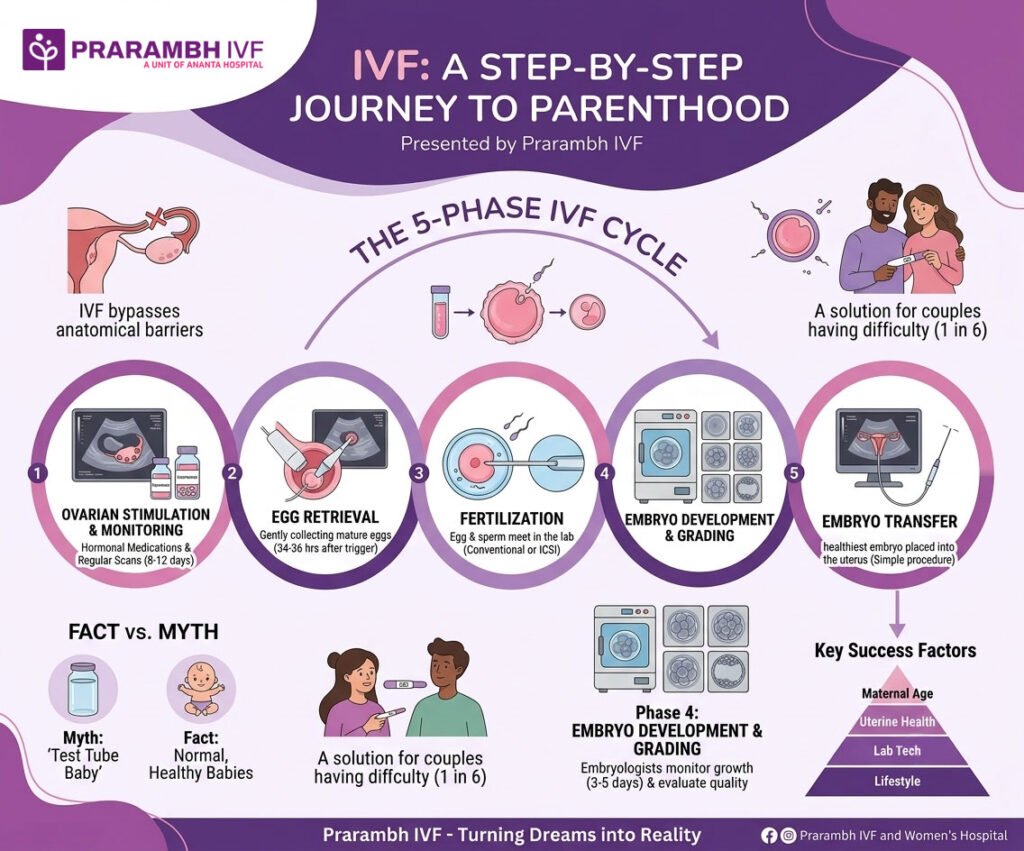
[Phase 1: Stimulation] ➔ [Phase 2: Retrieval] ➔ [Phase 3: Fertilization] ➔ [Phase 4: Culturing] ➔ [Phase 5: Transfer]
Phase 1: Ovarian Stimulation and Monitoring
In a natural monthly menstrual cycle, your ovaries typically mature just one single egg. To maximize the chances of success in an IVF cycle, specialists look to obtain multiple mature eggs.
- Medication: You will be prescribed hormonal medications (injections) for roughly 8 to 12 days to stimulate the ovaries to grow multiple follicles.
- Monitoring: Throughout this phase, you will visit the clinic regularly for transvaginal ultrasounds and blood tests. These visits allow your reproductive endocrinologist to track the growth of the follicles and adjust your medication dosages precisely.
- The Trigger Shot: Once the follicles reach the optimal size, a final hormonal injection (the “trigger shot”) is administered to schedule the final maturation of the eggs.
Phase 2: The Egg Retrieval Procedure
Approximately 34 to 36 hours after the trigger shot, the egg retrieval is performed.
- Comfort: The procedure is done under light sedation or anesthesia, meaning you will feel absolutely no pain.
- Method: Using an ultrasound-guided needle passed gently through the vaginal wall, the specialist aspirates the fluid from the mature follicles, collecting the eggs hidden inside. The entire procedure takes only 15 to 30 minutes, and you can usually go home the same day.
Phase 3: Sperm Collection and Processing
Simultaneously, on the day of egg retrieval, the male partner provides a fresh semen sample. The lab processes this sample using advanced washing techniques to separate the strongest, most motile sperm from the seminal fluid.
Phase 4: Fertilization in the Embryology Lab
This is where science fulfills its promise. The collected eggs and processed sperm are brought together in the laboratory. There are two primary methods used for this:
- Conventional Insemination: The eggs are placed in a dish alongside thousands of high-quality sperm, allowing fertilization to occur organically.
- ICSI (Intracytoplasmic Sperm Injection): For cases involving male factor infertility or previous fertilization failures, a single, structurally perfect sperm is selected under a high-powered microscope and injected directly into the center of the mature egg.
Phase 5: Embryo Development and Grading
The fertilized eggs (now embryos) are placed into state-of-the-art incubators that mimic the exact environment of a woman’s body. Over the next 3 to 5 days, the embryologist monitors their growth as they split into multiple cells, eventually reaching the blastocyst stage. The embryos are graded based on their structural layout and cellular uniformity to determine which ones have the highest chance of implantation.
Phase 6: The Embryo Transfer
The final clinical step is simple, quick, and requires no anesthesia.
- Process: Using a thin, flexible catheter guided by abdominal ultrasound, the fertility specialist passes through the cervix and gently deposits the selected embryo into the optimal location within the uterine cavity.
- The Wait: Following the transfer, you will wait approximately 10 to 14 days before taking a blood test (Beta hCG) to confirm if the embryo has successfully implanted, resulting in pregnancy.
Debunking the Myths: Separating Fact from Fiction
Fear often stems from misinformation. Because IVF involves laboratory science, it has been targets of numerous urban legends that cause unnecessary panic for hopeful parents. Let’s look at the facts.
| Common Myth About IVF | The Scientific Reality |
| “IVF babies are not completely natural or healthy.” | Fact: IVF babies are absolutely normal, healthy, and vibrant. The only difference is the physical location where the egg meets the sperm during the first three to five days. Once inside the womb, an IVF baby grows, develops, and is born exactly like any other child. |
| “IVF causes severe, permanent birth defects.” | Fact: Decades of global medical data tracking millions of IVF children show that the risk of congenital abnormalities is virtually identical to that of naturally conceived children. |
| “The ‘Test Tube Baby’ is grown inside a jar.” | Fact: The phrase “test tube baby” is an outdated, highly inaccurate term from the 1970s. Babies do not grow in tubes or jars. The laboratory phase lasts less than a week; the remaining nine months of development happen entirely inside a mother’s warm, protective uterus. |
| “IVF always results in twins or triplets.” | Fact: Historically, clinics transferred multiple embryos to boost success rates, leading to higher rates of multiple births. Today, modern advancements allow premium clinics to perform Single Embryo Transfers (eSET), delivering high success rates while ensuring a safe, single-child pregnancy. |
| “IVF is incredibly painful and requires bed rest.” | Fact: While injections can cause minor discomfort or bloating, the procedures themselves are painless due to modern sedation. Furthermore, strict bed rest after a transfer is an old myth—normal, low-stress movement actually promotes healthy pelvic blood flow. |
Key Factors That Influence IVF Success Rates
When embarking on an IVF journey, it is critical to maintain realistic expectations. No fertility clinic in the world can ethically guarantee a 100% success rate on the very first try, as biological variables differ significantly between couples. Understanding these factors can help you prepare mentally and physically:
- Maternal Age: Age remains the single most dominant factor influencing success. Women under 35 generally experience significantly higher success rates due to the baseline health of their ovarian reserve.
- Uterine Health: The condition of the endometrial lining is paramount. As covered in our specialized clinical guides, structural issues like fibroids, polyps, or a thin endometrium can impede the embryo’s ability to stick securely.
- Lifestyle Factors: Smoking, heavy alcohol consumption, chronic high stress, and a high Body Mass Index (BMI) can negatively impact egg and sperm quality. Adopting a nutritious diet and light exercise regimen prior to your cycle can significantly improve outcomes.
- Laboratory Infrastructure: The precision of the embryology lab directly dictates embryo survival rates. Advanced air filtration systems, precise incubator calibration, and the experience of the clinical embryologists play a massive role in final outcomes.
Why Choose Prarambh IVF for Your Parenthood Journey?
Navigating infertility can feel like an emotional roller coaster filled with medical jargon, vulnerabilities, and high stakes. At Prarambh IVF and Women’s Hospital, located in the heart of Ahmedabad, we provide more than just advanced medical technology—we provide a safe haven built on empathy, transparency, and clinical excellence.
Tailored Treatment Protocols
We recognize that no two bodies are identical. We don’t believe in assembly-line medicine. Every couple undergoes a comprehensive, highly personalized evaluation to determine the precise underlying cause of their struggle, ensuring that you receive the specific stimulation protocol that matches your unique biological profile.
State-of-the-Art Embryology Lab
Our clinical facility features cutting-edge laboratory technologies designed to maximize fertilization and blastocyst development rates. From advanced ICSI setups to highly secure cryogenic storage, your future family is protected by the highest standards of modern science.
Compassionate, Patient-First Guidance
We understand the emotional weight you carry. Our dedicated team of fertility doctors, embryologists, and compassionate support staff are here to hold your hand through every milestone. We demystify every test result, answer every late-night question, and stand by you as true partners in your journey.
Conclusion: Take Your First Step Today
If you have been trying to grow your family without success, remember this: You are not alone, and you do not have to give up on your dream. The statistical reality of 1 in 6 couples facing fertility obstacles means that thousands of others are walking this exact path alongside you.
Infertility is a medical hurdle, not a definitive final answer. With the right clinical expertise, modern scientific interventions, and a compassionate medical team, the dream of holding your healthy baby is closer than you think.
Don’t let outdated myths, fear, or a lack of clear information keep you from building the family you deserve. Knowledge is your greatest asset, and taking action is your first step forward.
Are you ready to begin your new chapter?
Schedule your personal consultation with our fertility specialists at Prarambh IVF today. Let us guide you step by step down the beautiful path toward parenthood. Your new beginning starts right here.
