
If you’ve started researching IVF, you’ve probably run into two acronyms that get thrown around almost interchangeably: IVF and ICSI. Many couples walk into their first fertility consultation assuming ICSI is simply “the newer, better version” of IVF — and more than a few ask for it by name, believing it improves their odds.
It doesn’t always. And that surprises people.
The truth is more specific: ICSI and conventional IVF are two different fertilization methods used within the same IVF cycle, and which one you need depends almost entirely on the male partner’s semen parameters and a handful of other clinical factors. Recommending ICSI when it isn’t medically necessary doesn’t meaningfully raise your chances of a baby — it just adds a step, and in some clinics, adds cost.
At Prarambh IVF and Women’s Hospital, we get asked “should we just do ICSI to be safe?” in nearly every consultation. This article walks through exactly how that decision is made — not by guesswork, but by semen analysis, fertilization history, and a few well-established clinical indications.
What Actually Happens During IVF — Before Fertilization Even Comes Up
Before comparing ICSI and conventional IVF, it helps to understand what they have in common. Both techniques are part of a standard IVF cycle and share the exact same early steps:
- Ovarian stimulation — medication is used to encourage the ovaries to produce multiple mature eggs instead of the usual one per cycle.
- Monitoring — regular ultrasounds and blood tests track follicle growth.
- Egg retrieval — a minor, sedated procedure collects the mature eggs directly from the ovaries.
- Fertilization — this is the one step where ICSI and conventional IVF differ.
- Embryo culture — fertilized eggs are grown in the lab for several days.
- Embryo transfer — a healthy embryo is placed into the uterus.
In other words, choosing between ICSI and conventional IVF isn’t a decision about your entire treatment plan. It’s a decision your embryologist makes about one single step on the day of egg retrieval, based on what the semen sample looks like that morning.
The Core Difference: How Fertilization Happens in the Lab
Conventional IVF
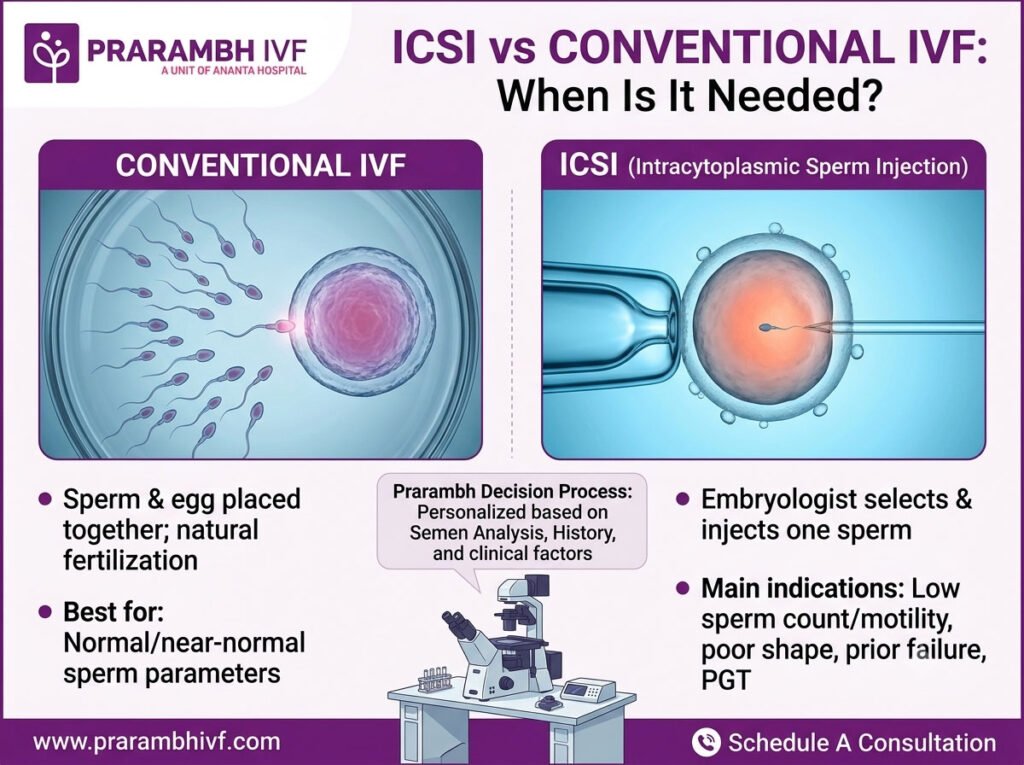
In conventional IVF, prepared sperm and retrieved eggs are placed together in a culture dish. The sperm then have to do what they’d naturally do inside the body — swim toward the egg, penetrate its outer layer, and fertilize it on their own. The embryologist doesn’t intervene in this step; nature does the work, just outside the body instead of inside it.
ICSI (Intracytoplasmic Sperm Injection)
In ICSI, an embryologist selects a single, healthy-looking sperm and injects it directly into the center of a mature egg using an extremely fine glass needle, under high-powered microscopic guidance. There’s no “swimming” or “penetrating” required — the embryologist does that part manually.
Because ICSI removes the natural selection barriers sperm normally have to get through, it can achieve fertilization even when sperm count, movement, or shape would make conventional IVF unreliable. That’s the entire reason ICSI exists — it was developed specifically for severe male factor infertility, not as a general upgrade to IVF.
When Is ICSI Actually Needed? The Real Clinical Indications
This is the part most couples actually came here for. Based on current fertility-society guidance and the semen and history-based criteria fertility specialists use, ICSI is generally recommended in the following situations:
1. Low Sperm Count (Oligozoospermia)
When the number of motile sperm available is too low to give conventional IVF a realistic chance of natural fertilization, ICSI bypasses the numbers problem entirely — it only takes one usable sperm per egg.
2. Poor Sperm Motility (Asthenozoospermia)
If sperm can’t move well enough to travel through the culture medium and penetrate the egg on their own, injecting a sperm directly solves the mobility issue.
3. Abnormal Sperm Shape (Teratozoospermia)
Sperm with irregular head or tail shapes may struggle to bind to and penetrate an egg naturally. ICSI allows the embryologist to visually select the best-formed sperm available and inject it directly.
4. Surgically Retrieved Sperm (Azoospermia)
When there’s no sperm in the ejaculate — due to a blockage or a production issue — sperm can sometimes be retrieved surgically directly from the testicle or epididymis (procedures like TESA or PESA). Surgically retrieved sperm is almost always used with ICSI, since the volume and motility recovered are typically too limited for conventional insemination.
5. High Sperm DNA Fragmentation
Sperm with high levels of DNA damage can still look normal under a standard semen analysis but fertilize poorly or lead to early embryo arrest. In select cases with confirmed high fragmentation, ICSI combined with careful sperm selection (and sometimes testicular sperm extraction) has been shown to improve outcomes.
6. Previous Fertilization Failure With Conventional IVF
If a couple has already gone through a conventional IVF cycle where few or no eggs fertilized, ICSI is typically recommended for the next cycle to remove fertilization as a variable and see whether the issue was sperm-egg binding rather than something else.
7. Planned Genetic Testing of Embryos (PGT)
When embryos are going to undergo preimplantation genetic testing (PGT-A or PGT-M), ICSI is generally preferred. Because conventional IVF involves surrounding the egg with thousands of sperm, there’s a small risk of residual sperm DNA contaminating the genetic sample. ICSI avoids that risk entirely, since only one sperm ever comes into contact with the egg.
8. Frozen or Previously Frozen Eggs
Eggs that have been frozen and thawed sometimes have a slightly hardened outer shell (the zona pellucida), which can make natural sperm penetration less reliable. ICSI is commonly used in these cycles for that reason.
9. Very Few Eggs Retrieved
When only a small number of mature eggs are retrieved, some clinics prefer ICSI simply to maximize the fertilization chance for each one, since there’s less room to “afford” a failed fertilization attempt.
When Is Conventional IVF Actually the Better Choice?
This is the part that surprises most couples: conventional IVF is not a downgrade. When sperm parameters are normal or only mildly reduced, and there’s no history of fertilization failure, current research shows conventional IVF performs comparably to ICSI — with a simpler lab process and no extra manipulation of the egg.
A large 2024 multicenter randomized trial published in The Lancet, along with a 2025 Danish multicenter trial published in Nature Medicine, both compared ICSI against conventional IVF in couples without severe male factor infertility. The consistent finding: routine ICSI did not improve live birth rates over conventional IVF in these couples. One widely cited trial reported live birth rates of roughly 36.6% with conventional IVF versus 33.8% with ICSI in couples without severe male factor issues — essentially comparable outcomes, with conventional IVF requiring less lab manipulation.
There’s also research specific to unexplained infertility — a diagnosis where no clear cause is found in either partner — showing that ICSI didn’t improve live birth rates in these cases either, and in fact came with a higher cycle cancellation rate than conventional IVF.
In short: ICSI is not “the strong option” and conventional IVF is not “the fallback.” They’re two tools suited to two different clinical pictures. Using ICSI when it isn’t indicated adds a manual step to fertilization without a proven benefit in live birth rates for these patients.
ICSI vs Conventional IVF: Success Rates, Side by Side
It’s worth being precise about what “success” means here, because fertilization rate and live birth rate are two different numbers, and they get mixed up constantly.
| Metric | ICSI | Conventional IVF |
|---|---|---|
| Typical fertilization rate per mature egg | Roughly 70–80% | Roughly 50–70% (when sperm parameters are adequate) |
| Live birth rate in normal/mild male factor cases | Comparable to conventional IVF | Comparable to ICSI |
| Live birth rate in severe male factor infertility | Clearly superior — often the only viable option | Not reliable without ICSI |
| Cycle cancellation risk (unexplained infertility) | Higher in some studies | Lower |
| Lab manipulation of the egg | Direct injection, more manual handling | Minimal — closer to natural fertilization |
| Best suited for | Male factor infertility, prior fertilization failure, PGT, frozen eggs | Normal/near-normal sperm parameters, tubal or ovulatory factors |
The key takeaway from this table: ICSI wins decisively where sperm quality is the limiting factor. Outside of that, the two methods land in a similar place on live birth outcomes — the difference is in how fertilization is achieved, not necessarily whether it succeeds.
How Prarambh IVF and Women’s Hospital Decides Between ICSI and Conventional IVF
We don’t default to ICSI for every cycle, and we don’t default to conventional IVF either. The decision is individualized, based on:
- A detailed semen analysis — count, motility, morphology, and where relevant, DNA fragmentation testing
- Fertility history — including any prior IVF cycles and how fertilization went
- Egg quantity and quality at the time of retrieval
- Whether genetic testing (PGT) is planned for the embryos
- Whether eggs are fresh or previously frozen
On the day of egg retrieval, our embryology team evaluates the semen sample and makes the fertilization-method decision based on these factors — not on what sounds more advanced, and not on a blanket clinic policy. If your case sits in a gray zone, we’ll walk you through exactly why we’re recommending one approach over the other, in plain language, before the retrieval day.
Common Myths About ICSI, Cleared Up
“ICSI guarantees pregnancy.” No fertilization method guarantees pregnancy. ICSI improves the odds of fertilization in cases where sperm quality is the limiting factor — it doesn’t remove every other variable involved in a successful pregnancy, like embryo quality or uterine receptivity.
“ICSI is always safer for the baby.” ICSI has an excellent overall safety record and has been used successfully for decades. It isn’t inherently “safer” than conventional IVF for babies conceived without a male factor indication — the two methods have comparable outcomes when used appropriately for the right clinical picture.
“If we’re paying for IVF, we should get ICSI to be sure.” This is the most common misconception we hear. When sperm parameters are normal, adding ICSI doesn’t reliably raise live birth rates — the evidence points to comparable outcomes with a simpler lab process for conventional IVF.
“ICSI is only for male infertility.” Mostly true, but not entirely — ICSI is also used for planned genetic testing (PGT), previously frozen eggs, very low egg yield, and after a prior conventional IVF cycle with poor fertilization, even when semen parameters look normal.
Frequently Asked Questions
Is ICSI more expensive than conventional IVF? Typically yes, since it requires a specialized embryologist to manually inject each mature egg. The cost difference varies by clinic — ask for a clear cost breakdown during your consultation.
Can we request ICSI even if it’s not medically indicated? Some clinics will perform it on request. At Prarambh IVF, we’ll discuss the evidence with you honestly so you can make an informed decision, rather than defaulting to ICSI without a clinical reason.
Does ICSI increase the risk of multiple births? No — the risk of multiple births is determined by how many embryos are transferred, not by the fertilization method used to create them.
How do we know if we need ICSI before starting treatment? A semen analysis is usually the first step. If it shows significantly low count, motility, or morphology, your specialist will likely recommend ICSI from the start. If parameters are normal, the final decision is often made on retrieval day.
Is ICSI recommended for unexplained infertility? Current evidence doesn’t show a live birth advantage for routine ICSI use in unexplained infertility, and some studies show a higher cycle cancellation rate with ICSI in these cases. Conventional IVF is often the appropriate starting point.
The Bottom Line
ICSI and conventional IVF aren’t competing treatments — they’re two fertilization tools that serve two different clinical situations. ICSI is genuinely necessary, and genuinely effective, for significant male factor infertility, surgically retrieved sperm, prior fertilization failure, and planned genetic testing. Outside of those situations, conventional IVF holds up just as well in the research, with a simpler lab process.
The right choice isn’t about which technique sounds more advanced — it’s about what your semen analysis, fertility history, and treatment goals actually call for.
If you’re trying to figure out which approach is right for your situation, we’re happy to walk through your reports with you. Schedule a consultation with our fertility specialists at Prarambh IVF and Women’s Hospital, and we’ll give you a clear, honest recommendation based on your case — not a default protocol.
Prarambh IVF and Women’s Hospital Website: www.prarambhivf.com
This article is for general educational purposes and is not a substitute for personalized medical advice. Please consult your fertility specialist to determine the right treatment approach for your specific situation.
