
For years, the biggest barrier standing between an Indian couple and parenthood wasn’t medical — it was financial. IVF is one of the most effective fertility treatments available today, but the cost of a single cycle can run into lakhs of rupees, and many couples need more than one attempt before they see a positive result. That reality has kept countless hopeful parents from even starting treatment.
The good news is that this is changing. Fertility financing in India has matured significantly over the last few years. Hospitals, banks, NBFCs, and healthcare-focused fintech platforms now offer EMI plans, medical loans, and even 0% interest schemes designed specifically for IVF and other assisted reproductive treatments. At Prarambh IVF and Women’s Hospital, we regularly guide patients through these options so that cost becomes a manageable part of the journey rather than the reason it never begins.
This guide breaks down exactly how IVF financing works in India, what it typically costs, and how couples across income levels are making treatment affordable in 2026.
Why IVF Financing Has Become So Important
IVF is rarely a one-time expense. A single cycle in India typically costs between ₹1.2 lakh and ₹3 lakh, depending on the city, the clinic, and the complexity of the case. Add medications, diagnostic tests, monitoring visits, and any additional procedures like ICSI or embryo freezing, and the total for a full treatment journey — often spanning two to three cycles — can climb to ₹5 lakh or more.
For most middle-class Indian households, that is not a sum sitting idle in a savings account. Many couples end up doing one of three things: draining their savings, borrowing from family, or — most concerning — delaying or abandoning treatment altogether. Delaying is particularly costly in fertility care, because age is one of the strongest predictors of IVF success. Every year of delay can meaningfully reduce the odds of a successful pregnancy, especially for women past their early thirties.
This is exactly the gap that IVF financing options are designed to close. Instead of waiting years to save up a lump sum, couples can start treatment now and repay the cost in structured, predictable monthly installments.
The Main Ways Couples Are Financing IVF Today
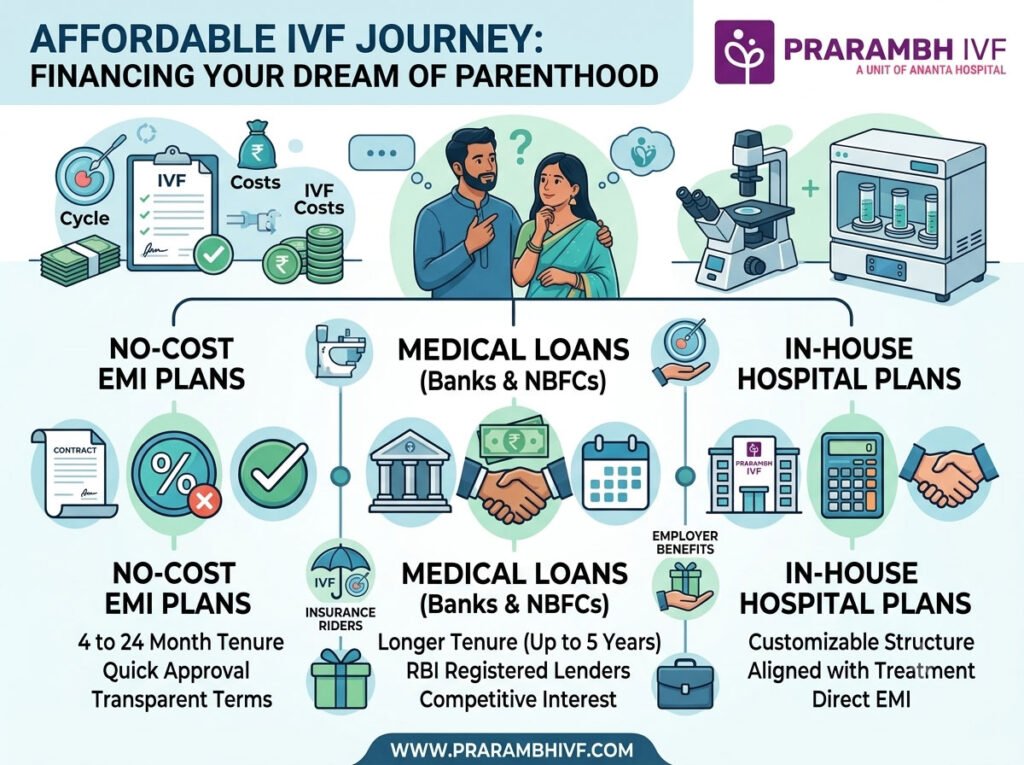
1. No-Cost or Zero-Interest EMI Plans
Many fertility hospitals now partner with financing companies to offer “no-cost EMI,” where the treatment cost is split into monthly installments without any additional interest charged to the patient. In practice, the interest is often absorbed by the hospital or financing partner as part of the arrangement, rather than truly disappearing — which is why it’s worth asking a simple question before signing up: is the cash price the same as the EMI price, or is there a hidden markup built into the “no-cost” plan? A genuine no-cost EMI means you pay exactly what you would have paid upfront, just spread across months.
These plans typically run from 4 to 24 months and require minimal documentation — usually identity proof, income proof, and basic KYC. Approval is often quick, sometimes within a day or two, which matters when a treatment cycle is time-sensitive.
2. Medical and Personal Loans from Banks and NBFCs
Beyond in-house EMI schemes, couples can approach banks and non-banking financial companies (NBFCs) directly for a medical loan or personal loan earmarked for fertility treatment. Several major banks and healthcare-focused lenders now offer loans specifically structured around IVF and assisted reproduction costs, with repayment tenures ranging from six months to five years.
A few things are worth understanding before choosing this route:
- Reducing balance vs. flat interest: Always ask whether the interest is calculated on a reducing balance or a flat rate. A loan advertised at “12% flat” can actually cost significantly more than a loan at “12% reducing,” even though the headline number looks similar.
- Key Fact Statement (KFS): RBI-registered lenders are required to provide a KFS that shows the true annual percentage rate (APR), including processing fees and other charges. This is the number that actually matters, not the marketing rate.
- Stick to RBI-registered lenders: This protects you from predatory terms and ensures there’s a formal grievance redress mechanism if something goes wrong.
3. Credit Card EMI Conversion
Couples with an existing credit card can often convert the IVF bill into EMIs directly through their card issuer. This is usually the fastest route since it requires no fresh loan application, but it tends to carry a higher interest rate than dedicated medical loans, and the interest portion is subject to GST — unlike personal loan interest, which is not. Credit card EMI is best suited for smaller shortfalls (like a single test or medication cost) rather than financing an entire treatment cycle.
4. Employer Health Benefits and Insurance Riders
Insurance coverage for IVF in India has historically been limited, but this is slowly changing. A growing number of large employers — particularly IT companies and multinationals — now include fertility benefits within their group health insurance, sometimes covering up to ₹5 lakh of treatment costs. Separately, a few insurers have started offering dedicated infertility riders or specialised fertility plans, though these often come with a waiting period of one to four years and coverage caps in the ₹50,000 to ₹4.5 lakh range.
If you’re employed, it’s worth checking with your HR department before assuming insurance won’t help — policies are updated more often than most employees realize, and fertility benefits are increasingly seen as a retention tool by companies competing for talent.
5. In-House Hospital Payment Plans
Many fertility hospitals, including Prarambh IVF and Women’s Hospital, offer customized in-house payment structures for patients who don’t want to go through a third-party lender. These are typically built around a manageable down payment followed by fixed monthly instalments directly to the hospital, often at reduced or zero interest for shorter tenures. Because the hospital already understands the treatment timeline, these plans can be aligned closely with the actual cycle schedule — for instance, structuring payments around stimulation, egg retrieval, and embryo transfer stages rather than one lump sum upfront.
Real-World Example: How EMI Changes the Decision
Consider a couple who has already been through two unsuccessful cycles and is now facing a financial burden of roughly ₹3 lakh for their next attempt. Without financing, they might be forced to wait a year or two to save up the amount — time that matters a great deal in fertility treatment. With a 12-month EMI plan, the same couple could make a down payment of around ₹30,000–35,000 and pay the balance over the following months at 0% interest, allowing them to start their next cycle almost immediately rather than losing another year to saving.
This is the core value of IVF financing: it doesn’t just make treatment cheaper, it makes timing possible. And in fertility care, timing is often the difference between success and having to try again.
Questions to Ask Before Choosing an EMI or Loan Plan
Before signing any financing agreement, it helps to ask the hospital or lender a short list of direct questions:
- Is this genuinely interest-free, or is the “cash price” quietly higher to offset a hidden interest cost?
- What is the total amount payable at the end of the tenure, including any processing fee?
- Is the interest calculated on a reducing balance or a flat rate?
- What happens if a cycle is cancelled or postponed for medical reasons — are instalments paused or refunded?
- Does the plan cover medications and monitoring, or only the core procedure cost?
- Is the lender RBI-registered, and is a Key Fact Statement provided?
Getting clear answers to these questions upfront prevents unpleasant surprises later, especially if a cycle doesn’t go as planned and needs to be repeated.
Building a Realistic Financial Plan Before You Start
Because most couples need more than one cycle, the smartest approach is to plan for the full treatment journey rather than just the first attempt. A realistic budget usually accounts for:
- The base cost of one IVF cycle
- Medication costs, which can vary significantly based on the stimulation protocol used
- Diagnostic and monitoring costs through the cycle
- A buffer for a possible second or third cycle
- Any additional procedures like ICSI, embryo freezing, or genetic testing, if recommended
Having this fuller picture — rather than anchoring only on the “starting from ₹X” figure often used in advertising — makes it far easier to choose the right financing option and avoid a mid-treatment financial crunch.
How Prarambh IVF and Women’s Hospital Supports Patients Through Financing
At Prarambh IVF and Women’s Hospital, we understand that the emotional weight of infertility is already significant — the last thing a couple needs is added financial stress at every step of the way. Our team works with patients to lay out the complete expected cost of their treatment plan upfront, explain the EMI and financing options available to them, and connect them with trusted lending partners where needed. Our goal is simple: cost should never be the reason a couple has to wait or give up on their journey to parenthood.
If you’re exploring IVF and want to understand what treatment might cost in your specific case — along with the financing options available to you — our team is here to walk you through it with complete transparency.
Frequently Asked Questions
Is IVF EMI really interest-free? It can be, but always verify. A genuine no-cost EMI means the total amount you pay on EMI equals the cash price. Ask the hospital or lender to confirm this in writing before proceeding.
How much does IVF cost in India per cycle? Most IVF cycles in India cost between ₹1.2 lakh and ₹3 lakh, depending on the clinic, city, and the specific protocol used. Medications and monitoring are usually additional.
Can I use insurance and EMI together for IVF? Yes. If your insurance or employer benefit covers part of the cost, the remaining balance — the co-pay amount — can typically still be financed through an EMI or loan plan.
How many IVF cycles do most couples need? This varies by individual case, but many couples require two to three cycles before achieving a successful pregnancy. Planning your financing around this possibility, rather than just a single cycle, is advisable.
What documents are needed for an IVF loan or EMI plan? Typically identity proof (such as an Aadhaar card), income proof (salary slips or bank statements), and basic KYC documents. Existing customers of a financing partner may need fewer documents.
Ready to take the next step? Prarambh IVF and Women’s Hospital offers transparent treatment costing and financing guidance tailored to your situation. Visit www.prarambhivf.com to schedule a consultation and understand your options.
This article is for general informational purposes only and does not constitute financial or medical advice. Interest rates, loan terms, and eligibility criteria vary by lender and change over time — please verify current details directly with the hospital or financing partner before making a decision.
