
If you’ve just had an embryo transfer, you’ve probably already heard your fertility team mention progesterone more times than you can count. Maybe you’ve been handed a prescription for injections, vaginal suppositories, or oral tablets — sometimes all three — and wondered: is this really necessary, or is it just precaution?
Here’s the direct answer: progesterone support after embryo transfer isn’t optional. It isn’t a “nice to have.” It is one of the single most important factors standing between a successful implantation and a failed cycle. Skipping doses, stopping early, or being inconsistent with your progesterone protocol can undo weeks of careful stimulation, retrieval, and embryo culture in a matter of days.
At Prarambh IVF and Women’s Hospital, we see, time and again, that patients who understand why progesterone matters are far more likely to stay consistent with it — and consistency is exactly what makes the difference. This guide breaks down what progesterone actually does, why your body may not produce enough of it after an IVF cycle, the different ways it’s administered, common side effects, and the mistakes to avoid during this critical two-week window.
What Does Progesterone Actually Do After Embryo Transfer?
Progesterone is often called the “pregnancy hormone” for good reason. After ovulation (or in an IVF cycle, after egg retrieval), progesterone is responsible for transforming the lining of the uterus — the endometrium — into a receptive, nutrient-rich environment capable of supporting an implanting embryo.
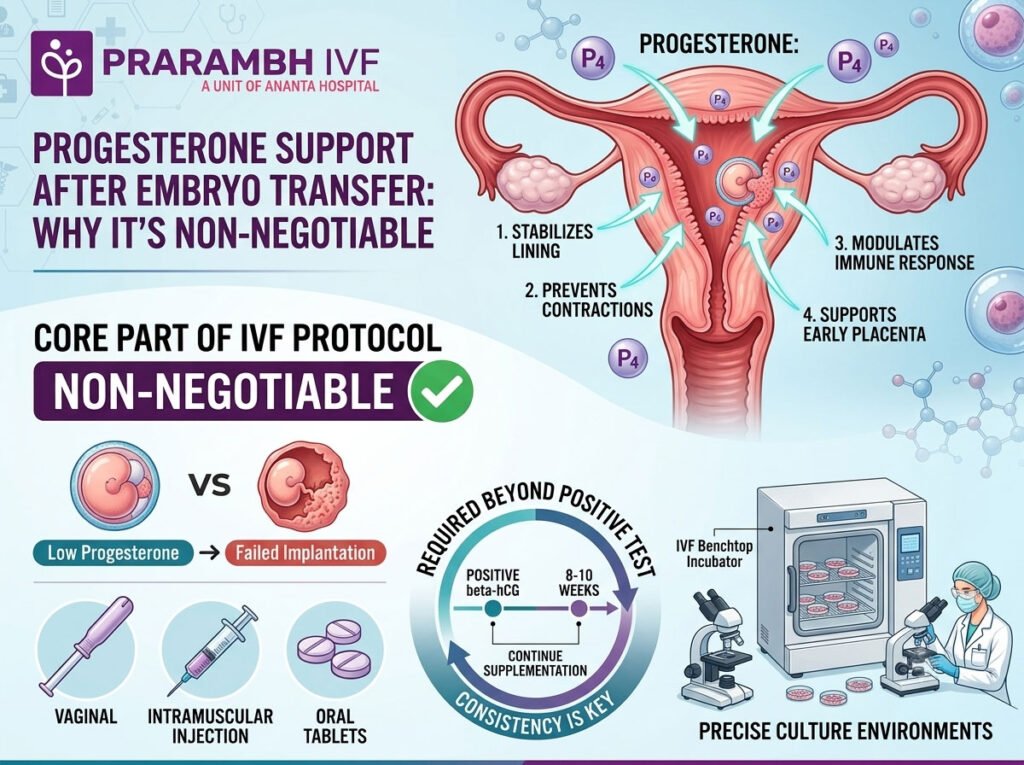
Specifically, progesterone:
- Thickens and stabilizes the endometrial lining, making it “sticky” enough for an embryo to implant successfully.
- Suppresses uterine contractions, preventing the uterus from contracting and potentially dislodging a newly implanted embryo.
- Modulates the immune response in the uterine lining, helping the body tolerate the embryo rather than reject it as foreign tissue.
- Supports early placental development, maintaining the pregnancy until the placenta itself takes over hormone production, typically around 8–10 weeks.
Without adequate progesterone, even a genetically normal, perfectly graded embryo may fail to implant — or may implant briefly and then be lost. This is why fertility specialists treat progesterone supplementation as a core part of the IVF protocol, not an afterthought.
Why Progesterone Support Is Needed in IVF Cycles Specifically
In a natural conception cycle, the corpus luteum — the structure left behind in the ovary after an egg is released — produces progesterone automatically. But IVF cycles disrupt this natural process in a few important ways:
1. Ovarian stimulation medications suppress natural progesterone production.
The high doses of gonadotropins used to stimulate multiple follicles, combined with GnRH agonists or antagonists used to control ovulation timing, interfere with the body’s normal hormonal signaling. The result is that the corpus luteum often doesn’t function normally, even after retrieval.
2. Egg retrieval removes the granulosa cells that would normally support progesterone production.
During retrieval, follicular fluid and surrounding cells are aspirated along with the egg. This reduces the ovary’s own capacity to produce sufficient progesterone in the days that follow.
3. Frozen embryo transfer (FET) cycles often involve no corpus luteum at all.
In many medicated FET cycles, ovulation doesn’t occur, meaning there’s no corpus luteum to produce progesterone naturally in the first place. In these cycles, essentially 100% of the progesterone your body receives comes from supplementation.
Because of these factors, “luteal phase support” — the medical term for progesterone (and sometimes estrogen) supplementation after transfer — is considered a standard, essential part of nearly every IVF and FET protocol.
The Different Forms of Progesterone Support
Your fertility specialist will choose a progesterone protocol based on your cycle type, medical history, and how your body responds. The three most common delivery methods are:
1. Vaginal Progesterone (Suppositories, Gels, or Inserts)
This is one of the most widely used methods because it delivers progesterone directly to the uterus through what’s called the “first uterine pass effect” — meaning the uterine lining gets a concentrated dose before the hormone circulates through the rest of the bloodstream.
Pros: Fewer systemic side effects, no injection pain, easy to self-administer.
Cons: Can cause vaginal irritation, discharge, or a messy residue; timing around intercourse or internal exams needs to be planned carefully.
2. Intramuscular (IM) Progesterone Injections
Progesterone in oil (PIO) injections are given daily, typically into the upper outer buttock or thigh muscle, using a longer needle due to the oil-based formulation.
Pros: Very reliable, consistent blood levels; long track record of clinical use.
Cons: Can cause significant injection-site pain, swelling, redness, or hardened lumps (sometimes called “PIO bumps”) with daily use over weeks.
3. Oral Progesterone
Oral tablets are less commonly used as a primary method in IVF because they’re metabolized quickly by the liver, resulting in lower and less predictable levels reaching the uterus. However, they’re sometimes used as a supplement alongside vaginal or injectable forms.
Pros: Convenient, no injection or vaginal application needed.
Cons: Generally considered less effective alone for luteal phase support in IVF; more likely to cause drowsiness or dizziness.
Combination Protocols
Many clinics, including our team at Prarambh IVF and Women’s Hospital, use a combination approach — for example, vaginal progesterone plus a weekly or twice-weekly IM injection — to ensure blood and tissue levels stay consistently high enough to support implantation, especially in patients with a history of previous implantation failure or thin endometrial lining.
How Long Do You Need to Continue Progesterone Support?
This is one of the most common questions patients ask, and it’s an important one — because stopping too early is one of the most preventable causes of early pregnancy loss after IVF.
Typically, progesterone support continues:
- From the day of embryo transfer (or in some protocols, starting a few days before transfer)
- Through a positive pregnancy test confirmed by beta-hCG bloodwork
- Often until 8–10 weeks of pregnancy, sometimes called the “luteal-placental shift” — the point at which the placenta has matured enough to produce sufficient progesterone on its own
Your doctor will guide the exact taper based on your hormone levels, ultrasound findings, and individual risk factors. Never stop or reduce your progesterone dose on your own, even if you feel fine — early pregnancy symptoms (or the absence of them) are not a reliable indicator of your actual hormone levels.
Signs of Low Progesterone After Embryo Transfer
While bloodwork is the only reliable way to know your progesterone levels, some patients report the following symptoms when levels are inadequate:
- Light spotting or bleeding
- Mild lower abdominal cramping
- Unusual fatigue beyond normal medication side effects
- Lower back pain
Important: Spotting during the two-week wait doesn’t automatically mean progesterone is low — it can also be completely normal implantation bleeding. The only way to know for certain is through a blood test ordered by your fertility team. If you notice any of these symptoms, contact your clinic rather than adjusting your medication yourself.
Common Side Effects of Progesterone Supplementation
Progesterone side effects are usually manageable, but it helps to know what’s normal so you’re not caught off guard:
- Bloating and mild abdominal discomfort
- Breast tenderness
- Fatigue or drowsiness, especially with oral forms
- Mood changes, including irritability or low mood
- Injection site soreness, redness, or lumps (with IM injections)
- Vaginal discharge or irritation (with vaginal forms)
Most of these side effects are the medication working as intended — they mirror the same hormonal shifts your body goes through in early pregnancy. That said, always report severe pain, heavy bleeding, signs of infection at an injection site, or allergic reactions to your care team immediately.
Practical Tips for Staying Consistent With Progesterone Support
Consistency is everything with luteal phase support — a missed or delayed dose can cause a dip in blood levels at exactly the wrong moment. A few practical strategies that help our patients stay on track:
- Set a fixed daily alarm for injections or vaginal doses, ideally at the same time every day.
- Warm the oil vial (for IM injections) in your hands or a warm water bath for a few minutes before injecting — this makes the oil less viscous and easier to administer.
- Rotate injection sites slightly to reduce lump formation and soreness.
- Keep a simple tracking log or app reminder, especially if you’re on multiple medications simultaneously.
- Travel-proof your supply — always carry a few extra days of medication when traveling, and keep vaginal progesterone at room temperature unless your pharmacist advises refrigeration.
- Ask before skipping — if you experience a bad reaction or missed dose, call your clinic rather than making the decision on your own.
Why Progesterone Support Is Especially Critical in Frozen Embryo Transfer (FET) Cycles
Frozen embryo transfers have become increasingly common, and many patients don’t realize that medicated FET cycles carry an even higher dependency on external progesterone than fresh transfer cycles. Since ovulation is often suppressed entirely in a programmed FET cycle, there is no corpus luteum producing progesterone naturally at all — every unit of hormone supporting the pregnancy is coming from your prescribed medication.
This is why clinics closely monitor progesterone blood levels before and after FET, and why some patients with historically low levels may be prescribed higher doses or combination protocols (vaginal plus injectable) specifically for frozen cycles.
The Bottom Line: Don’t Treat Progesterone as Optional
It’s easy, especially during the anxious two-week wait after embryo transfer, to focus entirely on symptoms, testing too early, or googling every twinge. But the single most controllable factor in your control during this window is medication adherence — and progesterone sits at the very center of that.
An embryo can be genetically perfect, expertly cultured, and transferred with flawless technique — but without adequate progesterone support, the uterine environment simply may not be ready to sustain it. This is why fertility specialists worldwide consider luteal phase support a non-negotiable part of IVF care, not a precaution that can be skipped if you’re feeling fine.
At Prarambh IVF and Women’s Hospital, our clinical team personalizes every patient’s progesterone protocol based on hormone monitoring, endometrial response, and individual history — because a one-size-fits-all approach simply doesn’t work for something this important. If you’re currently in your two-week wait, preparing for an upcoming transfer, or have questions about your specific progesterone protocol, our team is here to guide you through every step.
Have questions about your progesterone protocol or upcoming embryo transfer?
Reach out to Prarambh IVF and Women’s Hospital at info@prarambhivf.com or visit www.prarambhivf.com to schedule a consultation with our fertility specialists.
This article is intended for general educational purposes only and does not replace personalized medical advice. Always follow your fertility specialist’s specific instructions regarding medication dosage and duration.
Frequently Asked Questions
Can I stop progesterone once I get a positive pregnancy test?
No. Progesterone support typically continues well past a positive test — often through 8–10 weeks of pregnancy — until the placenta can produce enough hormone on its own. Stopping early without medical guidance significantly increases miscarriage risk.
Does progesterone cause a false sense of pregnancy symptoms?
Yes. Because progesterone itself causes bloating, breast tenderness, and fatigue, many of the “early pregnancy symptoms” patients notice during the two-week wait are actually medication side effects, not necessarily signs of pregnancy.
Is vaginal or injectable progesterone more effective?
Both are effective when used correctly, and many clinics use them in combination. The right choice depends on your individual protocol, endometrial response, and your doctor’s clinical judgment — there isn’t a single “better” option for every patient.
What happens if I miss a dose of progesterone?
Contact your clinic immediately rather than doubling your next dose or waiting until your next scheduled dose. Timing and consistency matter, and your care team can advise the safest way to get back on track.
Explore related fertility services at Prarambh IVF and Women’s Hospital:
- In Vitro Fertilization (IVF)
- In-Uterine Insemination (IUI)
- Female Infertility Treatments
- Male Infertility Treatments
- Ovulation Induction
- Egg Freezing
Category
Filed under: IVF Treatment
Related Blog Posts
You may also find these helpful:
- Thin Endometrium: Can You Still Get Pregnant with IVF?
- Why IVF Fails Even When Reports Are Normal
- Understanding IVF: A Step-by-Step Guide for Beginners
- PCOS and IVF: What Changes in Treatment Strategy?
- How Age Really Affects IVF Success: Real Data Explained
- Latest Fertility Treatments in 2026: What Couples Should Know
