
If you’ve just finished an IVF embryo transfer, chances are you’re now refreshing your inbox waiting for a single number: your beta hCG. It’s the number that turns weeks of injections, monitoring, and waiting into a real answer — pregnant or not. But once that first result arrives, most patients have the same follow-up question: is this number actually good?
At Prarambh IVF and Women’s Hospital, we get this question daily from patients navigating their post-transfer window. This guide gives you a complete, week-by-week hCG reference chart, explains how doubling time actually works, and tells you exactly when a number outside the expected range is something to flag versus something to simply keep monitoring.
What Exactly Is hCG?
Human Chorionic Gonadotropin (hCG) is produced by the earliest cells of a developing embryo — specifically the trophoblast cells that will eventually become the placenta — shortly after implantation into the uterine lining. Its main job in early pregnancy is to keep the corpus luteum (or your supplemental progesterone, in a medicated IVF cycle) producing enough progesterone to maintain the uterine lining and support the pregnancy until the placenta fully takes over that role, usually by around 10 weeks.
Because hCG appears in blood before it’s detectable in urine, and because IVF gives clinics an exact, known transfer date, hCG monitoring after IVF is far more precise than in a naturally timed pregnancy.
When Does Testing Start?
Your first beta hCG blood draw is scheduled based on the age of the embryo transferred, not your last menstrual period:
- Day 5 blastocyst transfer: first test around 9–11 days post-transfer
- Day 3 embryo transfer: first test around 12–14 days post-transfer
Testing earlier than your clinic’s recommended date is one of the most common causes of false anxiety — hCG simply may not have risen high enough yet to register accurately, even in a perfectly healthy, ongoing pregnancy.
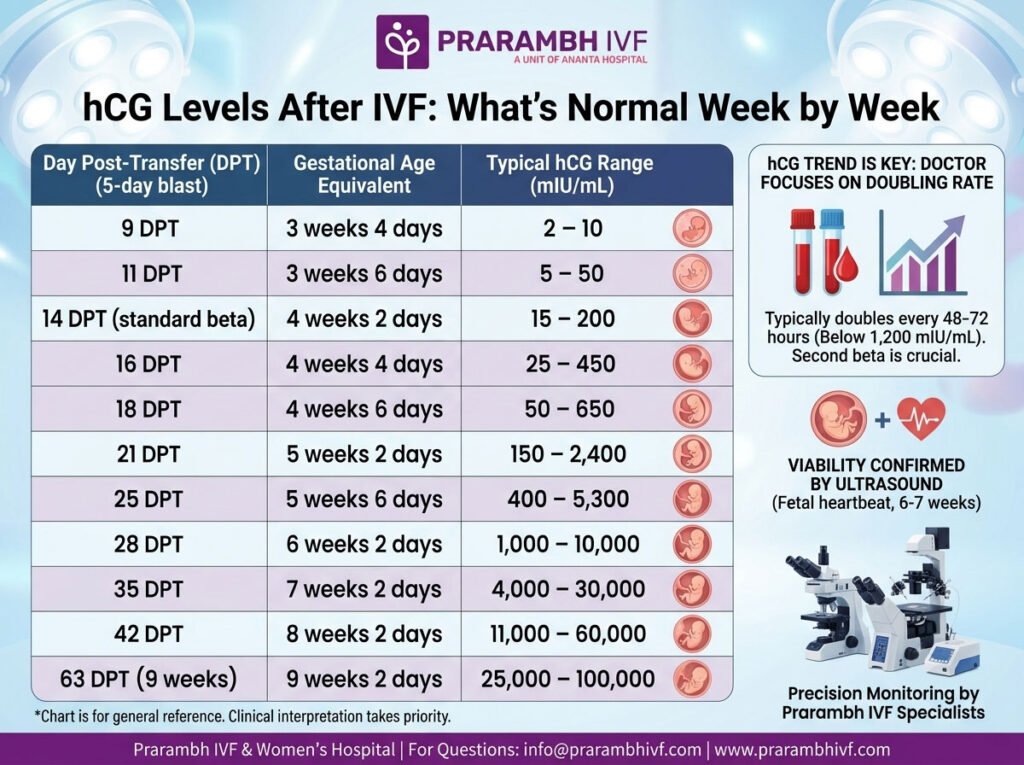
The Complete hCG Chart After IVF
| Days Post-Transfer (5-day blastocyst) | Gestational Age Equivalent | Typical hCG Range (mIU/mL) |
|---|---|---|
| 9 DPT | 3 weeks 4 days | 2 – 10 |
| 11 DPT | 3 weeks 6 days | 5 – 50 |
| 14 DPT (standard first beta) | 4 weeks 2 days | 15 – 200 |
| 16 DPT | 4 weeks 4 days | 25 – 450 |
| 18 DPT | 4 weeks 6 days | 50 – 650 |
| 21 DPT | 5 weeks 2 days | 150 – 2,400 |
| 25 DPT | 5 weeks 6 days | 400 – 5,300 |
| 28 DPT | 6 weeks 2 days | 1,000 – 10,000 |
| 35 DPT | 7 weeks 2 days | 4,000 – 30,000 |
| 42 DPT | 8 weeks 2 days | 11,000 – 60,000 |
| 63 DPT (9 weeks) | 9 weeks 2 days | 25,000 – 100,000 |
These ranges are broad on purpose. hCG naturally varies a great deal between individuals and even between pregnancies in the same person — a healthy pregnancy can start with a first beta as low as 20 mIU/mL or as high as 300 mIU/mL. Use this chart as a general reference only; your clinical team’s interpretation of your specific numbers always takes priority.
Why Your Doctor Cares More About the Trend Than the Number
A single hCG value tells you very little on its own. What your fertility team is really watching is the rate of increase between two consecutive tests, typically spaced 48 hours apart.
The doubling-time rule of thumb:
- Below 1,200 mIU/mL: hCG usually doubles every 48–72 hours
- Between 1,200–6,000 mIU/mL: doubling time slows to roughly 72–96 hours
- Above 6,000 mIU/mL: the rise slows further and doubling time becomes less predictive
- A minimum rise of ~53% over 48 hours is still considered a healthy, reassuring trend — it doesn’t have to fully double every single time
This is why your care team at Prarambh IVF and Women’s Hospital will almost always schedule a second beta hCG draw 48 hours after your first, rather than making any determination from one result alone.
When a Slower Rise Needs Attention
A slower-than-expected rise doesn’t automatically mean bad news, but it’s a signal for closer monitoring. Common explanations include:
- A later actual implantation date than assumed, shifting the whole timeline slightly
- Early pregnancy loss (chemical pregnancy) — where hCG rises briefly, then plateaus or drops
- Ectopic pregnancy, where implantation has occurred outside the uterine cavity — this needs urgent evaluation and monitoring
- Normal lab-to-lab variability, especially if two tests weren’t run at the same facility
If you’re navigating implantation concerns more broadly, our detailed breakdown of recurrent embryo implantation failure covers what’s typically investigated when transfers repeatedly don’t progress as expected.
When a Higher-Than-Average Number Shows Up
On the flip side, an unusually high hCG value for your day post-transfer isn’t necessarily worrying either. It can simply reflect:
- A twin or multiple pregnancy — more common with double embryo transfer
- Individual variation in how much hCG a particular pregnancy produces
- Rarely, a molar pregnancy, which is ruled out on ultrasound rather than blood work alone
If you transferred more than one embryo, our guide on embryo grading and why it matters explains how embryo quality factors into transfer decisions and expected outcomes.
What Happens After hCG Confirms Pregnancy?
Blood monitoring is the first checkpoint — not the final one. Once your hCG level crosses roughly 1,500–2,000 mIU/mL, your clinic will schedule a transvaginal ultrasound to confirm:
- Intrauterine location — ruling out an ectopic pregnancy
- Gestational sac, typically visible around 5–6 weeks
- Fetal heartbeat, typically visible around 6–7 weeks
This ultrasound — not the hCG chart above — is what ultimately confirms a viable, progressing pregnancy.
Throughout this window, continuing your prescribed progesterone support exactly as directed matters just as much as your hCG trend. If you haven’t already, it’s worth reading our post on why progesterone support after embryo transfer is non-negotiable, since stopping or missing doses too early can affect outcomes even when hCG looks perfectly healthy.
If You Had a Frozen Embryo Transfer
Patients often ask whether hCG patterns differ between fresh and frozen cycles. In general, the ranges and doubling expectations are the same — what differs is the hormonal preparation leading up to transfer. Our comparison of Frozen Embryo Transfer (FET) vs. Fresh Transfer breaks down how each protocol is managed and monitored.
Falling hCG Levels
A confirmed decline after an initial rise is the clearest sign of a pregnancy loss — either a chemical pregnancy or a resolving early miscarriage. If your numbers begin falling, your Prarambh IVF and Women’s Hospital care team will continue monitoring hCG until it returns to a non-pregnant baseline (below 5 mIU/mL), to make sure everything has resolved completely, and will walk you through next steps with care and clarity. For patients trying to understand this distinction more precisely, our article on chemical pregnancy vs. biochemical pregnancy is a useful next read.
A Few Practical Reminders During the Wait
- Skip the forum comparisons. Labs use different assay standards, so a number that looks “low” in an online thread may be completely normal on your clinic’s scale.
- Avoid home urine tests between blood draws — they measure hCG differently and tend to create unnecessary stress.
- Keep taking your medications exactly as prescribed, even if you’re anxious about a number, unless your doctor tells you otherwise.
- Call your clinic immediately for heavy bleeding, severe one-sided pain, or dizziness — these should always be evaluated promptly, regardless of what your last hCG result showed.
Your Next Step at Prarambh IVF and Women’s Hospital
An hCG chart can tell you what’s typical — only your fertility team can tell you what’s right for you. Our reproductive endocrinologists and embryologists personally review every beta hCG result against your specific IVF protocol and embryo transfer details, rather than a generic range, so you get a precise, honest read on where things stand.
Explore more on our blog:
- Endometrial Receptivity (ERA Test): Does Timing Explain Your Failed Transfers?
- IVF Success Rates by Age: What Couples Should Know
- What is Embryo Grading & Why It Matters in IVF
Our related services:
- In Vitro Fertilization (IVF)
- In-Uterine Insemination (IUI)
- Female Infertility Treatments
- Ovulation Induction
Browse more guides in our IVF Treatment category or visit the Prarambh IVF blog for the full library.
Questions about your own hCG results? Email us directly at info@prarambhivf.com or visit www.prarambhivf.com to book a consultation with our fertility specialists.
This article is for general educational purposes only and does not replace personalized medical advice. Always review your specific hCG results and pregnancy monitoring plan with your treating fertility specialist.
