
For many men, hearing the word “azoospermia” for the first time feels like the end of the road to biological fatherhood. It isn’t. Azoospermia — the complete absence of sperm in the ejaculate — is one of the most misunderstood diagnoses in male fertility, largely because most people don’t realize that “no sperm in the semen” does not always mean “no sperm at all.”
At Prarambh IVF and Women’s Hospital, we evaluate men with azoospermia every week, and in a large proportion of cases, sperm can still be found and retrieved directly from the testicle or epididymis using minor surgical procedures — TESA, TESE, or Micro-TESE — and used to achieve pregnancy through ICSI. This guide breaks down what azoospermia actually means, how it’s diagnosed, and which sperm retrieval technique is right for which situation.
What Is Azoospermia?
Azoospermia is a condition in which no sperm is detected in a man’s ejaculate after semen analysis. It’s diagnosed in roughly 1% of all men and around 10–15% of men presenting with infertility. It’s important to understand that azoospermia is not the same as infertility being untreatable — it’s a starting point for a more detailed investigation, not an endpoint.
Azoospermia falls into two broad categories, and figuring out which one applies is the single most important step in choosing the right treatment path.
Types of Azoospermia
1. Obstructive Azoospermia (OA)
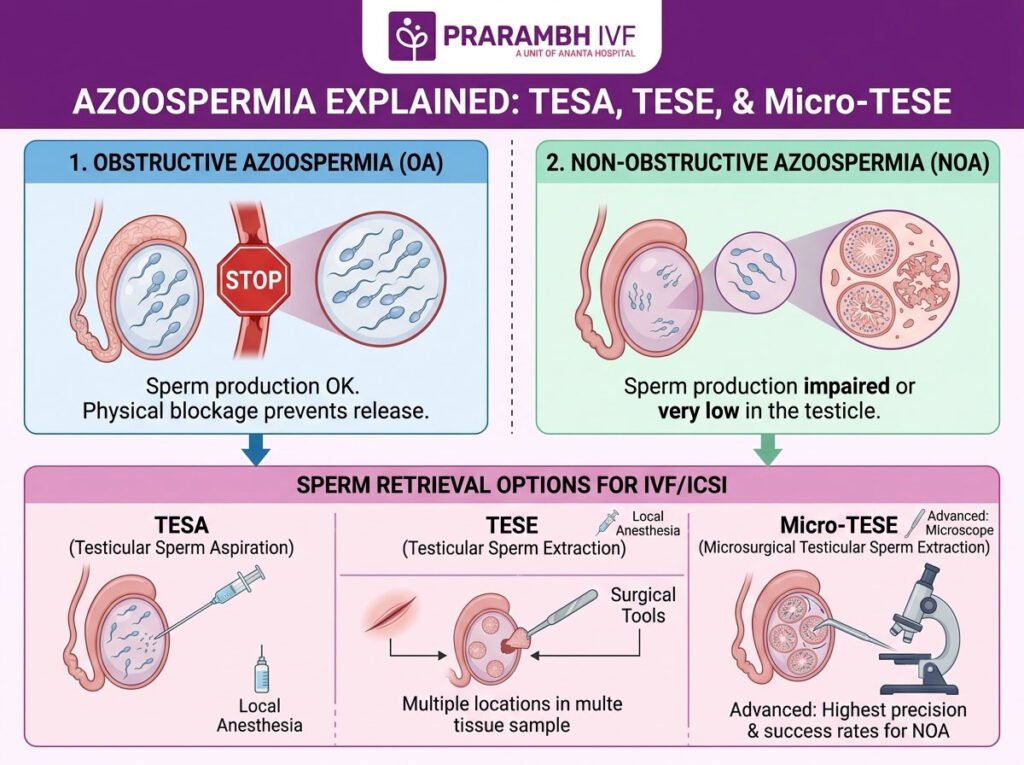
In obstructive azoospermia, sperm production in the testicles is normal, but a physical blockage somewhere in the reproductive tract — the epididymis, vas deferens, or ejaculatory ducts — prevents sperm from reaching the ejaculate.
Common causes include:
- Congenital absence of the vas deferens (often linked to CFTR gene mutations, the gene associated with cystic fibrosis)
- Previous vasectomy
- Infections causing scarring (epididymitis, prostatitis, sexually transmitted infections)
- Prior surgeries in the groin or pelvic region
- Ejaculatory duct obstruction
Because sperm production itself is intact in OA, sperm retrieval success rates are generally very high — often above 90%.
2. Non-Obstructive Azoospermia (NOA)
In non-obstructive azoospermia, the problem lies within the testicle itself — sperm production is impaired or absent due to testicular failure. This is the more complex category to treat, but even here, sperm can often still be found in small, isolated pockets within the testicular tissue.
Common causes include:
- Genetic conditions such as Klinefelter syndrome (XXY) or Y-chromosome microdeletions
- Undescended testicles (cryptorchidism) that weren’t corrected early
- Chemotherapy or radiation exposure
- Varicocele (in some cases)
- Hormonal disorders affecting the hypothalamic-pituitary-testicular axis
- Unknown/idiopathic causes (a significant proportion of NOA cases)
How Is Azoospermia Diagnosed?
A diagnosis of azoospermia isn’t made from a single test — it requires a structured workup to understand the underlying cause before deciding on a retrieval method.
- Repeat semen analysis — to confirm absence of sperm, as lab or collection errors can occasionally cause false results
- Hormonal blood tests — FSH, LH, and testosterone levels help distinguish OA from NOA (elevated FSH typically points toward NOA)
- Scrotal and transrectal ultrasound — to check testicular volume, structure, and look for obstructions
- Genetic testing — karyotyping and Y-chromosome microdeletion analysis, especially important in NOA
- Testicular biopsy — sometimes used diagnostically before or during a retrieval procedure
This is why azoospermia should always be evaluated by a fertility specialist experienced in male infertility rather than treated as a dead end after a single semen analysis report.
Sperm Retrieval Options: TESA, TESE, and Micro-TESE
Once the type of azoospermia is understood, the next step is retrieving sperm directly from the reproductive tract for use with ICSI during an IVF cycle. There are three primary techniques, each suited to different situations.
TESA (Testicular Sperm Aspiration)
TESA is a minimally invasive procedure in which a fine needle is inserted into the testicle to aspirate a small sample of tissue or fluid containing sperm. It’s typically performed under local anesthesia, takes only a few minutes, and requires no surgical incision.
Best suited for: Obstructive azoospermia, where sperm production is normal and only retrieval is needed.
Advantages: Quick, minimally invasive, low recovery time, can often be done as an outpatient procedure alongside egg retrieval in an IVF cycle.
Limitations: Lower success rate in non-obstructive azoospermia, since it samples a small, random area of tissue and may miss the isolated pockets of sperm production found in NOA.
TESE (Testicular Sperm Extraction)
TESE involves a small surgical incision into the testicle to remove a larger sample of testicular tissue, which is then processed in the lab to extract sperm. It’s more invasive than TESA but offers a higher yield of tissue to search through.
Best suited for: Both obstructive and non-obstructive azoospermia, particularly when TESA has failed or a larger tissue sample is needed.
Advantages: Higher chance of finding sperm compared to TESA in NOA cases, since more tissue can be examined.
Limitations: Slightly more invasive, requires a short recovery period, and still involves a degree of randomness in sampling.
Micro-TESE (Microsurgical Testicular Sperm Extraction)
Micro-TESE is the most advanced sperm retrieval technique and is considered the gold standard for men with non-obstructive azoospermia. It’s performed under an operating microscope, allowing the surgeon to identify and select the larger, healthier-looking seminiferous tubules — the areas most likely to contain sperm — rather than sampling tissue randomly.
Best suited for: Non-obstructive azoospermia, especially in cases where previous TESA or TESE attempts were unsuccessful, or where testicular volume is very low.
Advantages:
- Significantly higher sperm retrieval rates in NOA compared to TESA/TESE (studies generally show Micro-TESE outperforming conventional TESE in difficult NOA cases)
- Removes less overall tissue since sampling is targeted rather than random, reducing damage to testicular blood supply
- Better outcomes in men with conditions like Klinefelter syndrome
Limitations: Requires specialized microsurgical expertise and equipment, a longer procedure time, and is generally reserved for more complex NOA cases rather than used as a first-line option for obstructive azoospermia.
TESA vs. TESE vs. Micro-TESE: A Quick Comparison
| Factor | TESA | TESE | Micro-TESE |
|---|---|---|---|
| Best for | Obstructive azoospermia | OA and mild NOA | Non-obstructive azoospermia |
| Invasiveness | Minimal (needle) | Moderate (small incision) | Higher (microsurgery) |
| Precision | Random sampling | Random, larger sample | Targeted, microscope-guided |
| Success in NOA | Lower | Moderate | Highest |
| Recovery time | Same day | 1–2 days | Few days |
What Happens to the Retrieved Sperm?
Once sperm is retrieved through any of these methods, it’s either used fresh alongside an egg retrieval cycle or frozen for future use through semen freezing. Because retrieved sperm counts are often very low, these procedures are always paired with ICSI — where a single sperm is injected directly into a single egg — rather than conventional IVF fertilization, which requires much higher sperm numbers.
Success Rates: What to Realistically Expect
Success isn’t just about whether sperm is found; it’s also about what happens afterward. Broadly speaking:
- Obstructive azoospermia: Sperm retrieval success rates of 90–100%, since the testicle is producing sperm normally.
- Non-obstructive azoospermia (Micro-TESE): Sperm retrieval rates vary widely depending on the underlying cause, typically ranging from 40–60% overall, though this can be higher or lower depending on genetic and hormonal factors specific to the individual.
It’s worth emphasizing that even a “failed” TESA or TESE doesn’t necessarily mean the end of the road — many men who don’t yield sperm on a conventional TESE go on to have successful retrieval with Micro-TESE precisely because of its more thorough, targeted approach.
Is There Any Way to Avoid Surgical Retrieval?
In select cases of non-obstructive azoospermia caused by hormonal imbalance, hormonal therapy prior to retrieval can sometimes improve testicular function enough to either restore sperm in the ejaculate or improve retrieval outcomes. This is why a thorough hormonal workup — not just an ultrasound and a biopsy — matters so much before deciding on a retrieval strategy.
Emotional and Relationship Considerations
An azoospermia diagnosis can be emotionally difficult, often bringing up feelings of inadequacy, shame, or grief that are rarely discussed openly. It’s worth remembering that:
- Azoospermia is a medical condition, not a reflection of masculinity or worth
- Many men with azoospermia go on to become biological fathers through sperm retrieval and ICSI
- Couples benefit from processing this diagnosis together, and support — whether from a partner, counselor, or fertility support group — can make a meaningful difference through treatment
Why Choose Prarambh IVF and Women’s Hospital for Azoospermia Treatment
Azoospermia management requires more than just performing a retrieval procedure — it requires an accurate diagnosis of the underlying type, the right choice of retrieval technique for that specific case, and a lab equipped to identify and use even very small numbers of sperm effectively.
At Prarambh IVF and Women’s Hospital, our andrology and fertility team offers:
- Comprehensive diagnostic workup, including hormonal and genetic testing
- TESA, TESE, and Micro-TESE procedures based on individual diagnosis
- Advanced ICSI and embryology lab support to maximize the use of retrieved sperm
- Coordinated treatment planning between the male fertility and IVF teams under one roof
Final Thoughts
A diagnosis of azoospermia is not the end of the fertility journey — for most men, it’s simply a different starting point. With accurate diagnosis and the right retrieval technique, whether TESA, TESE, or Micro-TESE, biological fatherhood remains achievable for the majority of men who pursue treatment.
If you or your partner have been diagnosed with azoospermia, the most important next step is a detailed evaluation with a fertility specialist experienced in male infertility — not assuming the diagnosis closes the door on biological parenthood.
Related Reading:
- Understanding Male Infertility: Causes and Treatments
- Sperm DNA Fragmentation: The Missing Link in Male Infertility
- Semen Analysis Report: How to Read Your Results Line by Line
Related Services: Male Infertility Treatments | Semen Analysis | Semen Freezing | IVF | IUI
Category: Male Infertility | Tags: Azoospermia, TESA, TESE, Micro-TESE, ICSI, Male Infertility, Sperm Retrieval
📩 info@prarambhivf.com | 🌐 www.prarambhivf.com
