
If your doctor has just handed you a lab report with the letters “AMH” on it, you’re probably staring at a number and wondering what it actually means for your chances of having a baby. You’re not alone — the AMH test has become one of the most commonly ordered (and most misunderstood) fertility tests in the world.
At Prarambh IVF and Women’s Hospital, we see this confusion almost every day. Patients arrive with printouts, Google searches open on their phones, and a lot of anxiety over a single number. So let’s slow down and actually explain what AMH is, what your specific number tells you, and — just as importantly — what it doesn’t.
What Is AMH?
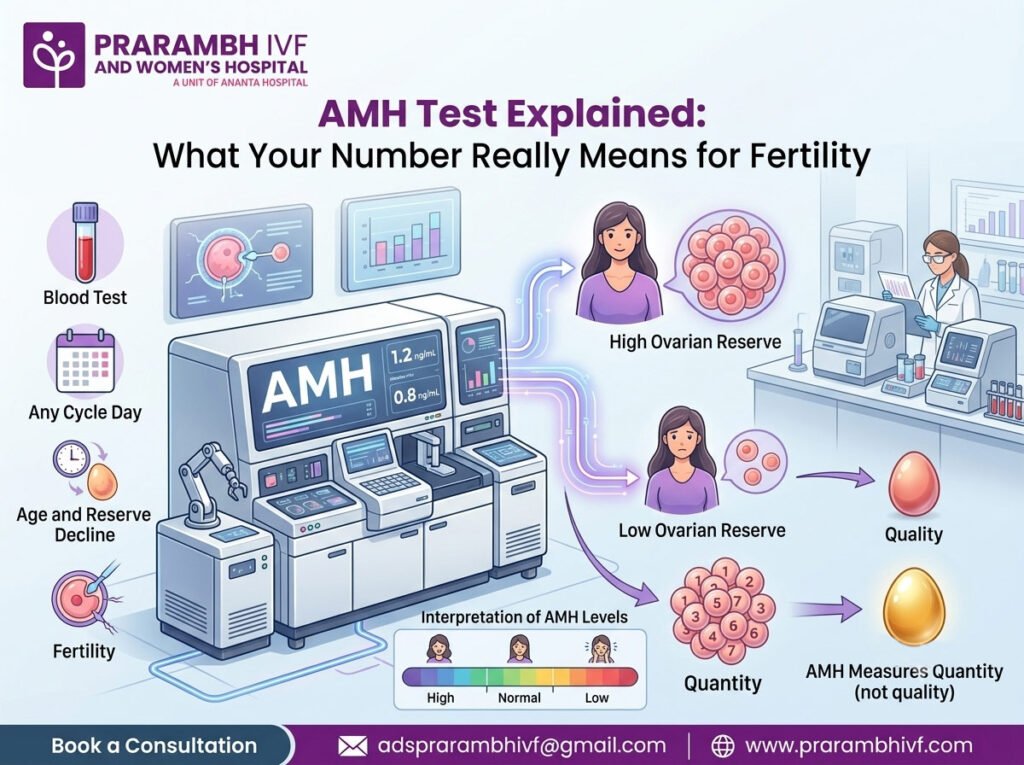
AMH stands for Anti-Müllerian Hormone. It’s a hormone produced by the small, developing follicles in your ovaries — specifically the granulosa cells that surround each egg in its early stages of growth. Every woman is born with a fixed number of eggs, and that number only goes down over time (it never goes up). AMH is released in proportion to how many of these small, “resting” follicles you currently have.
In simple terms: more small follicles = higher AMH. Fewer small follicles = lower AMH.
Because of this relationship, doctors use the AMH blood test as a proxy measurement for something called ovarian reserve — essentially, an estimate of how many eggs you have left compared to what’s typical for your age.
Why Do Doctors Order an AMH Test?
An AMH test is usually recommended when:
- You’re trying to conceive and want to understand your fertility timeline
- You’re planning to delay pregnancy and want to know your current reserve (often called “fertility mapping” or a “fertility MOT”)
- You’re about to start IVF or IUI treatment, so your fertility specialist can plan the right stimulation protocol and predict how your ovaries will respond to medication
- You have symptoms suggestive of PCOS (Polycystic Ovary Syndrome) — AMH tends to run high in PCOS
- You’ve had ovarian surgery, chemotherapy, or radiation, and your doctor wants to assess how treatment may have affected your egg supply
- You’re experiencing irregular periods and your doctor wants to investigate possible causes
Unlike some fertility hormones, AMH can be tested on any day of your menstrual cycle — you don’t need to time it around ovulation or your period, which makes it a convenient first step in a fertility workup.
How Is the AMH Test Done?
It’s a simple blood draw, similar to any other blood test — no special preparation is required, and results are typically ready within a few days. There’s no need to fast, and you can take it while on most forms of hormonal contraception, though your doctor may advise you on the best timing depending on your specific situation.
Understanding Your AMH Number: What’s “Normal”?
This is where things get tricky, because AMH values are usually reported in either ng/mL or pmol/L, and “normal” ranges vary depending on the lab and testing method used. That said, here’s a general guide most fertility clinics reference, using ng/mL:
| AMH Level (ng/mL) | Interpretation |
|---|---|
| Above 4.0 | High — possibly suggestive of PCOS |
| 1.5 – 4.0 | Normal / healthy reserve |
| 1.0 – 1.5 | Low-normal |
| 0.5 – 1.0 | Low |
| Below 0.5 | Very low |
AMH levels also naturally decline with age. Here’s a rough sense of average ranges by age group:
| Age Group | Typical Average AMH (ng/mL) |
|---|---|
| Under 25 | 3.0 – 5.0 |
| 25–30 | 2.5 – 4.0 |
| 30–35 | 1.5 – 3.5 |
| 35–40 | 0.8 – 2.5 |
| 40+ | Below 1.5, often much lower |
Important: These are broad averages, not diagnostic cutoffs. A 38-year-old with an AMH of 1.2 is not automatically “worse off” than a 28-year-old with the same number — context, and your fertility specialist’s interpretation, matter enormously.
What Does a Low AMH Number Mean?
A low AMH indicates a lower quantity of remaining eggs relative to what’s typical for your age. This is often described as “diminished ovarian reserve” (DOR).
Here’s the part that surprises most patients: low AMH does not mean you cannot get pregnant naturally, and it does not measure egg quality. AMH is purely a quantity marker. A woman with low AMH can still ovulate a healthy, high-quality egg each month — she simply may have fewer eggs left in the pipeline over her reproductive lifetime, which can mean a shorter window of opportunity, particularly if she’s also trying to conceive through IVF.
Common causes of low AMH include:
- Natural aging of the ovaries
- Premature ovarian insufficiency (POI)
- Prior ovarian surgery (such as removal of endometriomas or cysts)
- Chemotherapy or radiation treatment
- Genetic factors, including a family history of early menopause
- Smoking, which is known to accelerate follicle depletion
If your AMH comes back low, the most important next step is not panic — it’s a conversation with a fertility specialist. Low AMH may affect how your doctor approaches IVF stimulation (often using higher doses of medication or specific protocols designed for lower responders), but many women with low AMH still conceive successfully, either naturally or with assisted reproduction.
What Does a High AMH Number Mean?
A high AMH usually reflects a large number of small follicles in the ovaries — and the most common reason for this is Polycystic Ovary Syndrome (PCOS). Women with PCOS often have AMH levels two to three times higher than average for their age, because their follicles tend to “stall” in early development rather than maturing and being released each month.
High AMH isn’t necessarily bad news for fertility — in fact, it often means you have a good number of eggs available. However, it does come with its own considerations:
- Women with high AMH are at greater risk of Ovarian Hyperstimulation Syndrome (OHSS) during IVF, so fertility specialists will typically adjust medication doses carefully to reduce this risk
- Irregular or absent ovulation (common in PCOS) can make natural conception harder, even though egg supply is high
- Your doctor may recommend additional testing (like an ultrasound antral follicle count, glucose tolerance testing, or hormone panels) to confirm a PCOS diagnosis and guide treatment
What AMH Does NOT Tell You
This is the single most important thing to understand about this test:
AMH is a measure of egg quantity — not egg quality, and not your overall chance of getting pregnant.
A woman can have a “normal” AMH and still struggle to conceive due to issues with egg quality, fallopian tube blockage, uterine factors, or male-factor infertility. Conversely, a woman with low AMH can conceive naturally, sometimes without any fertility treatment at all. AMH is one piece of a much larger fertility puzzle — not a verdict.
Other tests your fertility specialist may combine with AMH to get the full picture include:
- Antral Follicle Count (AFC) via transvaginal ultrasound
- FSH and Estradiol levels (usually tested on day 2–3 of your cycle)
- Semen analysis for your partner, if applicable
- HSG (Hysterosalpingogram) to check tubal patency
- Thyroid and prolactin levels, which can affect ovulation
What Should You Do With Your AMH Result?
If you’ve just received your AMH report, here’s a practical checklist:
- Don’t self-diagnose from a number alone. Online AMH calculators and forums can cause unnecessary panic. Bring your report to a qualified fertility specialist for proper interpretation.
- Consider your full clinical picture — your age, cycle regularity, prior pregnancies, and any symptoms all matter alongside the AMH value.
- Ask about next steps based on your goals. Are you trying to conceive now, or are you assessing your fertility for future family planning? The recommended path differs significantly between the two.
- If your AMH is low and you’re trying to conceive, ask your doctor about timelines — this may be a signal to explore options like IUI or IVF sooner rather than later, especially if you’re over 35.
- If your AMH is high, ask whether further testing for PCOS is warranted, and discuss strategies to protect against OHSS if you pursue IVF.
How Prarambh IVF and Women’s Hospital Can Help
At Prarambh IVF and Women’s Hospital, we believe every patient deserves a clear, honest explanation of their fertility results — not just a number on a page. Our fertility specialists interpret your AMH result alongside a complete evaluation, including ultrasound assessment, hormonal profiling, and a detailed discussion of your personal fertility goals and timeline.
Whether your AMH is high, low, or right in the expected range, our team will walk you through what it genuinely means for your situation and help you choose the right path forward — whether that’s natural conception guidance, ovulation induction, IUI, or IVF with a protocol tailored to your ovarian response.
Have questions about your AMH report or your fertility journey? Reach out to us at adsprarambhivf@gmail.com or visit www.prarambhivf.com to book a consultation with our fertility specialists.
Frequently Asked Questions (FAQs)
1. Can AMH levels increase over time? No. AMH generally declines gradually with age as the total number of remaining eggs decreases. Some minor fluctuation can occur due to lab variability or hormonal contraception use, but a true increase is uncommon outside of specific conditions like PCOS.
2. Does low AMH mean early menopause? Not necessarily, but very low AMH — especially in women under 35 — can sometimes be an early indicator of diminished ovarian reserve or premature ovarian insufficiency. It’s worth discussing with a specialist rather than assuming the worst.
3. Can I still do IVF with low AMH? Yes. Many women with low AMH successfully complete IVF, often with adjusted stimulation protocols designed specifically for lower ovarian reserve. Success depends on multiple factors beyond AMH alone, including egg quality and overall reproductive health.
4. Is AMH testing accurate? AMH testing is considered one of the more reliable and consistent ovarian reserve markers, and unlike FSH, it doesn’t fluctuate much across your menstrual cycle. However, results can vary slightly between labs and testing kits, so it’s best to interpret results with the same lab and physician over time.
5. What is a good AMH level to get pregnant? There’s no single “magic number” required for pregnancy. Many women with AMH levels well below 1.0 ng/mL conceive naturally, while some with higher levels face other fertility challenges. AMH should always be viewed alongside your full fertility profile.
This article is for general informational purposes and should not replace personalized medical advice. Please consult a fertility specialist at Prarambh IVF and Women’s Hospital for guidance specific to your health and fertility goals.
