
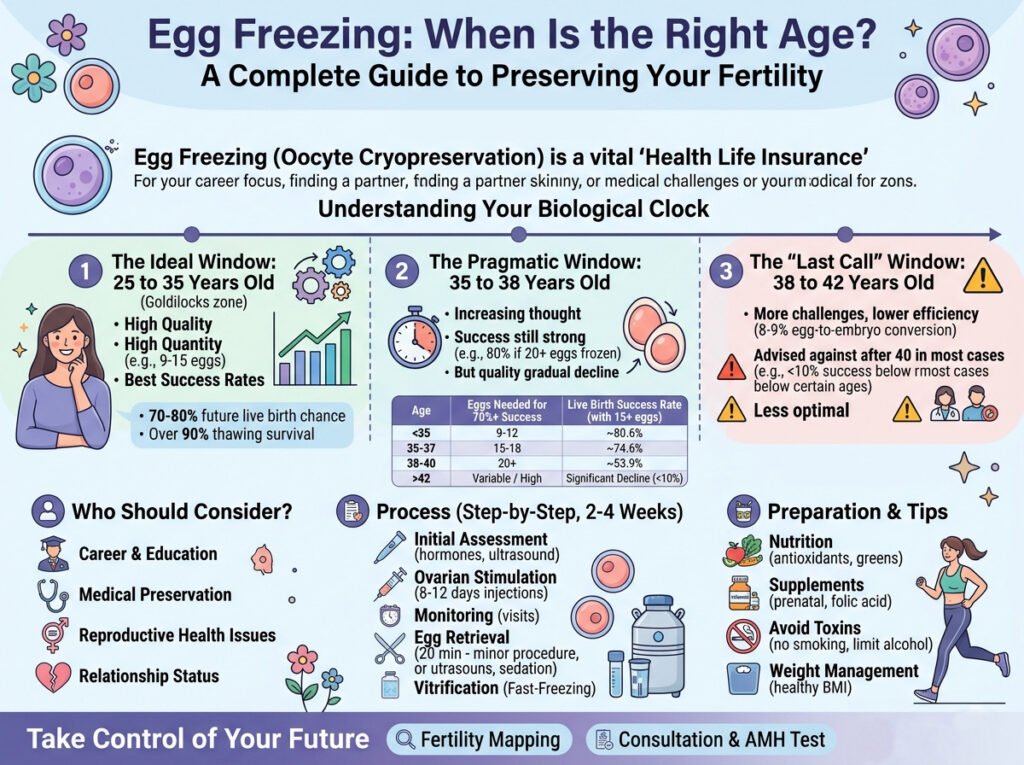
Egg Freezing: When Is the Right Age? A Complete Guide to Preserving Your Fertility
Egg freezing, or oocyte cryopreservation, has transformed from a niche medical procedure into a vital “health life insurance” for modern women. Whether you are focusing on your career, searching for the right partner, or navigating medical challenges, understanding the biological timeline of your fertility is essential.
At Prarambh IVF, we believe that empowerment comes from education. This guide provides an in-depth exploration of the “right age” for egg freezing, the science behind the process, and what you can expect at every stage of your journey.
1. Understanding the Biological Clock: Why Age Matters
Unlike men, who produce new sperm throughout their lives, women are born with a finite number of eggs. This “ovarian reserve” naturally declines in both quantity and quality over time.
- The Quantity Decline: A woman is born with approximately 1–2 million eggs. By puberty, this number drops to about 300,000–400,000. By the mid-30s, the decline accelerates significantly (Phyathai Hospital, 2026).
- The Quality Decline: As eggs age, they are more prone to chromosomal abnormalities (aneuploidy). This increases the risk of miscarriage and genetic disorders like Down syndrome (Carrot Fertility, 2024).
2. When is the “Right Age” to Freeze Your Eggs?
While you can technically freeze your eggs at various life stages, fertility specialists typically categorize the “right age” based on a balance of biological success and financial practicality.
The Ideal Window: 25 to 35 Years Old
Most medical professionals recommend the mid-20s to early 30s as the “Goldilocks zone” for egg freezing.
- High Quality: Eggs retrieved during this period have the highest survival rates after thawing (over 90%) and the best chances of resulting in a healthy pregnancy (Liv Hospital, 2026).
- High Quantity: Younger women often produce more eggs per stimulation cycle, which may mean fewer cycles are required to reach a “safe” number of banked eggs.
- Efficiency: For women under 35, freezing approximately 9–15 eggs provides a roughly 70–80% chance of a future live birth (Liv Hospital, 2026; Phyathai Hospital, 2026).
The Pragmatic Window: 35 to 38 Years Old
Many women begin considering egg freezing in their mid-30s. While success rates remain strong, they begin a gradual decline.
- Success Rates: Women aged 35–37 still see excellent outcomes, with an 80% success rate if at least 20 eggs are frozen (Liv Hospital, 2026).
- Increased Effort: As quality dips, you may need to freeze more eggs (often 15–20+) to achieve the same statistical likelihood of success as someone younger (Extend Fertility, 2026).
The “Last Call” Window: 38 to 42 Years Old
Freezing eggs after 38 is still possible but comes with more challenges.
- Lower Efficiency: The “egg-to-embryo conversion rate” drops. Only about 8–9% of eggs frozen between 38 and 42 result in a healthy embryo (Extend Fertility, 2026).
- Medical Reality: Most clinics advise against freezing after age 40, as the success rates for a live birth drop significantly (below 10% in some age brackets) due to natural aging (Penn Medicine, n.d.).
3. Success Rates by Age: The Numbers You Need to Know
Data from years of clinical practice highlights how age at the time of freezing impacts future results:
| Age at Freezing | Eggs Needed for 70%+ Success | Live Birth Success Rate (with 15+ eggs) |
| Under 35 | 9–12 eggs | ~80.6% |
| 35 – 37 | 15–18 eggs | ~74.6% |
| 38 – 40 | 20+ eggs | ~53.9% |
| Over 42 | Variable / High | Significant Decline (<10%) |
| (Sources: Liv Hospital, 2026; Extend Fertility, 2026) |
4. Who Should Consider Egg Freezing?
Beyond age, several personal and medical factors make egg freezing a proactive choice:
- Career & Education: For women who want to reach specific professional milestones before starting a family.
- Medical Preservation: Women facing chemotherapy or radiation, which can damage the ovaries.
- Reproductive Health Issues: Conditions like endometriosis, PCOS, or a family history of early menopause (Phyathai Hospital, 2026).
- Relationship Status: Those who haven’t found the right partner yet but want to ensure they have the option for biological children later.
5. The Egg Freezing Process: Step-by-Step
The procedure at a specialized clinic like Prarambh IVF typically takes about 2 to 4 weeks.
Step 1: Initial Assessment
Doctors perform blood tests to check hormone levels (AMH, FSH) and an ultrasound to count your follicles (Antral Follicle Count). This helps determine your egg reserve.
Step 2: Ovarian Stimulation (8–12 Days)
You will self-administer hormone injections to stimulate your ovaries to produce multiple mature eggs in a single cycle, rather than the usual one.
Step 3: Monitoring
Frequent clinic visits (every 2-3 days) for ultrasounds and blood work ensure the follicles are growing correctly and safely.
Step 4: Egg Retrieval
A minor 20-minute procedure performed under light sedation. A fertility specialist uses a thin needle, guided by ultrasound, to retrieve the eggs from the follicles (Penn Medicine, n.d.).
Step 5: Vitrification (Fast-Freezing)
The retrieved eggs are immediately frozen using “vitrification,” a flash-freezing technology that prevents ice crystals from forming, preserving the egg’s delicate structure (Phyathai Hospital, 2026).
6. Financial and Emotional Considerations
The Cost of Planning Ahead
In India, the cost per cycle typically ranges from ₹70,000 to ₹1,20,000, excluding medication and annual storage fees (BabySoon, 2026). While it is an investment, many see it as “fertility insurance” that prevents more expensive and emotionally taxing treatments later in life.
The Emotional Journey
Egg freezing can be an emotional rollercoaster. You might feel:
- Relief: Knowing you have a “Plan B” can reduce the pressure of the “ticking clock.”
- Physical Side Effects: Hormonal injections can cause temporary bloating, mood swings, or fatigue (PFRC IVF, 2026).
- Uncertainty: It is important to remember that egg freezing is a probability, not a guarantee.
7. How to Prepare Your Body
Regardless of your age, you can improve your outcomes by focusing on egg quality through lifestyle changes:
- Nutrition: Eat a diet rich in antioxidants, leafy greens, and lean proteins.
- Supplements: Prenatal vitamins and Folic Acid are often recommended (PFRC IVF, 2026).
- Avoid Toxins: Quit smoking and limit alcohol, as these can accelerate egg aging (Penn Medicine, n.d.).
- Weight Management: Maintaining a healthy BMI supports better hormonal response during stimulation.
8. Frequently Asked Questions (FAQs)
Q: Does egg retrieval make me run out of eggs faster?
No. Every month, your body “recruits” a group of eggs, but only one matures while the rest are naturally lost. Egg freezing simply “rescues” the eggs that would have otherwise been lost that month (Phyathai Hospital, 2026).
Q: How long can eggs be stored?
With modern vitrification technology, eggs can be stored for 10 years or even a lifetime without significant loss in quality (BabySoon, 2026).
Q: Is the procedure painful?
The retrieval is performed under sedation, so you won’t feel pain. Some mild cramping or bloating is common for 24–48 hours afterward.
Conclusion: Take Control of Your Future
There is no single “perfect” day to freeze your eggs, but there is a “best” window for your biology. If you are in your late 20s or 30s and aren’t ready for a child today, egg freezing offers a way to pause your biological clock.
At Prarambh IVF, we provide personalized fertility mapping to help you decide if now is the right time for you. Taking the first step—a simple consultation and AMH test—can give you the clarity you need to plan your future with confidence.
