
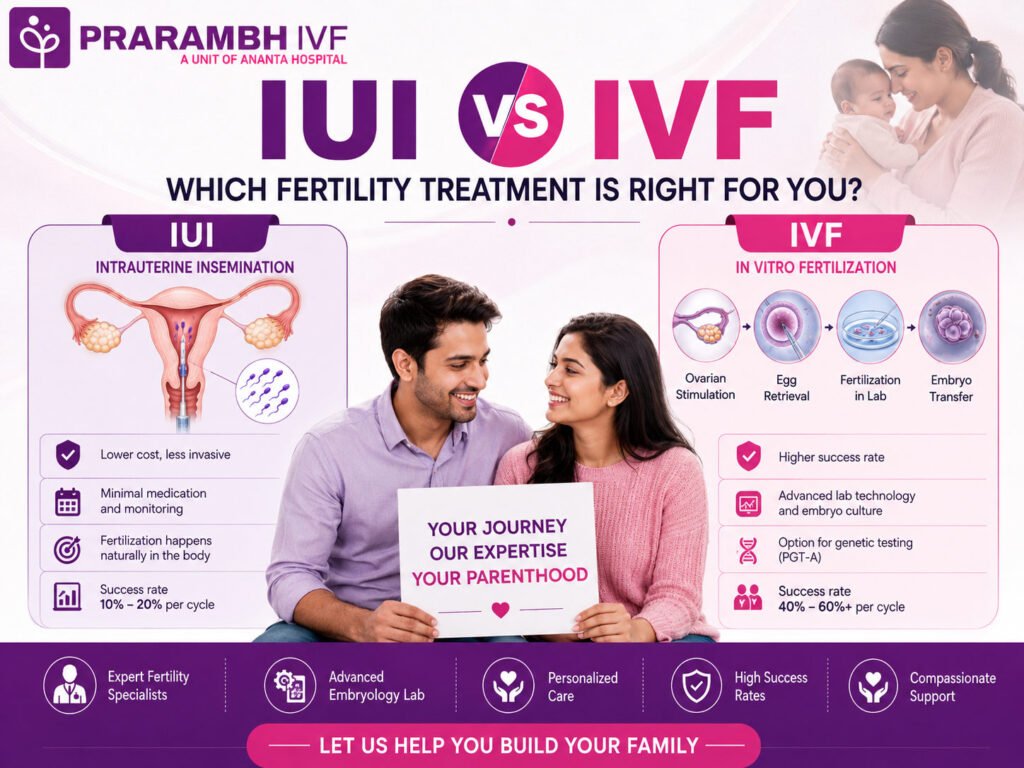
When couples or individuals first step into the world of assisted reproductive technology (ART), the amount of medical terminology can feel overwhelming. Among the various clinical options available, two acronyms appear more frequently than any others: IUI (Intrauterine Insemination) and IVF (In Vitro Fertilization).
While both procedures share the ultimate goal of helping you achieve a healthy pregnancy, they are profoundly different in terms of medical complexity, laboratory involvement, physical demands, timelines, and overall success rates.
At Prarambh IVF and Women’s Hospital, we believe that education is the foundation of confident medical decision-making. Choosing between IUI and IVF is not about finding a universally “better” treatment; it is about determining which specific clinical pathway aligns with your unique biological profile, diagnostic history, and personal timeline.
This comprehensive guide breaks down the precise differences between IUI and IVF, explores the medical pros and cons of each, and outlines how our fertility specialists help you choose the path that is truly right for you.
1. Defining the Core Procedures: How Do They Differ?
To understand which treatment suits your needs, we must first look at the fundamental differences in how fertilization takes place in each procedure.
What is IUI (Intrauterine Insemination)?
Commonly referred to as “artificial insemination,” IUI is a low-intervention, minimally invasive fertility procedure. In an IUI cycle, the female partner may take mild fertility medications to stimulate the ovaries to produce one or two mature eggs.
On the day of ovulation, the male partner provides a semen sample, which is processed in our laboratory to isolate the most active, healthy sperm. This concentrated sample is then placed directly inside the woman’s uterus using a thin, flexible catheter.
The Biological Key to IUI: In IUI, fertilization still happens naturally inside the woman’s body. The procedure simply shortens the journey for the sperm, bypassing the cervix and placing them in close proximity to the fallopian tubes right when an egg is released.
What is IVF (In Vitro Fertilization)?
IVF is a highly advanced, multi-step assisted reproductive technology. Unlike IUI, IVF completely bypasses the fallopian tubes. In an IVF cycle, the female partner takes higher doses of injectable medications to stimulate her ovaries to mature multiple eggs simultaneously.
These eggs are then surgically retrieved from the ovaries under light sedation. In our advanced embryology laboratory, the harvested eggs are combined with the partner’s or donor’s sperm to achieve fertilization. The resulting embryos are carefully cultured in state-of-the-art incubators for 3 to 6 days before one or more high-quality embryos are selected and transferred directly into the prepared uterus.
The Biological Key to IVF: In IVF, fertilization happens outside the human body, within a highly controlled laboratory environment. This gives embryologists and fertility specialists direct control over cellular development before an embryo is placed in the womb.
2. A Side-by-Side Comparison: IUI vs. IVF
When evaluating your options, seeing the core differences laid out structurally can provide significant clarity.
| Feature | Intrauterine Insemination (IUI) | In Vitro Fertilization (IVF) |
| Complexity | Low to moderate; minimal lifestyle disruption. | High; multi-phase medical and surgical steps. |
| Where Fertilization Occurs | Inside the body (in the fallopian tubes). | Outside the body (in an embryology laboratory). |
| Fallopian Tube Requirement | Must have at least one open, healthy tube. | Can be performed with completely blocked/missing tubes. |
| Anesthesia Needed | No; feels similar to a routine pap smear. | Yes; light sedation is used during egg retrieval. |
| Lab Involvement | Low; limited to sperm washing and processing. | High; includes egg identification, fertilization, and culture. |
| Average Success Rate | 10% to 20% per cycle (dependent on age). | 40% to 60%+ per cycle (dependent on age and tech). |
| Risk of Multiple Pregnancies | Higher risk of twins/triplets if multiple eggs mature. | Minimal risk when utilizing Single Embryo Transfer (eSET). |
3. When is IUI the Right Choice? (Clinical Indications)
For many patients, starting with a conservative, less invasive treatment plan makes excellent medical sense. Our specialists at Prarambh IVF and Women’s Hospital frequently recommend IUI as an initial treatment step under the following specific clinical conditions:
Unexplained Infertility
If a comprehensive fertility workup shows that the female partner is ovulating regularly, her fallopian tubes are completely open, and the male partner has normal semen parameters, but conception still hasn’t occurred, it is classified as unexplained infertility. In younger couples, trying 3 to 6 cycles of IUI is often a logical starting point.
Mild Male Factor Infertility
If a semen analysis reveals a slightly lower sperm count or mild issues with sperm motility (movement), natural conception can be challenging. IUI resolves this by using laboratory techniques to wash away cellular debris and immobile sperm, concentrating only the highest-quality, progressive sperm into a small volume of fluid for direct placement.
Cervical Factor Infertility
In some women, the cervical mucus can be abnormally thick or hostile to sperm, acting as a barrier that prevents sperm from entering the uterus. Because the IUI catheter passes directly through the cervix into the uterine cavity, it entirely bypasses this barrier.
Ovulatory Disorders Responsive to Mild Stimulation
For patients dealing with mild irregular cycles or conditions like Polycystic Ovary Syndrome (PCOS) who do not conceive with simple ovulation induction medications alone, combining tracking with an IUI can maximize timing precision.
4. When Should You Skip Straight to IVF?
While IUI is a wonderful option for specific situations, there are several medical scenarios where attempting IUI has a very low probability of success. In these instances, moving directly to IVF saves couples time, emotional exhaustion, and financial resources.
Fallopian Tube Blockage or Severe Damage
Because IUI relies on the sperm and egg meeting naturally inside the body, it requires at least one healthy, open fallopian tube. If both tubes are completely blocked, severely scarred from a past infection (such as Pelvic Inflammatory Disease), or have been surgically removed, IUI is biologically impossible. IVF completely bypasses the tubes by retrieving eggs directly from the ovaries and transferring embryos directly into the uterus.
Advanced Maternal Age (38 and Above)
As a woman approaches her late 30s and early 40s, both the quantity and genetic quality of her remaining eggs experience a natural, accelerated decline. Because IUI success rates drop significantly past age 38, accelerating to IVF allows specialists to maximize fertilization potential and utilize advanced screening.
Severe Male Factor Infertility
When a semen analysis reveals an extremely low sperm count (less than 5 million/mL), severe motility issues, or high sperm DNA fragmentation, there simply are not enough healthy sperm to make it through the fallopian tubes via IUI. IVF, combined with ICSI (Intracytoplasmic Sperm Injection), allows embryologists to select a single, healthy sperm cell and inject it directly into the egg, ensuring fertilization even with severe sperm factors.
Moderate to Severe Endometriosis
Endometriosis creates a highly inflammatory environment within the pelvis that can impair egg quality, alter tubal function, and cause anatomical distortions. IVF provides a much higher probability of success by removing the eggs from this hostile pelvic environment entirely during fertilization and early development.
5. Navigating the Treatment Timelines: Step-by-Step
Understanding the day-to-day commitment required for each procedure helps couples prepare mentally and physically for the road ahead.
1.Phase 1: Ovarian Stimulation:Days 1–5 of Cycle.
In both treatments, mild oral medications (IUI) or daily hormone injections (IVF) are started to encourage egg development. IVF requires closer monitoring with frequent ultrasounds and blood tests to track multiple follicles.
2.Phase 2: The Trigger Shot:Days 10–12 of Cycle.
Once monitoring shows that the follicles have reached an optimal size, a hormone injection (frequently hCG) is administered to finalize egg maturation and set the exact timing for the next phase.
3.Phase 3A: Sperm Washing & Insemination:Days 13–14 (IUI Pathway).
For IUI, the partner provides a semen sample on this day. The washed, highly concentrated sperm sample is immediately placed into the uterus in a quick, painless outpatient procedure. This completes the active phase of an IUI cycle.
4.Phase 3B: Surgical Egg Retrieval:Days 13–14 (IVF Pathway).
For IVF, the mature eggs are gently harvested directly from the ovaries using a thin needle under ultrasound guidance while the patient is under light sedation. Sperm is collected on the same day to begin laboratory fertilization.
5.Phase 4B: Laboratory Culture & PGT Testing:Days 15–20 (IVF Pathway).
Fertilized eggs are grown in advanced incubators to the blastocyst stage (Day 5 or 6). If desired or medically indicated, a safe cell biopsy can be taken at this stage for Preimplantation Genetic Testing (PGT-A) to ensure chromosomal health.
6.Phase 5B: Strategic Embryo Transfer:Variable Timeline (IVF Pathway).
A single, high-quality embryo is gently selected and placed into the receptive uterus using a thin catheter. Any remaining healthy embryos are safely frozen (vitrified) for future family building or sibling journeys.
6. Advanced Strategies to Maximize Success and Reduce Risks
Modern reproductive genetics and laboratory advancements have transformed what is possible in fertility medicine, helping to manage risks that were common in the early days of fertility treatments.
Preimplantation Genetic Testing (PGT-A) in IVF
One of the most profound advantages of choosing IVF over IUI is the ability to screen embryos for chromosomal health before transfer. PGT-A allows us to identify and transfer only euploid (chromosomally normal) embryos. This is incredibly beneficial for couples with advanced maternal age or recurrent miscarriages, as it significantly raises the implantation rate per transfer and drastically reduces the risk of pregnancy loss.
Preventing Multiples: Single Embryo Transfer (eSET)
In an IUI cycle, if a patient responds strongly to stimulation medications and matures 3 or 4 eggs, the clinic may have to cancel the cycle due to an unmanageable risk of high-order multiple pregnancies (twins, triplets, or more). Multiple pregnancies carry high health risks for both the mother and babies.
In contrast, IVF allows complete control over the number of embryos transferred. At Prarambh IVF and Women’s Hospital, we champion Elective Single Embryo Transfer (eSET). By transferring just one genetically vetted, high-quality blastocyst, we give you an optimal chance of pregnancy while maintaining the safety of a singleton pregnancy.
7. Psychological and Emotional Readiness: Factors to Consider
No discussion of fertility care is complete without acknowledging the emotional landscape. The journey to building a family can take a toll on your mental health, relationships, and daily routine.
- The IUI Experience: Because it involves fewer injections, minimal clinic visits, and lower financial investment, IUI is often described as feeling closer to natural conception. It is often an easier emotional transition for couples who are just beginning their fertility journey.
- The IVF Experience: IVF requires a high degree of emotional resilience. Navigating daily injections, waiting for laboratory updates on fertilization, and handling the suspense of genetic testing results requires strong emotional coping strategies.
At Prarambh IVF and Women’s Hospital, we incorporate professional emotional counseling, patient education support groups, and compassionate nursing care directly into our treatment pathways, ensuring your mind is cared for just as deeply as your body.
Your Guided Path at Prarambh IVF and Women’s Hospital
Ultimately, the choice between IUI and IVF is not a decision you have to make alone in isolation or based on generalized statistics found online. Every individual’s biological reserve, anatomy, hormone levels, and medical history form a highly unique puzzle that requires expert interpretation.
At Prarambh IVF and Women’s Hospital, we prioritize a patient-centered, highly personalized approach to fertility care. We do not believe in one-size-fits-all treatments. Our experienced reproductive endocrinologists conduct thorough, dual-partner diagnostic evaluations to understand the exact root causes of your fertility challenges. We map out the pros, cons, and realistic success probabilities of both IUI and IVF for your specific case, empowering you to make a decision that feels secure, hopeful, and medically sound.
Whether a conservative course of IUI or an advanced, state-of-the-art IVF protocol with genetic screening is right for you, you can rest assured that you are backed by world-class infrastructure, cutting-edge embryology laboratories, and a deeply compassionate clinical team dedicated to bringing your dream of family to life.
Let’s take the next step together:
Visit our official website at www.prarambhivf.com to book a personalized, completely confidential fertility consultation. Let us clarify your options and map out your unique pathway to parenthood.
