
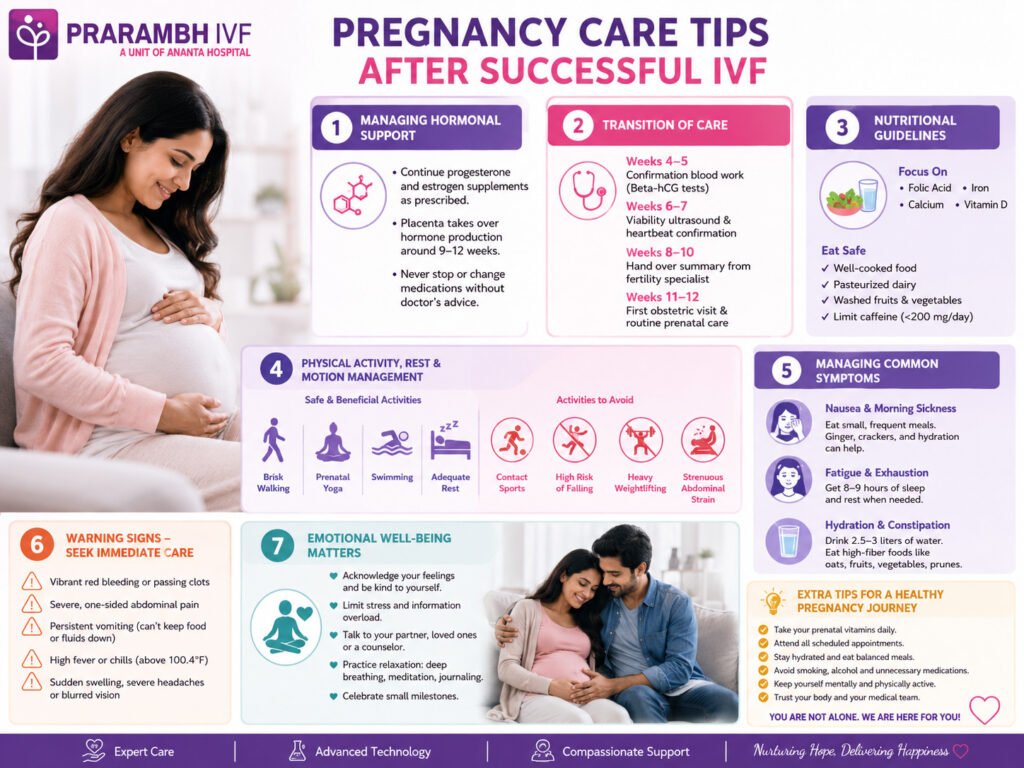
Seeing a positive result on a blood pregnancy test (Beta-hCG) after an In Vitro Fertilization (IVF) cycle is a moment of unparalleled joy, relief, and profound emotion. For many couples, this milestone represents the culmination of months, or even years, of hope, resilience, and medical dedication. It signifies that the first major hurdle of your fertility journey has been beautifully crossed.
However, at Prarambh IVF and Women’s Hospital, we understand that a positive pregnancy test also brings a new wave of questions and natural anxiety. Because an IVF pregnancy involves advanced laboratory assistance and close hormonal support, patients often wonder if their day-to-day prenatal care should differ from a natural pregnancy.
While an IVF pregnancy progresses similarly to a natural conception once fully established, the first trimester requires unique, careful management. This comprehensive guide outlines the essential pregnancy care tips, hormonal milestones, nutritional strategies, and emotional checkpoints you need to know to safeguard your health and your baby’s development.
1. The Critical First Trimester: Managing Hormonal Support
The most immediate difference between an IVF pregnancy and a naturally conceived pregnancy lies in how your hormonal ecosystem is maintained during the early weeks.
Understanding Progesterone and Estrogen Support
In a natural pregnancy, the structure left behind after ovulation (the corpus luteum) automatically produces the progesterone required to thicken the uterine lining and sustain the early embryo. In many IVF cycles—particularly Frozen Embryo Transfers (FET) or cycles utilizing downregulation—your natural ovulation may have been suppressed.
Therefore, your body relies completely on exogenous hormonal supplements to maintain the pregnancy.
- The Timeline: You will continue taking your prescribed progesterone (via vaginal gels, suppositories, or oral tablets) and estrogen supplements exactly as directed by your fertility specialist.
- The Placental Shift: Around weeks 9 to 12 of pregnancy, the developing placenta naturally takes over the production of these vital hormones. At Prarambh IVF and Women’s Hospital, we perform careful blood tests and ultrasounds during this window to safely and gradually ease you off these medications.
A Definite Rule for Safety: Never alter, skip, or abruptly stop your hormonal medications without explicit instructions from your fertility specialist. These supplements are the biological anchor of your early pregnancy.
2. Transitioning from Fertility Specialist to Obstetrician
One of the unique emotional adjustments after a successful IVF cycle is moving on from the close daily monitoring of your fertility clinic to the routine care of a general obstetrician.
1.Confirmation Blood Work:Weeks 4–5.
Serial Beta-hCG blood tests are performed 48 hours apart to ensure your pregnancy hormone levels are rising optimally.
2.The Viability Ultrasound:Weeks 6–7.
A high-resolution ultrasound is conducted at our clinic to confirm the location of the pregnancy (ruling out ectopic risks), verify the gestational sac, and listen to the early fetal heartbeat.
3.The Milestone Graduation:Weeks 8–10.
Once steady fetal growth is established, your fertility specialist will prepare a detailed medical summary of your IVF cycle, laboratory protocols, and medication history.
4.First Obstetric Prenatal Visit:Weeks 11–12.
You formally transition to your obstetrician for routine antenatal care, including regular physical exams, blood pressure monitoring, and your first-trimester genetic screening (NT scan).
3. Nutritional Guidelines for an IVF Pregnancy
Fueling your body with dense, high-quality nutrients supports placental development and cellular growth. Your dietary choices during an IVF pregnancy should focus on stability, food safety, and targeted micronutrients.
Essential Micronutrients to Prioritize
- Folic Acid (Folate): Crucial during the first trimester to prevent neural tube defects (spinal cord abnormalities). Ensure you take your prescribed prenatal vitamins containing at least 400–800 mcg of folic acid daily.
- Iron: As your pregnancy progresses, your total blood volume will expand significantly to supply oxygen to your baby. Iron-rich foods (lean meats, leafy green spinach, legumes, and beans) paired with Vitamin C help prevent prenatal anemia.
- Calcium and Vitamin D: Vital for the structural development of your baby’s bones and teeth. If your dietary intake of dairy, tofu, or fortified plant milks is low, our team will evaluate your levels to recommend safe supplementation.
Strict Food Safety Rules to Prevent Infections
Because pregnancy mildly alters your immune system, preventing foodborne illnesses is paramount. Avoid the following risk factors:
- Raw or Undercooked Proteins: Avoid raw eggs, sushi, unpasteurized dairy products, and soft cheeses (like blue cheese or feta) which can carry Listeria or Salmonella.
- Thoroughly Wash Produce: Ensure all raw vegetables and fruits are scrubbed meticulously to eliminate soil-born parasites like Toxoplasma.
- Limit Caffeine: Keep your total daily caffeine consumption under 200 mg (roughly one standard cup of brewed coffee) to optimize placental blood flow.
4. Physical Activity, Rest, and Motion Management
A successful embryo transfer does not mean you must spend the next nine months on strict bed rest. In fact, gentle physical movement improves circulation, reduces pregnancy-induced constipation, boosts your mood, and prepares your body for labor.
Safe and Low-Impact Exercises
If your obstetrician clears you for activity, aim for 30 minutes of gentle, low-impact exercise most days of the week:
- Brisk Walking: An excellent, highly safe cardiovascular activity that keeps your joints flexible without causing sudden jars.
- Prenatal Yoga: Focuses on controlled breathing, gentle stretching, and pelvic floor strengthening while avoiding deep twists or lying flat on your back past the first trimester.
- Swimming: The natural buoyancy of water relieves the pressure on your lower back and pelvis as your belly grows.
Activities to Avoid
Steer completely clear of contact sports, activities with a high risk of falling (like horseback riding or cycling on uneven terrain), heavy weightlifting, and any exercise that involves high-intensity abdominal straining. Listen closely to your body: if you experience dizziness, shortness of breath, or pelvic discomfort, stop immediately and rest.
5. Managing Common Early Pregnancy Symptoms
An IVF pregnancy will bring about the standard physical symptoms caused by surging pregnancy hormones. Managing these effectively keeps you comfortable during the early months.
Nausea and Morning Sickness
Despite its name, morning sickness can strike at any hour of the day.
- Management: Eat small, frequent meals throughout the day rather than three large ones to keep your stomach from becoming completely empty. Keep plain crackers by your bedside to eat before sitting up in the morning. Ginger tea or natural ginger candies can also help settle mild nausea.
Fatigue and Exhaustion
Your body is working at an accelerated metabolic rate to build a complex life-support system for your baby. Combined with the sedating effects of progesterone supplements, deep fatigue is completely normal.
- Management: Prioritize 8 to 9 hours of sleep per night and allow yourself the grace to take short, 20-minute naps during the day when your body demands it.
Hydration and Constipation
Progesterone naturally slows down your digestive tract to maximize nutrient absorption for the embryo, which can frequently lead to constipation.
- Management: Drink at least 2.5 to 3 liters of water daily. Increase your intake of high-fiber foods, such as whole grains, oats, prunes, and fresh vegetables. Never take over-the-counter laxatives without consulting your doctor.
6. Warning Signs You Should Never Ignore
While minor aches, light cramping, and stretching sensations in the lower abdomen are normal signs of your uterus expanding, there are specific symptoms that require immediate clinical evaluation.
At Prarambh IVF and Women’s Hospital, we instruct our patients to contact our emergency care line or visit the nearest emergency medical room immediately if they notice any of the following:
- Vibrant Red Vaginal Bleeding: While light spotting or brownish discharge can sometimes occur during early implantation or after a vaginal ultrasound, bright red bleeding or passing clots requires an immediate ultrasound evaluation.
- Severe, One-Sided Abdominal Pain: Sharp, persistent pain concentrated on one side of your lower abdomen could indicate an ovarian cyst twist or an ectopic pregnancy, requiring swift medical tracking.
- Persistent, Inconsolable Vomiting: If you cannot keep fluids or food down for more than 24 hours, you may be experiencing Hyperemesis Gravidarum, which requires intravenous hydration to protect your electrolyte balance.
- High Fever or Chills: A body temperature exceeding 100.4°F (38°C) should be evaluated to identify and treat underlying systemic infections promptly.
- Sudden Swelling or Severe Headaches: In the second or third trimester, a sudden swelling of the face or hands, accompanied by blurred vision or a persistent headache, can be an early indicator of Preeclampsia (pregnancy-induced high blood pressure).
7. Nurturing Your Mental and Emotional Health
The psychological journey of an IVF pregnancy is deeply complex. Couples who have gone through intensive fertility treatments often experience a unique phenomenon known as pregnancy after infertility anxiety. You might find yourself constantly worrying about miscarriage, checking for symptoms, or feeling hesitant to fully celebrate the pregnancy out of fear that something might change.
Cultivating Emotional Peace
- Acknowledge Your Feelings: Give yourself permission to feel a mix of gratitude, anxiety, and vulnerability. Your emotions are a natural response to the intensity of what you have overcome.
- Limit Information Overload: Avoid spending hours reading worst-case scenarios on internet forums. Stick to the evidence-based guidance provided by your healthcare team.
- Consider Specialized Counseling: Speaking with a fertility or prenatal psychologist can provide you with tailored mental frameworks to manage stress, rewrite anxious thoughts, and connect deeply with your pregnancy experience.
Your Continued Support at Prarambh IVF and Women’s Hospital
A successful IVF cycle is the beautiful dawn of a long-awaited chapter. While the medical procedures of the laboratory are complete, our commitment to your health, safety, and ultimate transition into parenthood remains absolute.
At Prarambh IVF and Women’s Hospital, we combine advanced, world-class maternal monitoring infrastructure with a deeply personal, compassionate approach. Our specialized reproductive endocrinologists and dedicated obstetric teams work in perfect alignment to guide you seamlessly through your first trimester, ensuring your hormonal shifts are safely managed, your early scans are thoroughly evaluated, and your transition to routine prenatal care is smooth and stress-free.
You have trusted us to help you begin this journey, and we are honored to watch your family grow. Trust your body, stay connected with your clinical team, and allow yourself to embrace the wonderful path ahead.
Connect with our maternal care team today:
Visit our official website at www.prarambhivf.com to explore our integrated antenatal care packages, book your first-trimester viability scans, or speak with our prenatal care consultants. Let us work together to protect your tomorrow.
