
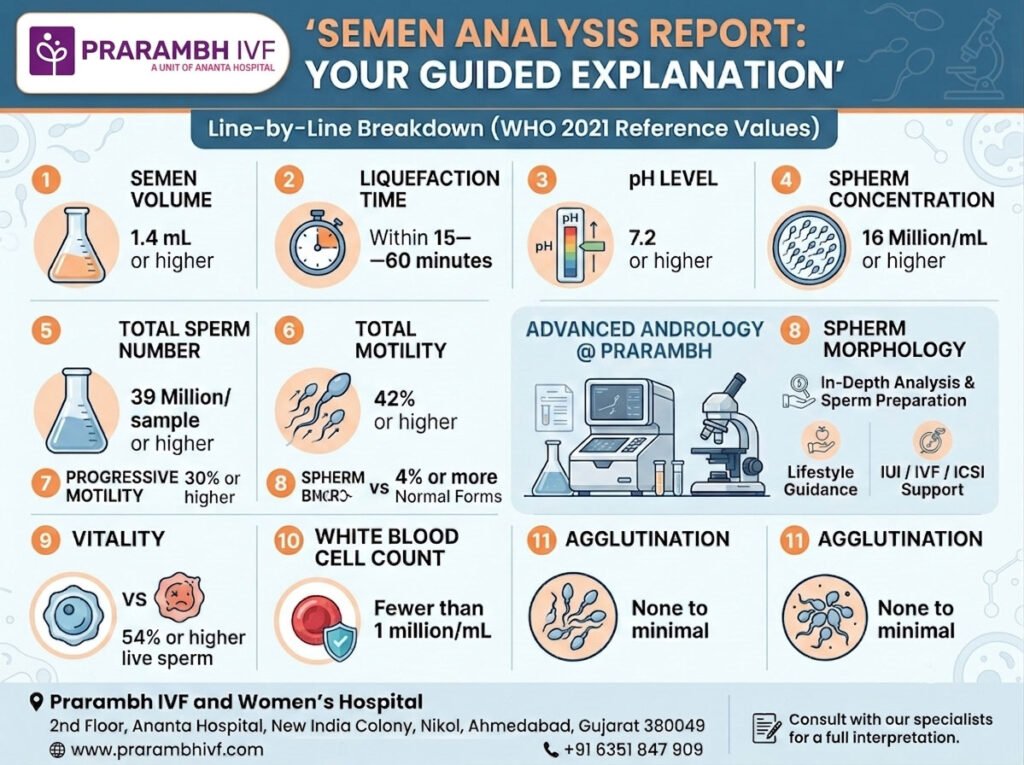
Getting a semen analysis report back can feel like reading a document in a foreign language. Rows of abbreviations, numbers, and reference ranges — with no explanation of what any of it actually means for your fertility. If you’ve just picked up your report and typed “semen analysis normal range” into Google at 11 PM, you’re far from alone.
At Prarambh IVF and Women’s Hospital, semen analysis is one of the very first tests we run for couples starting a fertility evaluation, because male factors contribute to nearly half of all infertility cases. This guide walks through a standard semen analysis report line by line, using the reference ranges set by the World Health Organization (WHO), so you can actually understand what you’re looking at before your next doctor’s appointment.
A quick but important note before we start: one abnormal report is not a diagnosis. Sperm parameters vary naturally from week to week depending on illness, stress, heat exposure, and even how long it’s been since your last ejaculation. Doctors typically ask for two to three samples, spaced a few weeks apart, before drawing any conclusions. Keep that in mind as you read your numbers.
What Is a Semen Analysis, Exactly?
A semen analysis (sometimes called a sperm count test or seminogram) is a laboratory examination of a semen sample under a microscope and through automated analysis systems. It looks at the physical characteristics of the semen itself — volume, color, thickness, and how it behaves after ejaculation — as well as the sperm cells within it: how many there are, how well they move, and whether they’re shaped normally.
The results are usually presented as a table, with each parameter listed alongside your result and a “reference range” or “normal value” for comparison. That reference range is where most of the confusion starts, so let’s go through each line.
1. Semen Volume
What it measures: The total amount of fluid in the sample, measured in millilitres (mL).
Normal range: 1.4 mL or higher (per WHO’s 2021 reference values).
What it means: Semen volume comes mainly from the seminal vesicles and prostate gland, not the testes, so a low volume doesn’t necessarily mean a low sperm count — but it can still affect fertility because there’s simply less fluid to carry sperm toward the cervix. Low volume can result from incomplete sample collection, a short abstinence period before the test, retrograde ejaculation (where semen enters the bladder instead of exiting the body), or blockages in the ejaculatory ducts. Unusually high volume is less common and generally isn’t a fertility concern on its own.
2. Liquefaction Time
What it measures: How long it takes the semen to change from a thick, gel-like consistency to a more liquid form after ejaculation.
Normal range: Within 15–60 minutes at room temperature.
What it means: Fresh semen is naturally thick and clumpy; it liquefies due to enzymes from the prostate. If liquefaction takes significantly longer than 60 minutes, it can sometimes interfere with sperm movement and may point to a prostate-related issue, though it’s often a minor, isolated finding.
3. pH Level
What it measures: How acidic or alkaline the semen is.
Normal range: 7.2 or higher (semen is naturally slightly alkaline).
What it means: A pH outside the normal range can hint at problems with the seminal vesicles or prostate. A low pH combined with low volume, for instance, sometimes points toward a blockage or absence of the vas deferens or seminal vesicles.
4. Sperm Concentration (Sperm Count)
What it measures: The number of sperm present per millilitre of semen.
Normal range: 16 million sperm per mL or higher.
What it means: This is usually the number people focus on the most, and it’s often referred to informally as “sperm count.” A concentration below the normal threshold is called oligozoospermia. It’s worth noting that concentration alone doesn’t tell the whole story — a man can have a normal sperm count but still face fertility challenges if motility or morphology (covered below) are poor, and vice versa.
5. Total Sperm Number
What it measures: The total number of sperm in the entire ejaculate (concentration multiplied by volume).
Normal range: 39 million sperm or higher, per sample.
What it means: This figure combines volume and concentration into a single number and is considered a more complete picture than concentration alone, since a low total count can result from either a low concentration, a low volume, or both together.
6. Total Motility
What it measures: The percentage of sperm in the sample that are moving at all, regardless of direction.
Normal range: 42% or higher.
What it means: Motility is about movement, not quantity. A sample can have a healthy sperm count but still face fertility challenges if too few of those sperm are actually mobile. Low total motility is called asthenozoospermia.
7. Progressive Motility
What it measures: The percentage of sperm moving efficiently in a fairly straight line or in large circles — the kind of movement needed to travel through the cervix and reach the egg.
Normal range: 30% or higher.
What it means: This is arguably more clinically meaningful than total motility, because sperm that move erratically or in tight little circles are far less likely to complete the journey to the egg, even if they’re technically “moving.” Doctors often look at progressive motility specifically when deciding between treatments like IUI and IVF/ICSI.
8. Sperm Morphology (Shape)
What it measures: The percentage of sperm with a normal size and shape — an oval head, a properly attached midpiece, and a single straight tail.
Normal range: 4% or more sperm with normal forms (using WHO’s strict Kruger criteria).
What it means: This number often alarms patients because it looks shockingly low compared to other parameters — even fertile men frequently have well over 90% of their sperm classified as “abnormal” in shape. That’s expected, because morphology is assessed under extremely strict criteria. A result below 4% is called teratozoospermia and may reduce the sperm’s ability to fertilize an egg naturally, but it doesn’t rule out pregnancy, especially with assisted techniques like ICSI, where a single well-formed sperm is selected and injected directly into the egg.
9. Vitality (Live Sperm Percentage)
What it measures: The percentage of sperm that are alive, as opposed to immotile because they are dead.
Normal range: 54% or higher.
What it means: This test matters mainly when total motility is low — it helps distinguish between sperm that are alive but simply not moving well (which may still be usable for treatments like ICSI) versus sperm that are actually dead. Low vitality is called necrozoospermia.
10. White Blood Cell (WBC) Count
What it measures: The number of white blood cells present in the semen sample.
Normal range: Fewer than 1 million per mL.
What it means: A high WBC count can indicate infection or inflammation somewhere in the reproductive tract, sometimes called leukocytospermia. This is worth investigating further, and treating it (usually with antibiotics if an infection is confirmed) can sometimes improve other semen parameters.
11. Agglutination and Aggregation
What it measures: Whether sperm are clumping together, either sperm-to-sperm (agglutination) or sperm sticking to other cells or debris (aggregation).
Normal range: None to minimal.
What it means: Significant agglutination can sometimes point toward an immune response against sperm (anti-sperm antibodies), which can interfere with movement and fertilization.
Putting It All Together: What Your Report Doesn’t Tell You
Here’s something important that a standard semen analysis report will never show you directly: it doesn’t test for sperm DNA fragmentation — the genetic integrity of the sperm’s DNA. A man can have completely normal count, motility, and morphology and still have high DNA fragmentation, which can contribute to unexplained IVF failure or early miscarriage. If you and your partner have had repeated unsuccessful cycles despite a “normal” semen analysis, this is a test worth asking your fertility specialist about.
Similarly, a single abnormal report is rarely the end of the story. Sperm production takes roughly 74 days, so lifestyle changes — quitting smoking, reducing alcohol, managing stress, avoiding excessive heat exposure (like hot tubs or laptops on the lap for long periods), and improving diet — can genuinely shift these numbers over a couple of months. That’s part of why doctors ask for repeat testing before making any treatment decisions.
When Should You See a Specialist?
You don’t need to wait for a red flag to get a baseline semen analysis. It’s generally recommended if:
- You and your partner have been trying to conceive for 12 months without success (or 6 months if your partner is over 35)
- You have a known history of testicular injury, surgery, infection, or undescended testicles
- You’re planning a vasectomy reversal or want to check fertility status before starting a family
- A previous report showed abnormal values and you want a repeat test or a second opinion
How Prarambh IVF and Women’s Hospital Can Help
Reading your own report line by line is a good first step, but interpreting it in the context of your full medical history — and deciding what, if anything, needs to happen next — is where a specialist consultation matters. At Prarambh IVF and Women’s Hospital, our andrology services include detailed semen analysis, sperm preparation techniques, and where needed, advanced testing like sperm DNA fragmentation analysis, along with tailored treatment plans ranging from lifestyle and medical management to IUI, IVF, and ICSI.
If you have a semen analysis report in hand and aren’t sure what it means for your fertility journey, we’re happy to walk through it with you.
📍 Prarambh IVF and Women’s Hospital 2nd Floor, Ananta Hospital, New India Colony, Nikol, Ahmedabad, Gujarat 380049 🌐 www.prarambhivf.com 📧 info@prarambhivf.com 📞 +91 6351 847 909
Frequently Asked Questions
Q1. Is a low sperm count always a sign of infertility? Not necessarily. A low count reduces the statistical odds of natural conception per cycle, but many men with counts below the normal range still father children naturally, and many more do so with assisted reproductive techniques.
Q2. How soon can I retest after an abnormal semen analysis result? Since sperm take about 2.5 months to fully develop, most doctors recommend waiting at least 2–3 weeks before a repeat test, and ideally allowing 2–3 months if you’re making lifestyle changes to see their effect.
Q3. Does a normal semen analysis rule out male infertility? Not completely. Standard analysis doesn’t check for sperm DNA fragmentation or certain functional issues, which is why some couples with “normal” reports still experience unexplained infertility or IVF failure.
Q4. How many days of abstinence are needed before a semen analysis? WHO guidelines recommend 2–7 days of ejaculatory abstinence before the test, as both very short and very long abstinence periods can skew results.
Q5. Can lifestyle changes actually improve semen parameters? Yes, in many cases. Quitting smoking, limiting alcohol, managing weight, reducing scrotal heat exposure, and improving sleep and diet have all been linked to measurable improvements in sperm parameters over a few months.
This article is for general educational purposes and does not replace a personal medical consultation. Reference ranges are based on WHO’s 6th edition (2021) laboratory manual for semen examination; always interpret your specific report with your treating doctor.
