
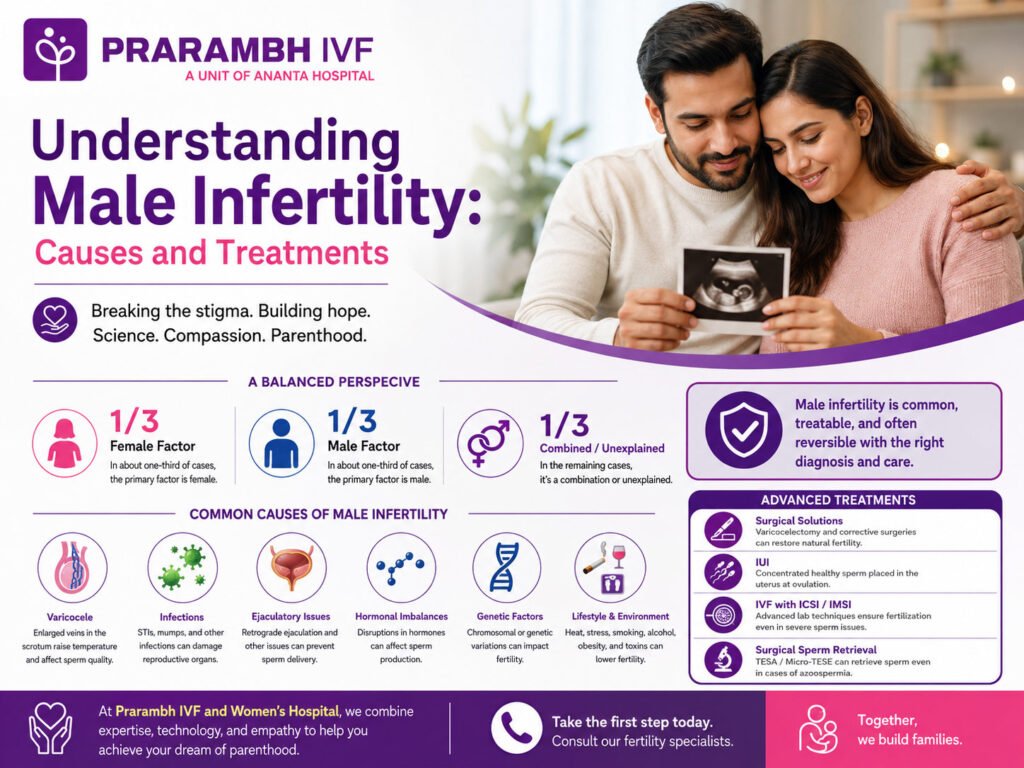
When couples face difficulties conceiving a child, historical and social stigmas have unfortunately tended to place the focus primarily on the female partner. However, modern reproductive medicine paint a completely different, balanced picture. Clinically, infertility is a shared journey. Statistics show that in approximately one-third of all infertility cases, the primary factor rests with the female; in another third, it rests with the male; and in the remaining third, it is a combination of both or remains unexplained.
At Prarambh IVF and Women’s Hospital, our goal is to break down these outdated stigmas with scientific clarity and clinical empathy. Male infertility is a common, highly treatable medical condition. Understanding its root biological causes is the first and most empowering step a couple can take toward achieving a healthy pregnancy.
This comprehensive guide serves to demystify male reproductive health, detailing how male infertility is diagnosed, its underlying medical causes, and the advanced clinical treatments available to help you build your family.
1. The Biology of Male Fertility: A Complex Cellular Journey
To understand why male infertility occurs, it is helpful to look at the intricate biological process required to produce and deliver healthy sperm. Unlike a female, who is born with a finite lifetime egg reserve, a healthy male produces millions of new sperm cells every single day in a process called spermatogenesis.
This cycle takes approximately 64 to 72 days from start to finish and relies on a delicate sequence of events:
- Hormonal Stimulation: The brain’s hypothalamus and pituitary gland must produce exact levels of hormones (FSH and LH) to signal the testicles to produce testosterone and sperm.
- Healthy Production: The testicles must function optimally to produce sperm that are structurally normal and capable of movement.
- Unobstructed Transport: Once produced, sperm travel through a complex network of delicate tubes (the epididymis and vas deferens), where they mix with fluid from the seminal vesicles and prostate gland to form semen before ejaculation.
If a disruption occurs at any point along this multi-step pathway—whether hormonal, structural, or genetic—it can result in a reduction of fertility potential.
2. When to Seek a Male Fertility Evaluation
At Prarambh IVF and Women’s Hospital, we recommend a comprehensive, simultaneous fertility evaluation for both partners if a couple has been actively trying to conceive without success for:
- 12 months if the female partner is under the age of 35.
- 6 months if the female partner is age 35 or older.
When to Seek Immediate Testing: A male partner should not wait for these timelines to pass if he has a known medical history of undescended testicles during childhood, pelvic or groin trauma, previous testicular surgeries, erectile or ejaculatory dysfunction, or a history of cancer treatments. Early evaluation saves time, reduces emotional stress, and preserves reproductive options.
3. The Cornerstone of Diagnosis: Semen Analysis Decoded
When a patient visits Prarambh IVF and Women’s Hospital for a fertility assessment, the primary diagnostic tool is a non-invasive Semen Analysis. This simple laboratory test evaluates the physical and cellular characteristics of an ejaculated semen sample against standard parameters established by the World Health Organization (WHO).
Understanding these key parameters helps pinpoint the exact nature of a male fertility factor:
Sperm Count (Concentration)
This measures the number of sperm cells present in a single milliliter of semen. A normal sperm count is typically 15 million sperm or more per milliliter.
- Oligospermia: A condition characterized by a lower-than-normal sperm count (less than 15 million/mL).
- Azoospermia: The complete absence of sperm cells in the ejaculated semen. This can be caused by a physical blockage (obstructive) or a severe production failure within the testicles (non-obstructive).
Sperm Motility (Movement)
To successfully fertilize an egg, sperm must be capable of traveling forward through the female reproductive tract. This metric tracks the percentage of active, moving sperm. Ideally, 40% or more of the sperm cells should exhibit healthy motility, with at least 32% showing progressive forward movement. Low motility is clinically referred to as Asthenozoospermia.
Sperm Morphology (Shape and Structure)
The physical structure of a sperm cell is vital to its ability to penetrate and fertilize an egg. Under a high-powered microscope, a normal sperm cell has an oval head and a single, long tail. According to strict Kruger criteria, a sample is considered normal if at least 4% of the sperm display ideal structure. An elevated percentage of abnormally shaped sperm is known as Teratozoospermia.
4. Primary Causes of Male Infertility
Male infertility rarely stems from a single, generic source. Instead, it is usually categorized into structural, hormonal, genetic, or lifestyle-driven medical conditions.
A. Varicocele: The Most Common Reversible Cause
A varicocele is an enlargement or swelling of the veins within the scrotum, very similar to varicose veins that develop in the legs. Varicoceles affect roughly 15% of all men, but are found in up to 40% of men experiencing primary infertility.
- The Biological Impact: These enlarged veins cause blood to pool in the scrotum, raising the local temperature surrounding the testicles. Because healthy sperm production requires an environment that is roughly 1°C to 2°C cooler than core body temperature, this chronic heat stress degrades both sperm count and quality.
B. Infections and Inflammatory Conditions
Infections can interfere with sperm production, degrade sperm health, or cause localized scarring that blocks the transport of semen.
- Sexually Transmitted Infections (STIs): Conditions like chlamydia or gonorrhea can cause severe inflammation of the epididymis (epididymitis) or testicles (orchitis).
- Mumps Orchitis: Contracting the mumps virus during or after puberty can cause severe, permanent inflammatory damage to the sperm-producing cells within the testicles.
C. Retrograde Ejaculation and Ejaculatory Issues
In a standard ejaculation, the bladder neck closes tightly, forcing semen forward out of the urethra. In cases of retrograde ejaculation, the bladder sphincter fails to close properly, causing semen to travel backward into the urinary bladder during an orgasm. This can be caused by diabetes, spinal cord injuries, or certain medications.
D. Hormonal Imbalances
While less common than female hormonal disorders, deficiencies in the endocrine system can severely disrupt spermatogenesis. If the pituitary gland fails to produce adequate amounts of Luteinizing Hormone (Hormone LH) and Follicle-Stimulating Hormone (Hormone FSH), the testicles lack the chemical signals required to produce testosterone and mature sperm.
E. Genetic Variations and Chromosomal Factors
Some forms of severe male infertility are rooted in a patient’s genetic profile. Conditions such as Klinefelter Syndrome (where a male is born with an extra X chromosome, XXY) or microdeletions on the Y chromosome can cause severe testicular underdevelopment, resulting in very low sperm counts or non-obstructive azoospermia.
5. Lifestyle, Environmental, and Unexplained Factors
The delicate process of daily sperm development is highly sensitive to external variables and behavioral habits. At Prarambh IVF and Women’s Hospital, we actively work with patients to identify and correct daily stressors that may be suppressing their reproductive health.
Exposure to Excess Heat
Frequent use of hot tubs, saunas, laptops placed directly on the lap for prolonged periods, or working in high-temperature industrial environments can raise scrotal temperatures enough to cause a temporary but noticeable drop in sperm production.
Substance Use and Medications
- Anabolic Steroids: Taking exogenous testosterone or anabolic steroids to build muscle mass is one of the most severe, yet completely preventable, causes of male infertility. It sends a feedback signal to the brain to halt natural hormone production, effectively shutting down sperm production entirely.
- Smoking and Alcohol Consumption: Chronic smoking introduces toxins that induce high levels of oxidative stress, damaging sperm DNA. Excessive alcohol use can lower testosterone levels and impair sperm parameters.
Obesity and Metabolic Health
An elevated Body Mass Index (BMI) causes hormonal shifts, frequently converting testosterone into estrogen. This hormonal imbalance reduces sperm count and can contribute to erectile dysfunction.
6. Advanced Clinical Treatments for Male Infertility
An infertility diagnosis is simply a starting point for a targeted, highly scientific medical strategy. Modern reproductive science offers an array of effective interventions tailored to the specific cause of a male fertility factor.
A. Surgical Repair of Varicocele (Varicocelectomy)
If a physical exam or scrotal ultrasound confirms that a significant varicocele is degrading your sperm parameters, a minimally invasive microscopic surgical procedure called a varicocelectomy can be performed. By safely tying off the enlarged veins, blood flow is redirected to healthy veins, normalizing scrotal temperature. Within 3 to 6 months post-surgery, a majority of patients show a significant improvement in sperm concentration and motility.
B. Assisted Reproductive Technologies (ART)
When sperm counts or motility are significantly lower than standard thresholds, or when lifestyle changes do not yield adequate improvements, advanced laboratory procedures provide exceptional success rates.
1.Intrauterine Insemination (IUI):Mild to Moderate Factors.
A semen sample is collected and processed in our laboratory to isolate the most active, healthy sperm. This concentrated sample is then placed directly inside the woman’s uterus using a thin catheter at the exact moment of ovulation, reducing the distance the sperm must travel.
2.In Vitro Fertilization (IVF) with ICSI:Severe Sperm Factors.
When sperm counts are exceptionally low or morphology is poor, standard IVF is upgraded with Intracytoplasmic Sperm Injection (ICSI). Our embryologists use micro-manipulators to select a single, structurally perfect sperm cell and inject it directly into a mature harvested egg, achieving reliable fertilization.
3.Intracytoplasmic Morphologically Selected Sperm Injection (IMSI):Advanced Selection.
For couples facing recurrent IVF failures or severe teratozoospermia, IMSI utilizes ultra-high-magnification digital lenses to view sperm at up to 6,000x magnification. This allows us to inspect internal structures and choose sperm entirely free of subtle structural defects.
C. Advanced Surgical Sperm Retrieval (For Azoospermia)
For men diagnosed with azoospermia (zero sperm in the ejaculate), achieving biological fatherhood is still entirely possible through micro-surgical sperm retrieval. Even when sperm are absent in semen, viable sperm cells can frequently be found tucked away inside the testicular tissues.
Our specialized reproductive urologists perform these precise, minimally invasive procedures under local or light sedation:
- TESA (Testicular Sperm Aspiration): A fine needle is gently passed into the testicle to aspirate fluid and tissue samples, which are immediately analyzed under a laboratory microscope by an embryologist to extract live sperm.
- Micro-TESE (Microscopic Testicular Sperm Extraction): For patients with non-obstructive azoospermia, an operating microscope is used to precisely scan the internal tissue of the testicle. This allows the surgeon to identify and harvest only the specific, widened tubules most likely to contain active sperm, minimizing tissue loss.
Sperm cells retrieved via TESA or Micro-TESE are immediately paired with ICSI to fertilize the female partner’s eggs, turning what was once considered absolute sterility into a highly successful pathway to parenthood.
Your Path Forward at Prarambh IVF and Women’s Hospital
Male infertility is a common, understandable, and deeply manageable medical condition. It is a biological challenge that can be precisely mapped, analyzed, and overcome using modern reproductive technologies. Navigating this process requires stepping away from isolation or self-doubt and stepping into an atmosphere of expert clinical care.
At Prarambh IVF and Women’s Hospital, we provide a safe, respectful, and highly confidential environment for men and couples to explore their reproductive health. We combine cutting-edge andrological diagnostic suites and advanced embryology infrastructure with a warm, empathetic clinical team that guides you clearly through every milestone of your treatment.
You do not have to navigate fertility questions or roadblocks in isolation. Our team of reproductive endocrinologists, specialized andrologists, and compassionate fertility coordinators is here to design a personalized roadmap that honors your unique health goals.
Take the first step toward clarity today:
Visit our official website at www.prarambhivf.com to schedule a private, thorough, and highly confidential andrology consultation. Together, we can find the right path forward to bring your dream of family to life.
