
Every 35 seconds, an IVF baby is born somewhere in the world. While many people are familiar with the general concept of In Vitro Fertilization (IVF), few know what actually happens behind the closed doors of the embryology laboratory.
The journey to parenthood through IVF starts with two key components—one healthy egg and one active sperm—meeting in a carefully controlled lab environment.
In this edition of our IVF Jagruti Series, Dr. Komal Unadkat (IVF Specialist & Fertility Expert at Prarambh IVF) explains the step-by-step process of sperm preparation, fertilization techniques (Traditional IVF vs. ICSI), and initial embryo growth.
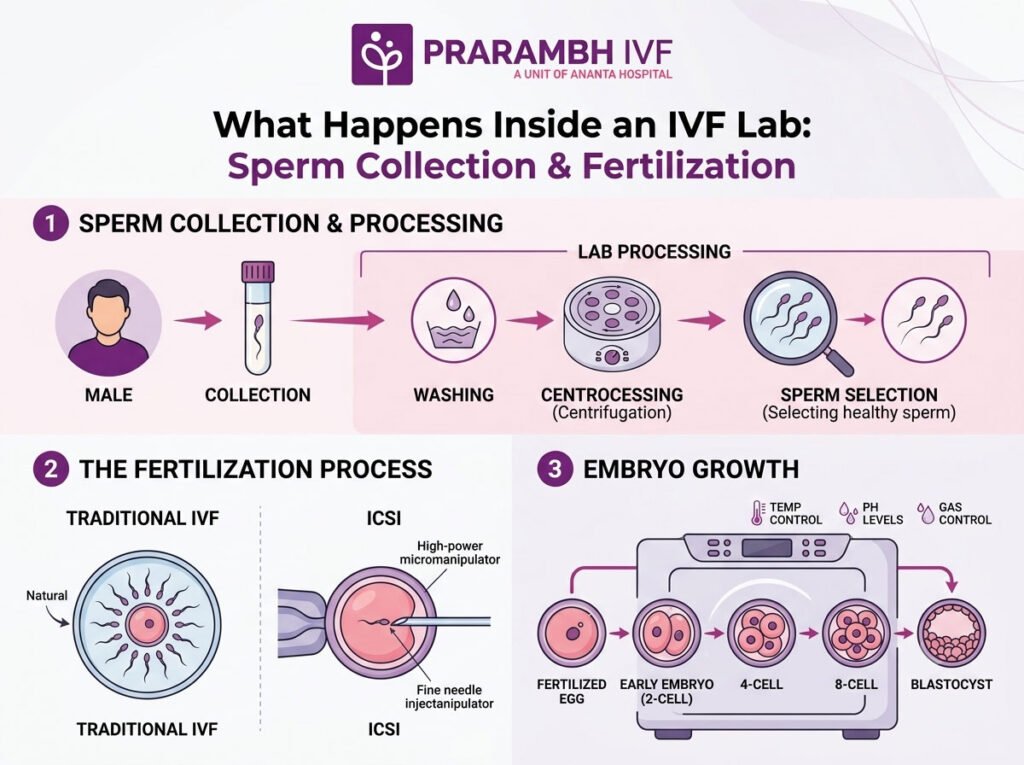
Step 1: Sperm Collection and Processing
Once mature eggs are retrieved and safely placed in the lab, the next crucial step is securing a healthy sperm sample from the partner.
- Comfort & Privacy: The semen sample is collected in a private, clean, and comfortable setting within the hospital premises.
- Immediate Processing: The sample is immediately transferred to the lab to preserve sperm viability.
- Sperm Washing & Selection: In the lab, technicians process the semen to filter out inactive or poor-quality sperm, selecting only the healthiest and most active sperms. Better sperm quality directly translates to a higher chance of successful fertilization and pregnancy.
Step 2: The Magic Moment of Fertilization
Fertilization is the pivotal phase where science meets hope. Depending on the couple’s specific fertility needs and sperm quality, embryologists choose one of two primary fertilization methods:
1. Traditional IVF
- How it works: Thousands of prepared, high-quality sperm are placed around a single egg in a culture dish.
- The Process: Fertilization happens naturally inside the dish as the strongest sperm penetrates the egg on its own.
2. ICSI (Intracytoplasmic Sperm Injection)
- How it works: A single, healthiest sperm is selected under a high-power microscope and directly injected into the center of the egg using precision instruments.
- When it’s used: ICSI is primarily recommended when sperm count, motility, or morphology is low, or in cases of previous IVF fertilization failure.
Step 3: Embryo Formation and Early Growth
Once fertilization successfully occurs, an embryo is formed—marking the very beginning of a new life.
The newly formed embryo is not immediately transferred into the uterus. Instead, it is nurtured in specialized lab incubators that strictly replicate the environment of the human body (maintaining precise temperature, pH, and gas levels). The embryo is monitored as it divides and grows before the final transfer stage.
Final Thoughts
Understanding the science behind IVF helps demystify the treatment process and reduces anxiety for couples on their fertility journey. Every step taken inside the lab brings aspiring parents one step closer to holding their baby.
Have Questions About IVF or Fertility Treatments?
At Prarambh IVF, we believe in guiding you through every stage of your parenthood journey with clarity, care, and advanced reproductive technology.
- 📍 Location: 2nd Floor, Ananta Hospital, Nr. Shaheed Maj. Rushikesh Ramani Garden, Nikol, Ahmedabad – 382350
- 📞 Contact Us: +91 63518 47909
- 🌐 Follow Us: Stay tuned for the next part of our IVF Jagruti Series where we discuss how embryos grow and how they are transferred into the uterus!
