
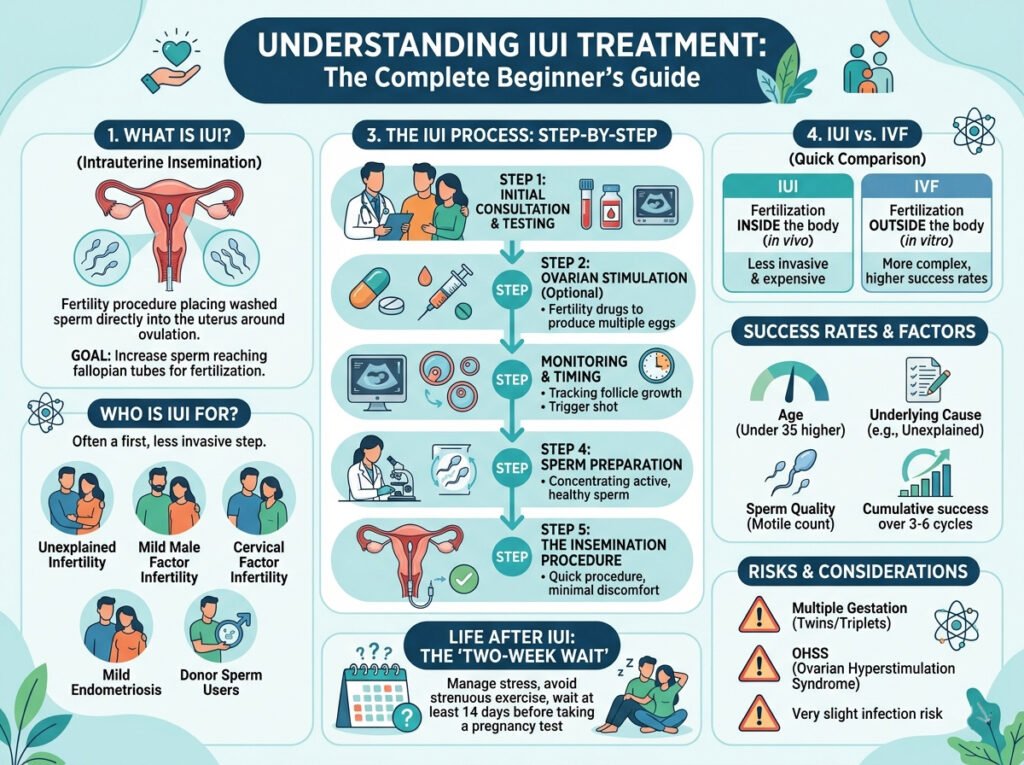
Embarking on a journey toward parenthood is a deeply personal and transformative experience. For many couples facing challenges with natural conception, Intrauterine Insemination (IUI) serves as a hopeful and effective first step in fertility treatment.
In this guide, we will break down everything you need to know about IUI—from the initial procedure to success rates and what to expect during the process.
1. Understanding IUI: What Exactly is It?
Intrauterine Insemination (IUI), often referred to as artificial insemination, is a fertility procedure where specially prepared (washed) sperm is placed directly into a woman’s uterus around the time of ovulation.
The primary goal of IUI is to increase the number of sperm that reach the fallopian tubes, thereby increasing the chance of fertilization. By bypassing the cervix and placing the sperm higher up in the reproductive tract, IUI gives the sperm a “head start.”
2. Who is IUI For? (Indications for Treatment)
IUI is often the first line of treatment because it is less invasive and more affordable than In Vitro Fertilization (IVF). It is commonly recommended for:
- Unexplained Infertility: When no clear cause for infertility is found after testing.
- Mild Male Factor Infertility: If there are slight issues with sperm count or motility.
- Cervical Factor Infertility: If the cervical mucus is too thick or hostile to sperm.
- Endometriosis: For mild cases of endometriosis where the fallopian tubes are not blocked.
- Semen Allergy: In rare cases where a woman has an allergy to proteins in semen.
- Donor Sperm: For single women or couples requiring donor sperm.
3. The IUI Process: A Step-by-Step Walkthrough
Understanding the timeline of an IUI cycle can help alleviate the anxiety of the unknown. Here is the typical journey:
Step 1: Initial Consultation and Testing
Before starting, our specialists at Prarambh IVF perform a thorough evaluation. This includes blood tests to check hormone levels, an ultrasound to check the health of the ovaries and uterus, and a semen analysis for the partner.
Step 2: Ovarian Stimulation (Optional)
While IUI can be done during a natural menstrual cycle, many doctors prescribe “fertility drugs” (like Clomiphene Citrate or Letrozole) to stimulate the ovaries to produce multiple mature eggs.
Step 3: Monitoring and Timing
Monitoring is crucial. Through transvaginal ultrasounds and blood tests, we track the growth of the follicles. Once the follicles reach the ideal size, a “trigger shot” of hCG (Human Chorionic Gonadotropin) is administered to induce ovulation.
Step 4: Sperm Preparation
On the day of the IUI procedure, the male partner provides a semen sample. The lab then “washes” the sperm. This process separates the highly active, healthy sperm from the seminal fluid and debris, concentrating them into a small volume.
Step 5: The Insemination Procedure
The actual IUI is a quick procedure, similar to a pap smear. A thin, flexible catheter is inserted through the cervix into the uterus. The concentrated sperm is then injected directly. The process takes about 5 to 10 minutes and usually causes minimal discomfort.
4. IUI vs. IVF: What’s the Difference?
It is important for beginners to distinguish between IUI and IVF.
- IUI: Fertilization happens inside the body (in vivo). It is less invasive and less expensive.
- IVF: Fertilization happens outside the body (in vitro) in a lab. It is more complex but generally has higher success rates per cycle.
5. Success Rates and Factors
The success rate of IUI depends on several factors, including:
- Age: Women under 35 generally see higher success rates.
- Underlying Cause: Couples with unexplained infertility often have better outcomes than those with severe endometriosis.
- Sperm Quality: The concentration of motile sperm after washing is a key predictor.
- Number of Cycles: Success is often cumulative; many couples find success within 3 to 6 cycles.
6. Risks and Considerations
IUI is generally very safe, but there are a few risks to be aware of:
- Multiple Gestation: If fertility drugs are used, there is a higher chance of twins or triplets.
- OHSS: Ovarian Hyperstimulation Syndrome is a rare side effect of fertility medication where ovaries become swollen and painful.
- Infection: There is a very slight risk of infection following the procedure.
7. Life After IUI: The “Two-Week Wait”
The period between the procedure and the pregnancy test is often the most stressful part. Patients are advised to:
- Avoid strenuous exercise for a few days.
- Continue any prescribed progesterone support.
- Wait at least 14 days before taking a home pregnancy test to avoid a “false positive” from the trigger shot.
8. Why Choose Prarambh IVF for your IUI Journey?
At Prarambh IVF, we combine state-of-the-art technology with a compassionate, personalized approach. We understand that every fertility journey is unique. Our team is dedicated to providing transparent care, ensuring you are informed and supported every step of the way.
