
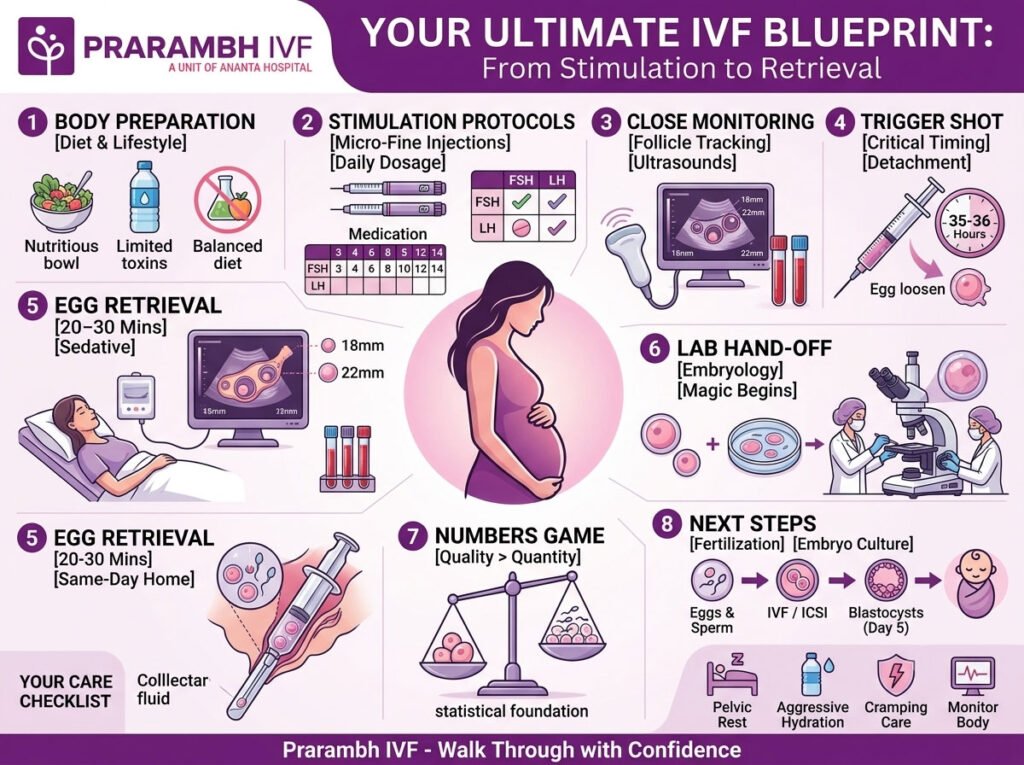
For many couples navigating the emotional landscapes of infertility, deciding to undergo In Vitro Fertilization (IVF) is a powerful, life-altering moment. It represents a concrete path toward building a family, guided by cutting-edge reproductive science. However, it is entirely normal to feel a wave of anxiety alongside that hope. The medical terminology, the strict schedules, and the thought of self-administered injections can make the process feel incredibly overwhelming at first glance.
A very common misconception among patients is that the IVF journey begins entirely inside a laboratory embryology dish, where the egg and sperm are combined. In reality, the foundation of a successful pregnancy is built long before science does its magic under a microscope. It begins within the woman’s body.
The initial active clinical phase of any IVF cycle centers around two critical, interconnected checkpoints: Ovarian Stimulation and Egg Retrieval. At Prarambh IVF and Women’s Hospital, we firmly believe that education, transparency, and physical comfort are paramount to your fertility success. When you truly understand exactly what your body is experiencing, the medical anxiety fades, allowing you to walk through your treatment plan with absolute confidence.
This comprehensive, 2000-word guide serves as your clinical and practical blueprint. It details how to prepare your body for these initial steps, what happens day-by-day, and how to optimize your physical and emotional well-being for the path ahead.
The Biological Philosophy: Why We Must Prepare the Body
To appreciate why the preparation phase is so essential, we must look at the natural, unassisted reproductive cycle of a woman.
The Natural Menstrual Cycle vs. The Controlled IVF Cycle
Every single month, a woman’s ovaries naturally house dozens of microscopic, fluid-filled sacs called antral follicles. Each of these follicles contains a single immature egg. In a typical natural menstrual cycle, the brain releases a specific hormone called Follicle-Stimulating Hormone (FSH). This hormone signals the ovaries to start growing these follicles. However, the human body is naturally optimized to carry only one baby at a time. Therefore, the body selects just one dominant follicle to mature fully and release an egg during ovulation. The remaining follicles recruited for that specific month naturally regress, break down, and are reabsorbed by the body.
In an IVF cycle, the clinical goal shifts significantly. Because not every collected egg will be perfectly mature, not every mature egg will fertilize successfully, and not every fertilized embryo will develop into a robust, high-grade blastocyst, having a higher volume of quality eggs acts as a vital clinical cushion.
Ovarian stimulation does not create new eggs; rather, it uses advanced medical protocols to rescue those extra follicles that would otherwise have dissolved in a natural cycle. It encourages multiple eggs to grow and mature simultaneously, giving you the absolute best statistical chance of achieving a healthy pregnancy.
Phase 1: Ovarian Stimulation – The Injections and Monitoring Protocols
This active phase formally kicks off on day two or day three of your menstrual cycle. You will visit Prarambh IVF and Women’s Hospital for an initial baseline transvaginal ultrasound and blood work. This ensures that your ovaries are completely at rest, there are no residual cysts from a previous cycle, and the uterine lining is thin and ready to start fresh. Once cleared by our fertility specialists, your customized stimulation protocol begins.
The Medication Window: The First 10 to 14 Days
The stimulation phase typically lasts between 10 to 14 days. During this window, you will administer subcutaneous injections. While the word “injections” frequently intimidates patients, the reality is much gentler than most expect:
- Micro-Fine Needles: The injections use extremely small, micro-fine needles, very similar to the insulin pens used by diabetic patients. The physical discomfort is minimal, usually described as a light pinch or a mild stinging sensation that fades within a couple of minutes.
- The Hormonal Fuel: The primary medications consist of concentrated doses of FSH (and sometimes Luteinizing Hormone, or LH). This provides the necessary fuel to prompt multiple follicles to grow uniformly.
- The Ovulation Blocker: Around day 5 or 6 of the stimulation, a second daily injection is introduced to the protocol. The purpose of this medication is to temporarily block your body’s natural surge of LH, preventing the ovaries from releasing the eggs prematurely into the pelvis before our medical team can harvest them.
[Day 1-3: Baseline Scan] ➔ [Day 3-5: FSH Injections Begin] ➔ [Day 6: Ovulation Blocker Added] ➔ [Day 10-14: Trigger Shot Given]
Close Monitoring: The Science of Precision Medicine
During these 10 to 14 days, you will visit our advanced clinic in Ahmedabad every few days for routine follicular tracking. These appointments are highly structured and involve two vital components:
- Transvaginal Ultrasounds: Our fertility specialists carefully measure the growing diameter of each individual fluid-filled follicle on both ovaries. We are looking for the majority of the follicles to reach an optimal maturity range, typically between 18mm and 22mm.
- Hormonal Blood Tests: We closely track your serum Estradiol (E2) levels. Because growing follicles naturally secrete estrogen, monitoring these hormonal spikes tells our clinical team exactly how well your ovaries are responding. This data allows us to dynamically adjust your daily medication dosages, ensuring maximum safety and efficacy.
Managing the Physical and Emotional Toll of Stimulation
As your ovaries respond to the medications, experiencing mild physical changes is a normal, healthy sign that the protocol is working. Because your ovaries temporarily expand in size to accommodate multiple mature follicles, you will likely experience:
- A sensation of pelvic fullness or heaviness.
- Mild to moderate bloating around the lower abdomen.
- Breast tenderness.
- Cyclical mood shifts or fatigue, very similar to an intensified case of Pre-Menstrual Syndrome (PMS).
At Prarambh IVF, we remind our patients that feeling a bit tired or heavy during this period is a positive milestone. It means your body is doing the heavy lifting required to mature your eggs. Rest, gentle movement, and proper self-care are heavily prioritized during this week.
The Critical Bridge: Timing the Trigger Shot
Once the ultrasound monitoring confirms that the maximum number of follicles have reached peak maturity, the daily stimulation injections stop immediately. Your protocol now transitions to the single most time-sensitive medication of the entire cycle: The Trigger Shot.
The trigger shot typically consists of human Chorionic Gonadotropin (hCG) or a GnRH agonist. This injection initiates the final cellular maturation process of the eggs inside the follicles, causing them to detach from the inner follicular wall so they can be smoothly collected.
Timing is absolutely critical. The trigger shot must be taken at the exact hour and minute specified by your clinical team. The subsequent egg retrieval procedure is strictly scheduled 35 to 36 hours after this injection. If the shot is taken too early or too late, the eggs may either remain tightly trapped inside the follicles or be ovulated naturally into the pelvic cavity, making clinical retrieval impossible.
Phase 2: Egg Retrieval – What Happens on the Day of the Procedure
Once the trigger shot has performed its job, you will arrive at the advanced surgical day-care wing of Prarambh IVF and Women’s Hospital for the egg retrieval procedure (medically referred to as follicular aspiration).
While it is normal for patients to feel nervous on this day, understanding the exact timeline and the minimally invasive nature of the procedure can provide significant peace of mind.
[Fast from Midnight] ➔ [Arrival & IV Prep] ➔ [Light Sedation Administered] ➔ [Ultrasound Needle Aspiration (20-30 Mins)] ➔ [Same-Day Discharge]
Step-by-Step Breakdown of the Surgical Day
1. Pre-Operative Preparation and Anesthesia
You will be asked to fast completely (no food, water, or liquids) from the midnight prior to the procedure. Once you are checked into your private room, our medical team will prepare you for the operating room. The procedure is performed under short general anesthesia or light conscious sedation. This ensures that you will sleep peacefully through the entire process and will feel absolutely no pain or discomfort.
2. The Transvaginal Ultrasound-Guided Aspiration
The egg retrieval is an entirely internal procedure. It does not involve any surgical incisions, external cuts, or stitches.
- Our fertility specialist inserts an advanced transvaginal ultrasound probe fitted with a micro-fine needle guide into the vagina.
- The ultrasound allow the doctor to clearly visualize each mature, fluid-filled follicle on a high-definition monitor.
- A very thin, hollow aspiration needle is advanced through the vaginal wall directly into the ovarian follicles.
- A gentle, automated suction pump draws out the follicular fluid, which carries the microscopic egg along with it.
3. The Real-Time Lab Hand-Off
As the fluid is collected from each follicle, the test tubes are immediately passed through a specialized, heated pass-box built directly into the wall connecting the operating theater to our state-of-the-art embryology laboratory. Under a high-powered microscope, our embryologists immediately locate the eggs, isolate them from the fluid, wash them in protective culture media, and place them safely into advanced incubators that perfectly mimic the warm, protective environment of a woman’s fallopian tubes.
4. Recovery and Same-Day Discharge
The entire surgical collection process takes only 20 to 30 minutes from start to finish. Once the retrieval is complete, the sedative medications are reversed, and you will wake up gently in our recovery room.
Most patients remain in the recovery area for approximately 1 to 2 hours until the grogginess of the anesthesia clears completely. Because it is a minimally invasive day-care procedure, you will be discharged to return home the very same day to rest in your own comfortable environment.
The Numbers Game: Understanding Egg Quantity vs. Quality
A very frequent question asked during our clinical consultations at Prarambh IVF is: “How many eggs do I need to get pregnant?”
While online forums often emphasize very high, double-digit numbers, advanced reproductive medicine favors egg quality over sheer quantity. The ideal number of retrieved eggs depends heavily on maternal age, baseline Anti-Müllerian Hormone (AMH) levels, and the underlying cause of infertility.
Generally, retrieving between 8 to 15 mature eggs is considered the optimal clinical sweet spot. This volume provides an excellent statistical foundation for laboratory fertilization and embryo cultivation while keeping the risk of Ovarian Hyperstimulation Syndrome (OHSS) exceptionally low.
It is vital to remember that a lower egg yield does not mean your cycle has failed. It takes only one high-quality egg and one healthy sperm to create a beautiful, genetically viable embryo that leads to a full-term, healthy baby.
What Happens Next? The Magic of the Embryology Laboratory
The successful completion of your egg retrieval marks the conclusion of the first major chapter of your active IVF cycle. The medical baton is now officially passed to our embryology team.
[Retrieved Eggs] + [Partner/Donor Sperm] ➔ [Fertilization (Conventional or ICSI)] ➔ [Blastocyst Culture (Day 5)] ➔ [Embryo Transfer/Freezing]
Within a few hours of collection, the retrieved eggs are evaluated for cellular maturity. The mature eggs are then united with your partner’s (or donor’s) prepared sperm using one of two primary laboratory methods:
- Conventional Insemination: Thousands of active, washed sperm are placed in a specialized dish alongside the mature egg, allowing natural fertilization to take place independently.
- ICSI (Intracytoplasmic Sperm Injection): A highly sophisticated micro-manipulation technique where a senior embryologist selects a single, structurally perfect sperm and injects it directly into the center of the mature egg. This approach is highly recommended for couples dealing with severe male factor infertility, low sperm motility, or structural abnormalities.
Over the next 3 to 5 days, our laboratory team monitors the fertilized eggs as they divide cleanly into cellular embryos, keeping them safe until they reach the advanced blastocyst stage. From there, they are prepared for either a fresh embryo transfer or cryopreserved (frozen) for a future, highly optimized Frozen Embryo Transfer (FET) cycle.
Your Practical Preparation & Recovery Checklist
To ensure your body and mind are completely optimized for the stimulation and retrieval phases, our clinical team at Prarambh IVF has compiled this practical lifestyle checklist:
1. Diet and Cellular Nutrition Optimization
- Embrace Whole Foods: Focus heavily on a nutrient-dense, Mediterranean-style diet. Incorporate plenty of lean proteins (chicken, fish, tofu, lentils), leafy green vegetables, avocados, walnuts, berries, and whole grains to support cellular health and mitochondrial energy within the growing eggs.
- Aggressive Hydration: Drink 2.5 to 3 liters of water and electrolyte-rich fluids daily, particularly during the last 5 days of stimulation. This helps your kidneys flush out excess hormones and drastically reduces the discomfort of bloating.
- Eliminate Toxins: Avoid alcohol completely and limit your caffeine intake to a maximum of one small cup of coffee per day during the active cycle.
2. Strict Medication Protocols
- Prioritize Consistency: Administer your daily subcutaneous injections at the exact same time every single day, ideally within a strict 1-hour window (e.g., every evening between 8:00 PM and 9:00 PM).
- Smart Storage: Check your medication labels carefully. The majority of stimulation hormones are highly temperature-sensitive and must be kept refrigerated between 2°C and 8°C. Do not freeze them.
- Double-Alarm Your Trigger: Set multiple alarms on your phone to guarantee your trigger shot is taken at the exact minute prescribed by your doctor.
3. Post-Retrieval Recovery Care
- Anticipate Mild Cramping: It is completely normal to experience mild pelvic cramping, minor spotting, or a sensation of internal pressure for 24 to 48 hours after the retrieval needle puncture. Over-the-counter pain relievers approved by our doctors can manage this easily.
- Pelvic Rest: Avoid strenuous workouts, heavy lifting, running, or sexual intercourse for at least one week following your retrieval. This allows your expanded ovaries to safely shrink back to their natural size without risk of complications.
- Monitor Your Body: Reach out to our team immediately if you experience sudden, rapid weight gain (more than 1 kg in 24 hours), severe nausea, shortness of breath, or sharp abdominal pain, as these can be early indicators of severe ovarian overresponse.
Why Trust Prarambh IVF and Women’s Hospital?
At Prarambh IVF, located in the heart of Ahmedabad, India, we understand that infertility is never merely a medical diagnosis. It is a deeply personal, emotional, and transformative journey that requires equal parts advanced science and human empathy.
We don’t believe in assembly-line medicine. Every single ovarian stimulation protocol we design is tailored exclusively to the individual patient’s unique ovarian reserve markers, age, metabolic profile, and medical history. Our hospital features international-standard embryology laboratories, cutting-edge high-resolution ultrasound diagnostics, and a team of dedicated fertility experts committed to ensuring you feel safe, supported, and thoroughly heard at every turn.
The path of IVF demands patience, resilience, and excellent science. While the process involves careful scheduling and precise medical steps, remember that every daily injection, every ultrasound monitor scan, and every laboratory phase brings you one step closer to the ultimate dream of holding your baby in your arms.
Frequently Asked Questions (FAQs)
1. Can ovarian stimulation deplete my future egg supply or cause early menopause?
No, this is a very common myth. Every month, a woman’s body naturally recruits a large cohort of immature eggs from her baseline reserve. In a natural cycle, only one grows while the rest naturally degenerate and disappear. Ovarian stimulation simply uses hormones to rescue the eggs that were already destined to be lost that specific month. It does not touch your future egg reserve and will not cause early menopause.
2. Are the daily hormone injections painful to self-administer?
Most patients find that the anticipation of the needle is much worse than the actual injection. Because the needles are micro-fine and designed for simple subcutaneous use right under the skin of the stomach or thigh, the physical pain is minimal. Our specialized nursing team provides hands-on, step-by-step training before your cycle begins so you feel completely confident.
3. How many days off from work will I need for the egg retrieval procedure?
We recommend taking only the day of the egg retrieval procedure off from work. This allows you to go home, rest, and allow the minor grogginess of the light anesthesia to clear your system completely. The vast majority of our patients feel excellent and return to their routine office work and daily activities the very next morning.
4. What is Ovarian Hyperstimulation Syndrome (OHSS), and how is it prevented?
OHSS is a medical complication where the ovaries overrespond to stimulation medications, causing fluid retention and pelvic discomfort. At Prarambh IVF, patient safety is our highest priority. We utilize personalized, low-dose antagonist protocols, close blood monitoring, and modern agonist triggers to virtually eliminate the risk of severe OHSS, ensuring a safe and comfortable treatment experience.
5. What happens if my follicles don’t grow at the same rate?
It is completely normal for follicles to grow at slightly different speeds. During your routine tracking ultrasounds, our fertility specialists monitor the average size distribution. We carefully adjust your medication doses to encourage the smaller follicles to catch up, aiming to harvest the maximum number of mature, uniform eggs during your procedure.
If you are ready to explore your options or have specific questions about your fertility health, connect with us at www.prarambhivf.com or book a personal consultation with our leading specialists at Prarambh IVF and Women’s Hospital today. Your beautiful new beginning starts right here.
