
Did you know that during an IVF cycle, doctors may create multiple embryos, but only the best-quality embryo is selected for transfer?
Selecting the healthiest embryo is one of the most vital steps in an IVF journey, as it directly influences the chances of a successful pregnancy.
In this edition of our IVF Jagruti Series, Dr. Komal Unadkat (IVF Specialist & Fertility Expert at Prarambh IVF) explains how embryos are monitored in the lab, how the best embryo is chosen, and what happens during a painless embryo transfer procedure.
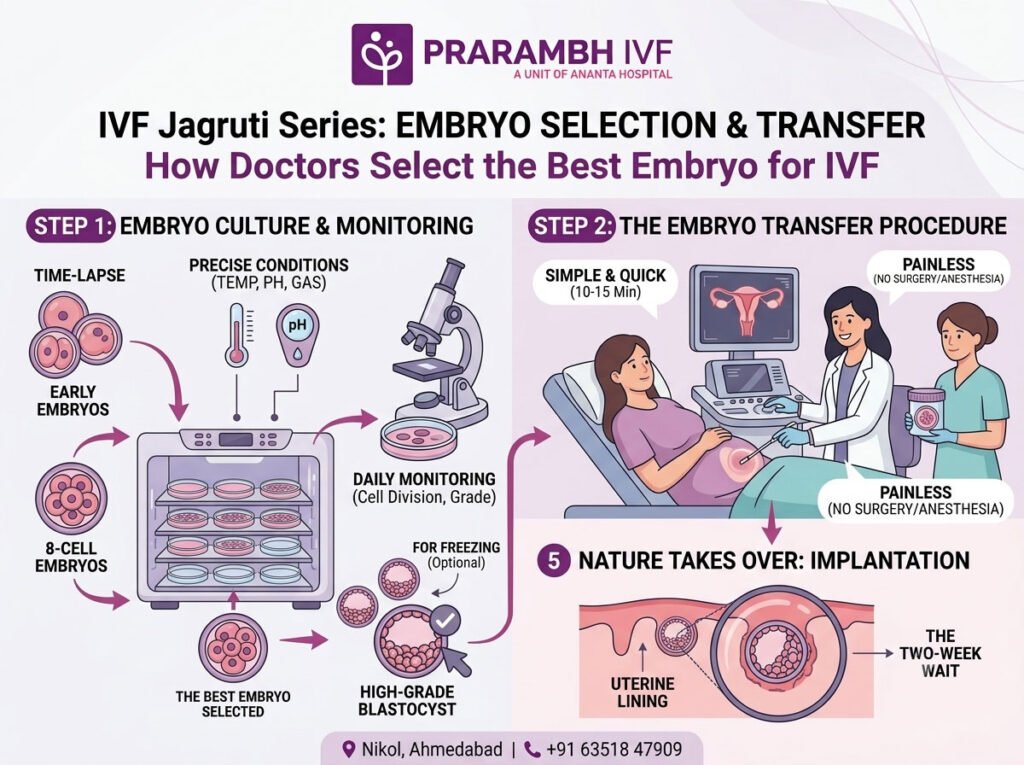
Step 1: Embryo Culture and Monitoring
Once fertilization occurs in the lab, the embryo is not transferred into the uterus immediately. Instead, it undergoes a crucial development phase called embryo culture.
- Specialized Incubators: The embryo is placed inside a state-of-the-art incubator that precisely mimics the natural environment of the human body (temperature, pH, and gas balance).
- 5 to 6 Days of Observation: Embryos are typically cultured in the lab for 5 to 6 days until they reach the blastocyst stage.
- Daily Monitoring: Embryologists and fertility doctors evaluate the embryos daily under high-power microscopes to assess their growth rate, cell division, and structural strength.
- Selection: Only the healthiest and highest-grade embryo is selected for the transfer procedure.
What happens to the remaining embryos? Any extra healthy, high-quality embryos can be frozen (cryopreserved) for future IVF cycles if needed.
Step 2: The Embryo Transfer Procedure
Once the best embryo is selected, it is time for the final lab-assisted step: placing the embryo into the uterus.
Many patients worry about pain during this stage, but the procedure is remarkably simple, quick, and stress-free:
- ⏱️ Duration: Takes only 10 to 15 minutes.
- 🩺 No Surgery & No Anesthesia: It is a non-invasive outpatient procedure.
- 🌿 Minimal Discomfort: Using a thin, flexible catheter (tube), the doctor gently places the selected embryo into the uterine cavity.
What Comes Next? Nature Takes Over
After the embryo transfer, the patient is advised to rest briefly before returning to normal light activities. From this point on, nature takes over as the embryo attempts to implant into the uterine lining.
This phase begins the famous “two-week wait”—a time where medical science steps back, and hope takes center stage.
Have Questions About IVF or Embryo Transfer?
At Prarambh IVF, we are dedicated to providing compassionate care, advanced reproductive technology, and transparent guidance every step of the way.
- 📍 Location: 2nd Floor, Ananta Hospital, Nr. Shaheed Maj. Rushikesh Ramani Garden, Nikol, Ahmedabad – 382350
- 📞 Contact Us: +91 63518 47909
- 🌐 Follow Us: Stay tuned for the next part of our IVF Jagruti Series where we discuss post-transfer medications and pregnancy testing!
