
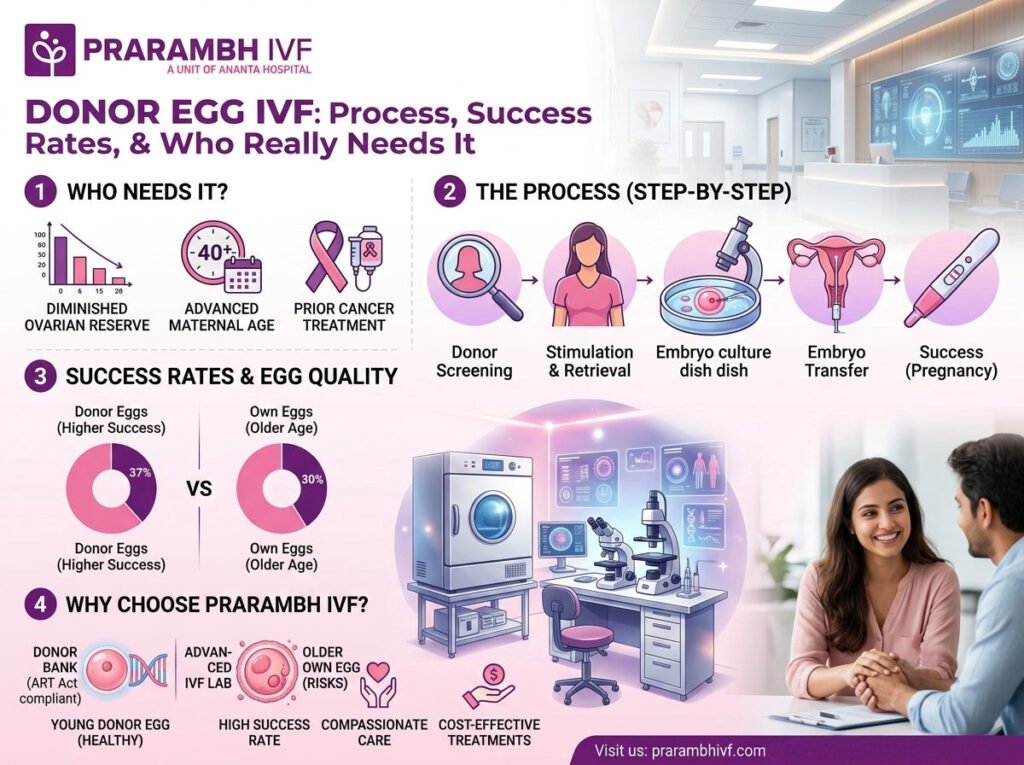
For many women and couples struggling with infertility, hearing the words “your own eggs may not work” can feel like the end of the road. But it isn’t. Donor egg IVF has helped thousands of families in India and around the world experience pregnancy and parenthood when their own eggs could not do the job. At Prarambh IVF and Women’s Hospital, we meet patients every week who arrive anxious and confused about donor egg IVF — and leave with a clear plan and real hope. This guide walks you through exactly what donor egg IVF is, how the process works step by step, what success rates actually look like, and how to know if it’s the right path for you.
What Is Donor Egg IVF?
Donor egg IVF is a form of in-vitro fertilization where eggs from a screened, healthy donor are used instead of the intended mother’s own eggs. The donor eggs are fertilized in a lab with sperm from the partner or a sperm donor, and the resulting embryo is transferred into the intended mother’s (or a gestational carrier’s) uterus.
The key difference from conventional IVF is simple: instead of stimulating the patient’s own ovaries to retrieve her eggs, the fertility clinic uses eggs retrieved from a young, medically and genetically screened donor. Everything else — fertilization, embryo culture, and embryo transfer — follows a very similar path to standard IVF.
This distinction matters because egg quality, far more than uterine health in most cases, is the single biggest driver of IVF success. When a woman’s own eggs are limited in number or affected by age-related or genetic issues, donor eggs can dramatically improve the odds of a healthy pregnancy.
Why Egg Quality Matters So Much
Every woman is born with a fixed number of eggs, and both the quantity and quality of those eggs decline with age — more sharply after 35, and even more so after 40. Poor egg quality is associated with a higher rate of chromosomal abnormalities in embryos, which in turn increases the risk of failed implantation, miscarriage, and conditions like Down syndrome.
Donor eggs typically come from women in their early-to-mid 20s who have been through rigorous medical, genetic, and psychological screening. Because these eggs come from younger, healthier ovaries, embryos created from them tend to have significantly better chromosomal health — which is precisely why donor egg IVF success rates are often higher than standard IVF success rates for older patients or those with diminished ovarian reserve.
The Donor Egg IVF Process, Step by Step
Understanding the process can ease a lot of anxiety. Here is how donor egg IVF typically unfolds at a fertility centre like Prarambh IVF and Women’s Hospital.
Step 1: Initial Consultation and Fertility Assessment
The journey starts with a detailed consultation. Your fertility specialist will review your medical history, previous IVF attempts (if any), hormone levels (AMH, FSH), ultrasound findings, and overall reproductive health. This helps determine whether donor eggs are genuinely necessary or whether other treatments could work first.
Step 2: Choosing a Donor
Patients can choose between a known donor (a family member or friend) or an anonymous donor sourced through a licensed egg bank or donor program. In India, egg donation is regulated under the Assisted Reproductive Technology (ART) Act, which mandates anonymity between donor and recipient (except in specific circumstances) along with strict age limits, screening protocols, and consent processes.
Donors are screened for:
- Overall physical and reproductive health
- Genetic conditions and family medical history
- Infectious diseases (HIV, hepatitis B and C, and others)
- Psychological readiness and informed consent
Clinics often try to match physical characteristics like height, build, skin tone, blood group, and sometimes educational background between donor and recipient, especially when confidentiality is important to the family.
Step 3: Synchronizing Cycles
If a fresh embryo transfer is planned, the donor’s cycle and the recipient’s uterine lining need to be synchronized using hormonal medication. Many clinics now prefer using frozen donor eggs or embryos, which removes the need for cycle synchronization and offers more scheduling flexibility — often with comparable success rates to fresh cycles.
Step 4: Donor Ovarian Stimulation and Egg Retrieval
The donor undergoes ovarian stimulation with injectable fertility medications over roughly 10–12 days to encourage multiple follicles to mature. Once ready, eggs are retrieved through a minor, ultrasound-guided procedure done under sedation, usually taking 15–20 minutes.
Step 5: Preparing the Recipient’s Uterus
Meanwhile, the recipient takes estrogen and progesterone to thicken and prepare the uterine lining so it is receptive to embryo implantation. Regular ultrasounds monitor lining thickness and quality.
Step 6: Fertilization and Embryo Culture
The retrieved donor eggs are fertilized in the lab using the partner’s or a donor’s sperm, typically via ICSI (Intracytoplasmic Sperm Injection) for the best fertilization rates. The resulting embryos are cultured for 3–5 days, often to the blastocyst stage, where embryologists assess quality and select the strongest embryo(s) for transfer.
Step 7: Embryo Transfer
A single, high-quality embryo (or occasionally two, depending on clinical judgment) is transferred into the recipient’s uterus through a thin catheter — a quick, generally painless outpatient procedure that doesn’t require anesthesia.
Step 8: The Two-Week Wait and Pregnancy Test
About 10–14 days after transfer, a blood test (beta-hCG) confirms whether implantation was successful. If positive, monitoring continues with follow-up scans to confirm a healthy, ongoing pregnancy.
Donor Egg IVF Success Rates: What the Numbers Actually Show
One of the biggest reasons donor egg IVF has grown so popular is its consistently strong success rate compared to standard IVF using a woman’s own eggs at advanced maternal age.
- Because donor eggs typically come from women under 30, success rates per embryo transfer are largely independent of the recipient’s age — a 45-year-old recipient using donor eggs has success rates similar to a much younger woman.
- Clinical success rates with donor egg IVF using high-quality embryos commonly range from 50% to 65% per embryo transfer, though this varies by clinic, embryo quality, and whether fresh or frozen embryos are used.
- Cumulative success rates — meaning the chance of pregnancy across two or three embryo transfers from the same donor cycle — are often even higher, frequently exceeding 70–80% for many patients.
- Frozen donor egg/embryo cycles now perform comparably to fresh cycles at most well-equipped centres, thanks to advances in vitrification (fast-freezing) technology.
It’s important to remember that these figures are averages. Your individual success rate depends on donor egg quality, sperm quality, uterine receptivity, embryo grade, and your fertility centre’s laboratory standards and expertise.
Who Really Needs Donor Egg IVF?
Donor egg IVF is not the first-line treatment for everyone — it’s typically recommended after a thorough evaluation rules out or fails other options. You may be a strong candidate for donor egg IVF if you experience any of the following:
1. Diminished Ovarian Reserve or Premature Ovarian Insufficiency
Women with very low AMH levels, few remaining eggs, or early menopause (before age 40) often cannot produce enough viable eggs of their own for successful IVF.
2. Advanced Maternal Age
Women over 40–42, especially those who have had multiple failed IVF cycles with their own eggs, often see significantly better outcomes by switching to donor eggs.
3. Poor Egg or Embryo Quality
Repeated IVF failures, poor fertilization, or consistently poor embryo development despite good ovarian stimulation can signal an egg-quality issue rather than a uterine or sperm-related one.
4. Genetic Disorders
Women who carry a serious inheritable genetic condition they don’t wish to pass on may choose donor eggs to reduce that risk.
5. Prior Cancer Treatment
Chemotherapy or radiation can damage ovarian reserve. Women who didn’t freeze eggs before treatment, or whose fertility preservation wasn’t successful, are often excellent donor egg candidates.
6. Surgically Removed Ovaries or Absent Ovaries
Women born without ovaries, or who have had them surgically removed due to medical conditions, require donor eggs to conceive biologically.
7. Recurrent Miscarriage Linked to Egg Quality
When genetic testing of miscarried pregnancies repeatedly shows chromosomal abnormalities traceable to the mother’s eggs, donor eggs can substantially reduce future miscarriage risk.
Emotional Considerations: It’s More Than a Medical Decision
Choosing donor egg IVF is as much an emotional journey as a medical one. Many women grieve the loss of a genetic connection to their child before they can fully embrace this path — and that’s a completely normal part of the process. It helps to know that:
- The recipient mother carries the pregnancy, experiences childbirth, and is the child’s birth mother in every meaningful legal and biological sense related to pregnancy and delivery.
- Epigenetics research suggests the uterine environment during pregnancy can influence gene expression in the developing baby, creating a biological connection beyond genetics alone.
- Counseling — individual or with a partner — is strongly recommended before beginning treatment, and most reputable clinics build this into the process.
Cost Considerations in India
Donor egg IVF in India is considerably more affordable than in countries like the US or UK, which is one reason many international patients travel here for treatment. Costs vary by city, clinic reputation, donor compensation norms, and whether fresh or frozen donor eggs are used, so it’s best to get a personalized breakdown during consultation rather than relying on generic estimates.
Choosing the Right Clinic for Donor Egg IVF
Not all fertility centres offer the same quality of donor screening, laboratory standards, or embryology expertise — and these differences directly affect your success rate. When evaluating a clinic, ask about:
- ART Act compliance and donor screening protocols
- Their embryology lab’s blastocyst culture and vitrification success rates
- Whether they use fresh or frozen donor eggs, and why
- Transparent, itemized success rate data (not just marketing claims)
- Access to genetic counseling and psychological support
Final Thoughts
Donor egg IVF has transformed what’s medically possible for women who once believed biological motherhood was out of reach. With strong success rates, rigorous donor screening standards, and advances in embryo freezing technology, it has become one of the most reliable paths to pregnancy for women facing egg-quality challenges, advanced maternal age, or premature ovarian insufficiency.
If you’re exploring whether donor egg IVF is right for you, the most important next step is a personalized fertility evaluation — not generic statistics. At Prarambh IVF and Women’s Hospital, our fertility specialists take the time to understand your medical history, explain every option clearly, and build a treatment plan around your specific needs.
Ready to take the next step? Visit us at www.prarambhivf.com.
This article is for general informational purposes and does not replace personalized medical advice. Please consult a qualified fertility specialist to discuss your specific situation.
