
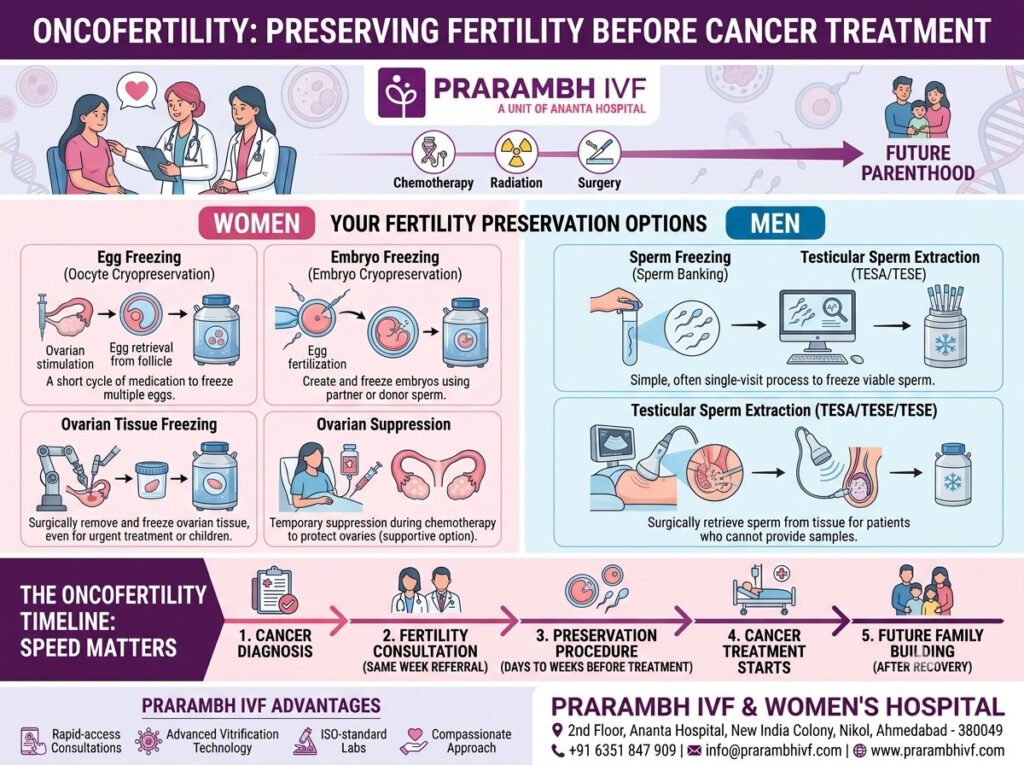
A cancer diagnosis changes everything in an instant. Between scan reports, oncologist appointments, and treatment schedules, one question often gets pushed to the background: “Will I still be able to have children after this?” This is exactly where oncofertility steps in — a specialized branch of reproductive medicine that bridges oncology and fertility care, giving cancer patients the chance to protect their reproductive future before chemotherapy, radiation, or surgery begins.
At Prarambh IVF and Women’s Hospital, Ahmedabad, we believe that fighting cancer should never mean giving up on the dream of parenthood without at least being given the option. This guide explains what oncofertility is, why timing matters so much, and what fertility preservation choices are available to men and women facing cancer treatment.
What Is Oncofertility?
Oncofertility is a multidisciplinary field that brings together oncologists, reproductive endocrinologists, embryologists, and counselors to help cancer patients preserve their fertility before starting gonadotoxic (fertility-damaging) treatments. The term itself combines “oncology” (cancer care) and “fertility,” reflecting the collaborative approach needed to protect a patient’s reproductive potential while treating their disease.
The goal of oncofertility is simple but powerful: cancer treatment should not have to come at the cost of future biological parenthood, whenever it is medically safe and feasible to preserve that option.
Why Fertility Preservation Before Cancer Treatment Matters
Many cancer treatments — while lifesaving — can permanently damage the reproductive system. Chemotherapy drugs, especially alkylating agents, radiation to the pelvis or abdomen, and certain surgeries can:
- Destroy the ovarian reserve (the pool of eggs a woman is born with)
- Damage sperm-producing cells in the testes
- Cause early or premature menopause
- Damage the uterus, making it difficult to carry a pregnancy
- Reduce sperm count, motility, or quality, sometimes permanently
The extent of damage depends on the type of cancer, the specific drugs used, the radiation dose and location, and the patient’s age at the time of treatment. Younger patients often have a better chance of preserving fertility if action is taken early — but the window to do so is narrow, usually just days to a couple of weeks before treatment begins.
This is why oncofertility counseling should ideally happen immediately after diagnosis, before the first cycle of chemotherapy or the first radiation session, not after treatment is already underway.
How Cancer Treatments Affect Fertility
Chemotherapy
Certain chemotherapy drugs are more likely to affect the ovaries and testes than others. Alkylating agents (such as cyclophosphamide) carry a higher risk of ovarian and testicular damage compared to other drug classes. The risk increases with higher cumulative doses and with the patient’s age — women closer to their late 30s have a lower ovarian reserve to begin with, so the same dose can cause more significant fertility loss.
Radiation Therapy
Radiation aimed at or near the pelvis, abdomen, spine, or whole body can directly damage the ovaries, testes, or uterus. Even radiation delivered to the brain (for pituitary-region tumors) can disrupt the hormonal signals that regulate ovulation and sperm production.
Surgery
Some cancer surgeries — such as removal of one or both ovaries, the uterus, or the testes — can directly and permanently affect fertility, regardless of chemotherapy or radiation.
Combination Treatments
Many cancer protocols use a combination of chemotherapy, radiation, and surgery, which compounds the risk to fertility. This is why an individualized fertility risk assessment, done by a reproductive specialist in coordination with the treating oncologist, is so important before treatment starts.
Who Should Consider Oncofertility Counseling?
Fertility preservation isn’t only for a specific age group or cancer type. It’s worth discussing with a fertility specialist if you are:
- A woman of reproductive age (roughly late teens to early 40s) newly diagnosed with cancer
- A man of any reproductive age about to start chemotherapy or radiation
- A parent of a child or adolescent diagnosed with cancer, since pediatric and adolescent patients can also benefit from certain preservation techniques
- Someone diagnosed with breast cancer, lymphoma, leukemia, testicular cancer, ovarian cancer, or any cancer requiring gonadotoxic treatment
- Already planning a family, or simply wanting to keep the option open for the future
Even if you’re unsure whether you want biological children later, preserving the option now — before treatment — keeps that door open, since fertility often cannot be recovered once treatment is complete.
Fertility Preservation Options for Women
1. Egg Freezing (Oocyte Cryopreservation)
This is one of the most common and well-established options. It involves a short course of hormonal stimulation (typically 10–14 days) to grow multiple eggs, followed by an egg retrieval procedure under sedation. The eggs are then vitrified (flash-frozen) and stored for future use — to be thawed, fertilized, and transferred as embryos when the patient is ready to conceive.
2. Embryo Freezing (Embryo Cryopreservation)
Similar to egg freezing, but the retrieved eggs are fertilized with sperm (partner’s or donor) to create embryos before freezing. Embryo freezing has a long track record of high survival and success rates after thawing.
3. Ovarian Tissue Freezing
For patients who cannot wait even the 10–14 days needed for egg or embryo freezing — such as those needing to start chemotherapy urgently, or prepubertal girls — a piece of ovarian tissue can be surgically removed and frozen. This tissue can later be re-implanted to restore hormone function and, in some cases, natural fertility.
4. Ovarian Suppression During Chemotherapy
In certain cases, medication (GnRH agonists) may be used alongside chemotherapy to temporarily suppress ovarian activity, which may help reduce chemotherapy-related ovarian damage. This is generally considered a supportive option rather than a replacement for egg or embryo freezing.
5. Fertility-Sparing Cancer Surgery
For some gynecological cancers detected at an early stage, fertility-sparing surgical approaches (removing only the affected tissue rather than the whole uterus or both ovaries) may be possible. This decision is made jointly with the oncology and fertility team based on the cancer type and stage.
Fertility Preservation Options for Men
1. Sperm Freezing (Sperm Banking)
The simplest and most widely used option for men. A semen sample is collected, analyzed, and frozen — a process that can often be completed within a single visit before treatment begins. Frozen sperm can remain viable for many years and can be used later for IUI, IVF, or ICSI.
2. Testicular Sperm Extraction (TESA/TESE)
For men who cannot produce a sample naturally, or for adolescent boys, sperm can sometimes be surgically retrieved directly from testicular tissue and frozen for future use.
3. Testicular Tissue Freezing
For prepubertal boys who do not yet produce mature sperm, testicular tissue freezing is an emerging option, though it remains largely experimental and is typically offered at specialized centers.
The Oncofertility Timeline: Why Speed Matters
One of the biggest challenges in oncofertility is time. Cancer treatment usually needs to start quickly, and fertility preservation must be coordinated carefully so it doesn’t delay lifesaving therapy. A typical timeline looks like this:
- Diagnosis confirmed by the oncologist
- Same-week referral to a reproductive specialist for a fertility risk assessment
- Fertility preservation procedure (egg/embryo freezing takes about 10–14 days; sperm freezing can be done in a single visit; ovarian tissue freezing can be done urgently, sometimes within 1–2 days)
- Cancer treatment begins as planned, with minimal to no delay
- Frozen eggs, embryos, sperm, or tissue stored safely for future use, once the patient is cancer-free and ready to build their family
Open communication between the oncology team and the fertility team is essential to make sure this timeline is followed safely, without compromising cancer care.
Emotional Support Matters Too
A cancer diagnosis is overwhelming enough without having to make complex fertility decisions under time pressure. Oncofertility counseling isn’t just a medical conversation — it’s also an emotional one. Patients and their partners often benefit from:
- Clear, honest explanations of the risks and realistic chances of success
- Time to ask questions without feeling rushed
- Support in deciding what preservation option, if any, feels right for them
- Reassurance that choosing not to pursue fertility preservation is also a valid, respected decision
At Prarambh IVF and Women’s Hospital, our team takes the time to walk patients through every option with compassion, so decisions are made with clarity — not panic.
Why Choose Prarambh IVF and Women’s Hospital for Oncofertility Care
Prarambh IVF and Women’s Hospital, located in Nikol, Ahmedabad, offers dedicated fertility preservation services designed to work in coordination with your oncology team, including:
- Rapid-access fertility consultations for newly diagnosed cancer patients
- Egg Freezing and embryo cryopreservation using advanced vitrification technology
- Semen Freezing and sperm banking with same-day processing
- State-of-the-art cryopreservation facilities within an ISO-standard embryology lab
- A compassionate, patient-first approach that respects the urgency of cancer treatment timelines
- Transparent counseling on realistic success expectations, without overpromising outcomes
Our reproductive specialists work closely with oncologists across Ahmedabad to ensure fertility preservation never delays the start of cancer treatment, while still giving patients a genuine chance to protect their reproductive future.
Frequently Asked Questions
Is fertility preservation safe for cancer patients? In most cases, yes. Fertility preservation procedures are generally scheduled to avoid delaying cancer treatment, and protocols are adapted (for example, using alternative stimulation methods for hormone-sensitive cancers like certain breast cancers) to minimize any risk. Your oncology and fertility teams will coordinate to ensure safety.
How much time does egg or sperm freezing add before starting cancer treatment? Sperm freezing can usually be completed in a single day. Egg or embryo freezing typically takes about 10–14 days for hormonal stimulation and retrieval. Ovarian tissue freezing can sometimes be arranged even faster when time is extremely limited.
Will insurance or financing help cover fertility preservation costs? Coverage varies widely. Our team can walk you through the expected costs and available payment options during your consultation.
Can frozen eggs, embryos, or sperm be used successfully years later? Yes. Modern vitrification techniques allow eggs, embryos, and sperm to remain viable for many years in frozen storage, with success rates depending on factors like the patient’s age at the time of freezing and overall reproductive health.
What if I’m already mid-way through cancer treatment — is it too late? It’s always worth a consultation. Depending on where you are in treatment, some options may still be available, or your specialist can help plan for fertility assessment and family-building options once treatment is complete.
Take the First Step Today
If you or a loved one has recently been diagnosed with cancer, don’t let the fertility conversation get lost in the urgency of treatment planning. A short consultation, at the right time, can preserve options that may otherwise be lost forever.
Book a fertility preservation consultation with Prarambh IVF and Women’s Hospital today.
📍 2nd Floor, Ananta Hospital, New India Colony, Nikol, Ahmedabad, Gujarat 380049 📞 +91 6351 847 909 📧 info@prarambhivf.com 🌐 www.prarambhivf.com
Related Services
- Egg Freezing
- Semen Freezing
- In Vitro Fertilization (IVF)
- Female Infertility Treatments
- Male Infertility Treatments
- Semen Analysis
Explore More on Our Blog
- Latest Fertility Treatments in 2026: What Couples Should Know
- What is Embryo Grading & Why It Matters in IVF
- How Age Really Affects IVF Success: Real Data Explained
- Understanding IVF: A Step-by-Step Guide for Beginners
- Coping with IVF: Tips for Emotional Wellbeing
