
If you’re going through IVF, you’ll hear your embryologist or fertility specialist mention “the trigger shot” more than once — and for good reason. It’s one of the smallest steps in an IVF cycle by volume, but one of the most time-sensitive by importance. Get the timing wrong by even an hour, and it can affect how many mature eggs are retrieved.
At Prarambh IVF and Women’s Hospital, we know that the trigger shot is often the step patients feel most anxious about, simply because so much seems to depend on a single injection administered at a precise time. This guide breaks down exactly what the trigger shot is, why it matters, how timing is calculated, and what you should expect in the days that follow.
What Is a Trigger Shot in IVF?
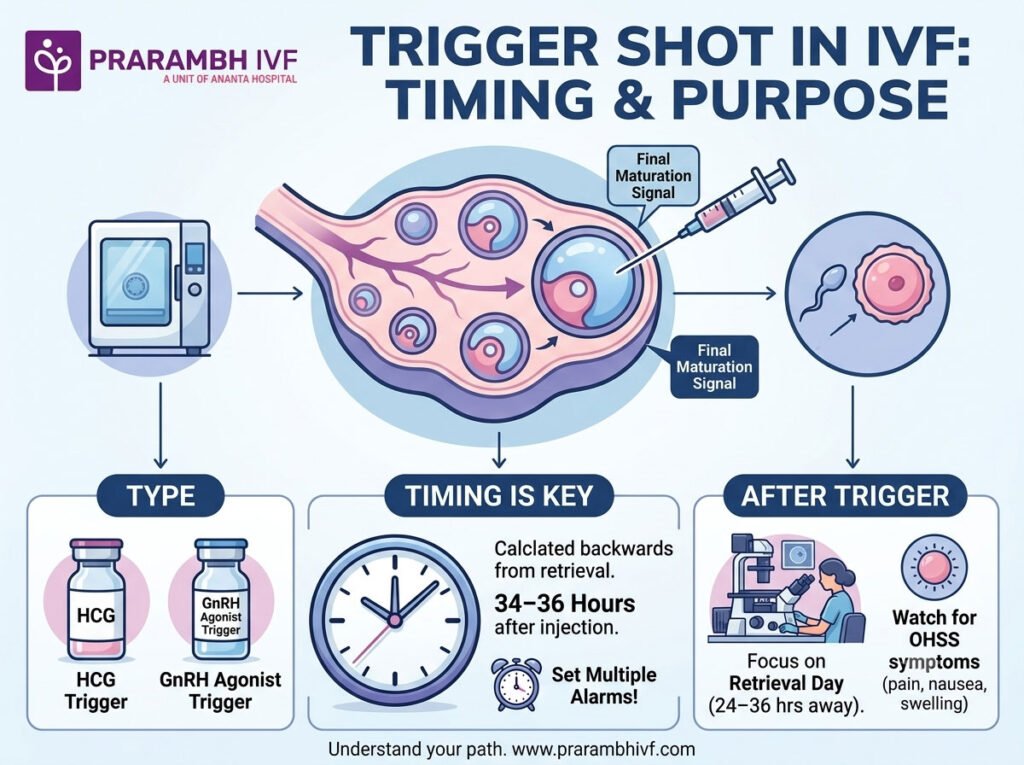
A trigger shot is an injection given near the end of the ovarian stimulation phase of an IVF cycle to complete the final maturation of the eggs and trigger ovulation. During stimulation, fertility medications encourage the ovaries to grow multiple follicles, each containing an egg. But those eggs aren’t fully mature yet — they need one final biological signal to finish developing and become ready for retrieval.
In a natural cycle, that signal comes from a surge of luteinizing hormone (LH) released by the body. In an IVF cycle, your fertility team replicates that surge artificially, at a precisely chosen moment, using a trigger injection. This is what makes IVF timing predictable — instead of waiting for your body to ovulate on its own (and potentially releasing eggs before they can be retrieved), your care team controls exactly when final maturation happens.
Why the Trigger Shot Matters So Much
The trigger shot isn’t just a formality — it’s the step that determines the success of the entire retrieval procedure. Here’s why it plays such an outsized role:
- It finalizes egg maturity. Without the trigger, eggs remain immature and generally cannot be fertilized, even with advanced lab techniques like ICSI.
- It sets the retrieval clock. Egg retrieval is scheduled almost exactly 34–36 hours after the trigger injection — not before ovulation happens naturally, and not so late that eggs are lost.
- It reduces the risk of premature ovulation. Combined with other medications in your protocol, the trigger helps your team retrieve eggs at the ideal window rather than risking natural release beforehand.
In short, everything your body has done over the previous 8–14 days of stimulation builds toward this one carefully timed injection.
Types of Trigger Shots Used in IVF
Not every patient receives the same type of trigger, and your fertility specialist will choose the option best suited to your hormone levels, protocol, and risk factors.
1. hCG Trigger (Human Chorionic Gonadotropin)
This is the most commonly used trigger shot. hCG mimics the natural LH surge closely and is highly effective at completing egg maturation. Brand names commonly used include recombinant or urinary hCG formulations.
2. GnRH Agonist Trigger (Lupron Trigger)
For patients at higher risk of Ovarian Hyperstimulation Syndrome (OHSS) — often those with a high follicle count or PCOS — a GnRH agonist trigger may be used instead of, or alongside, hCG. It stimulates the body’s own natural LH surge without the prolonged hormonal effect of hCG, which significantly lowers OHSS risk.
3. Dual Trigger
In some protocols, a combination of a low-dose hCG trigger and a GnRH agonist is used together. This approach aims to balance strong egg maturation with a reduced risk of OHSS, and is often chosen for patients who didn’t respond optimally to a single trigger in a previous cycle.
Your specialist at Prarambh IVF and Women’s Hospital will determine which protocol fits your hormonal profile after reviewing your stimulation response through bloodwork and ultrasound monitoring.
How Trigger Shot Timing Is Decided
Timing is everything with the trigger shot, and it isn’t guesswork — it’s based on data collected throughout your stimulation cycle.
Monitoring leads the decision. Through regular transvaginal ultrasounds and estradiol blood tests, your care team tracks the size of your growing follicles. Once a sufficient number of follicles reach approximately 17–20mm in diameter, your body is considered ready for triggering.
The exact hour is scheduled backward from retrieval. Because egg retrieval must happen 34–36 hours after the trigger injection, your clinic will tell you an exact time — often late evening — to administer the shot at home or at the clinic. This is calculated precisely so your retrieval procedure, typically done under light sedation, falls within that ideal window.
Why precision matters:
- Too early: Follicles may not be mature enough, resulting in fewer usable eggs.
- Too late (or missed): There’s a risk of spontaneous ovulation before the retrieval, meaning eggs could be released into the abdominal cavity and lost entirely.
This is why fertility clinics are strict about the exact time of the injection — patients are usually given a precise time down to the minute, along with instructions on administration technique.
How the Trigger Shot Is Administered
Trigger shots are typically self-administered as a subcutaneous injection, similar to the stimulation medications you’ve likely already been using. Your nursing team will walk you through the process, but a few points are worth keeping in mind:
- Set multiple alarms — missing or significantly delaying the trigger can affect the entire cycle.
- Follow storage instructions carefully; some trigger medications need refrigeration, others don’t.
- Confirm the dosage with your clinic before injecting, especially if your protocol involves a dual trigger with two separate medications.
- If you’re unsure about anything, call your clinic rather than guessing — timing errors are one of the few truly irreversible mistakes in an IVF cycle.
What Happens After the Trigger Shot
Once the injection is given, your body begins the final maturation process, and your care team shifts focus to preparing for retrieval.
In the 24–36 Hours Before Retrieval
You may notice mild bloating, pelvic heaviness, or tenderness as the ovaries remain enlarged from stimulation. This is normal. You’ll typically be advised to avoid strenuous activity and intercourse during this window to reduce the risk of ovarian torsion, given how enlarged the ovaries can become after weeks of stimulation.
Egg Retrieval Day
The retrieval procedure is performed under sedation, usually taking 15–20 minutes. A thin needle guided by ultrasound is used to collect fluid (and the eggs within it) from each mature follicle. Because retrieval timing is calculated directly from your trigger shot, arriving at the clinic on time for this appointment is just as important as the injection itself.
Watching for OHSS Symptoms
Ovarian Hyperstimulation Syndrome is a possible side effect after stimulation and triggering, particularly with an hCG trigger in patients who respond strongly to medication. Mild symptoms like bloating and discomfort are common and usually resolve on their own. However, you should contact your clinic immediately if you experience:
- Rapid weight gain over a few days
- Severe abdominal pain or significant swelling
- Shortness of breath
- Persistent nausea or vomiting
- Reduced urination
This is precisely why your specialist may recommend a GnRH agonist or dual trigger if your monitoring shows a high follicle count — it’s a preventive step, not a reaction to a problem.
After Retrieval: The Days That Follow
Once eggs are retrieved, they’re assessed in the lab and, depending on your treatment plan, fertilized shortly afterward. Meanwhile, your body begins transitioning into the luteal phase, and your specialist will likely prescribe progesterone support to prepare the uterine lining for embryo transfer. If you’re heading toward a fresh transfer, understanding how progesterone support works after embryo transfer is a useful next step in your journey.
Trigger Shot in IUI vs IVF
It’s worth noting that a trigger shot isn’t exclusive to IVF — it’s also used in IUI cycles to time ovulation precisely before insemination. The underlying hormonal principle is the same, but the goal differs slightly: in IUI, the trigger times natural ovulation for insemination; in IVF, it times final egg maturation for a surgical retrieval procedure roughly a day and a half later.
Common Questions About the Trigger Shot
Does the trigger shot hurt? Most patients describe it as similar to the stimulation injections already used during the cycle — a brief pinch with mild soreness at the injection site.
What if I forget the exact time? Call your clinic immediately. Do not guess or administer a second dose without medical guidance, as this can affect your retrieval schedule.
Can I feel ovulation happening after the trigger? Some patients notice mild cramping or twinges as follicles mature, but you should not ovulate naturally before retrieval — your team schedules the procedure specifically to happen before that occurs.
Will the trigger shot show up on a pregnancy test? Yes. Because hCG is the same hormone measured in home pregnancy tests, an hCG trigger can cause a false positive if you test too early — which is why clinics advise waiting for a blood test (beta hCG) rather than testing at home during the days following retrieval or transfer.
How Prarambh IVF and Women’s Hospital Supports You Through This Step
Every detail of your stimulation and trigger protocol at Prarambh IVF and Women’s Hospital is personalized based on your hormone response, follicle development, and individual risk factors — including your likelihood of OHSS. Our team monitors you closely through ovulation induction and stimulation, calculates your exact trigger time, and guides you step by step through retrieval and the days that follow, so you’re never left wondering what happens next.
If you have questions about your upcoming IVF cycle or want to understand how the trigger shot fits into your specific treatment plan, our specialists are here to help.
Book a consultation: https://www.prarambhivf.com/contact-us/ Call us: +91 6351 847 909 Email us: info@prarambhivf.com
