
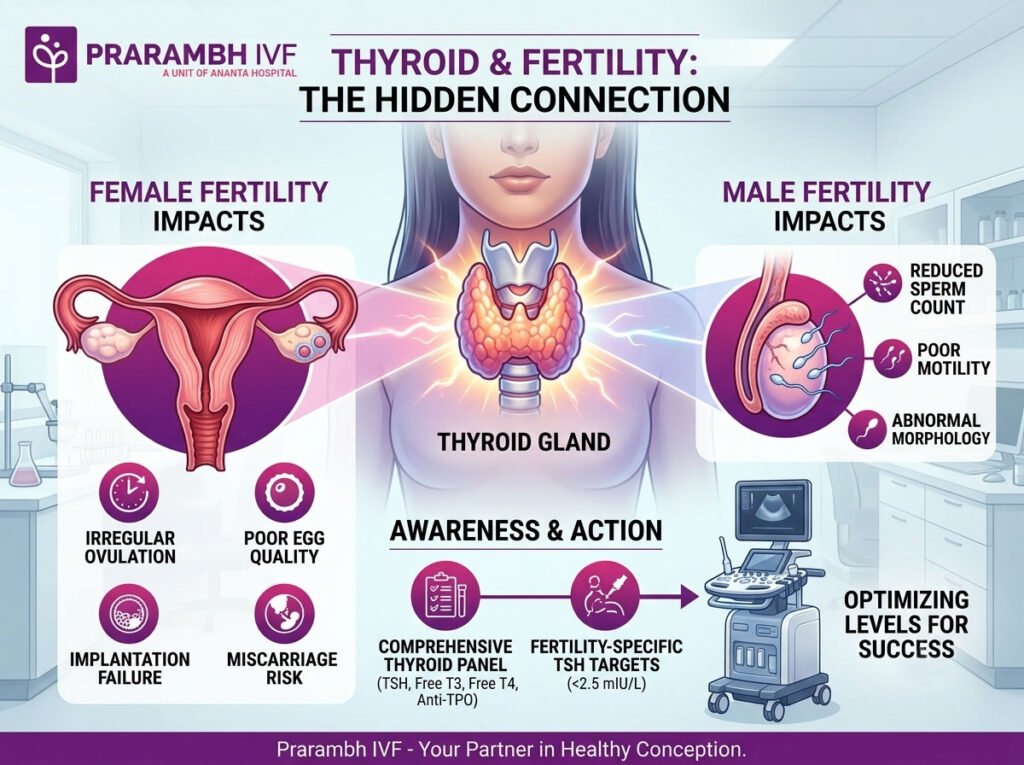
When couples struggle to conceive, the first tests usually focus on the obvious suspects — egg count, sperm quality, uterine health, tubal patency. But there’s a small, butterfly-shaped gland in the neck that quietly influences almost every one of those systems, and it’s often overlooked until much later in the fertility workup: the thyroid gland.
At Prarambh IVF and Women’s Hospital, we routinely see couples who have gone through months — sometimes years — of unexplained infertility, only to discover that an undiagnosed or poorly controlled thyroid disorder was working against them the entire time. This blog breaks down exactly how the thyroid affects fertility, in both men and women, and what you can do about it.
1. Why the Thyroid Matters So Much for Fertility
The thyroid gland produces hormones — primarily T3 (triiodothyronine) and T4 (thyroxine) — that regulate your body’s metabolism. But these hormones don’t operate in isolation. They interact directly with the hypothalamic-pituitary-gonadal (HPG) axis, the same hormonal system that controls ovulation, menstrual regularity, and sperm production.
When thyroid hormone levels are too high (hyperthyroidism) or too low (hypothyroidism), this interaction gets disrupted. The result can be:
- Irregular or absent ovulation
- Disrupted menstrual cycles
- Poor egg quality
- Implantation failure
- Early pregnancy loss
- Reduced sperm count and motility in men
Because thyroid dysfunction often develops gradually and produces vague, easy-to-dismiss symptoms — fatigue, weight changes, mood shifts — many people don’t realize their thyroid could be the reason behind their fertility struggles until a doctor specifically orders the test.
2. Hypothyroidism and Fertility
Hypothyroidism (an underactive thyroid) is the more common thyroid disorder seen in fertility clinics, and it has several direct effects on reproductive health.
Ovulatory Dysfunction
Low thyroid hormone levels can interfere with the release of gonadotropin-releasing hormone (GnRH), which in turn disrupts the signals your ovaries need to mature and release an egg each month. This can lead to irregular cycles or anovulation (cycles where no egg is released at all).
Elevated Prolactin Levels
Hypothyroidism often triggers a rise in prolactin, a hormone that can suppress ovulation entirely when elevated. This is one of the lesser-known but clinically significant ways an underactive thyroid quietly blocks conception.
Luteal Phase Defects
An underactive thyroid can shorten the luteal phase (the second half of your cycle, after ovulation), reducing the window in which a fertilized egg can successfully implant in the uterine lining.
Higher Miscarriage Risk
Multiple studies have linked subclinical hypothyroidism — a milder form where TSH is elevated but T3/T4 remain in the normal range — to a higher risk of early pregnancy loss, even in women who conceive naturally or through IVF.
3. Hyperthyroidism and Fertility
Hyperthyroidism (an overactive thyroid) is less common but can be equally disruptive.
- It frequently causes irregular or lighter periods, and in some cases, complete loss of ovulation.
- It’s associated with a higher risk of miscarriage and preterm birth if pregnancy does occur without treatment.
- Left uncontrolled, it can increase the risk of pregnancy complications such as preeclampsia and low birth weight.
Both hyper- and hypothyroidism underline the same clinical point: thyroid balance, not just “normal” thyroid function, is what fertility depends on.
4. Thyroid Antibodies: The Overlooked Factor
Even when TSH, T3, and T4 all appear normal, some patients test positive for thyroid autoantibodies — most commonly Anti-TPO (thyroid peroxidase antibodies). This indicates autoimmune thyroiditis (Hashimoto’s disease), even before it visibly affects hormone levels.
Research has associated elevated thyroid antibodies with:
- Higher rates of unexplained infertility
- Increased risk of miscarriage, even with normal thyroid hormone levels
- Lower implantation rates during IVF cycles
This is why, at Prarambh IVF and Women’s Hospital, we often recommend thyroid antibody testing as part of a complete fertility workup — not just a basic TSH check — especially for patients with a history of recurrent pregnancy loss or unexplained infertility.
5. What’s the “Ideal” TSH Level for Fertility?
This is one of the most common questions we get, and it’s also a point where general population reference ranges and fertility-specific recommendations diverge.
- A standard lab may consider TSH up to 4.0–4.5 mIU/L as “normal.”
- Most fertility specialists, however, aim for a TSH below 2.5 mIU/L in women who are trying to conceive or preparing for IVF, since research suggests conception rates and pregnancy outcomes improve within this tighter range.
- Once pregnancy is confirmed, TSH targets become even stricter, since the developing baby is fully dependent on maternal thyroid hormone during the first trimester before its own thyroid becomes functional.
This is a key reason thyroid testing shouldn’t be treated as a simple pass/fail check — the “acceptable” range for a woman planning pregnancy is meaningfully different from the general population range.
6. Thyroid Health and Male Fertility
Thyroid dysfunction isn’t just a female fertility issue. In men, both hypothyroidism and hyperthyroidism have been linked to:
- Reduced sperm concentration and motility
- Abnormal sperm morphology (shape)
- Lower testosterone levels
- Erectile dysfunction in more severe or prolonged cases
Because male-factor infertility contributes to roughly half of all infertility cases, thyroid screening is increasingly recommended for men as well — particularly when semen analysis results are borderline or unexplained.
7. Thyroid Function and IVF Success Rates
For couples undergoing IVF specifically, thyroid balance plays a role at nearly every stage:
- Ovarian stimulation: Thyroid hormone influences how the ovaries respond to stimulation medications, affecting egg yield and quality.
- Embryo implantation: A stable thyroid-hormone environment supports a receptive uterine lining, which is critical for successful implantation.
- Pregnancy maintenance: Since the fetus depends entirely on maternal thyroid hormone in early pregnancy, poorly controlled thyroid levels going into an IVF cycle raise the risk of early loss even after a successful embryo transfer.
This is why thyroid panels (TSH, free T3, free T4, and often Anti-TPO antibodies) are a standard part of the pre-IVF workup at Prarambh IVF and Women’s Hospital — correcting a thyroid imbalance before stimulation begins can meaningfully improve outcomes.
8. Common Thyroid-Related Symptoms Couples Often Dismiss
Because thyroid symptoms overlap with everyday stress, many patients don’t connect the dots. Watch for:
- Persistent fatigue, even after adequate sleep
- Unexplained weight gain or weight loss
- Irregular, heavy, or absent periods
- Hair thinning or hair loss
- Cold intolerance (hypothyroidism) or heat intolerance (hyperthyroidism)
- Mood changes, anxiety, or depression
- Difficulty conceiving despite normal ovulation-tracking apps or ovulation kits
If several of these sound familiar, it’s worth requesting a full thyroid panel — not just a general checkup — before continuing further fertility testing.
9. Diagnosis: What a Proper Thyroid Fertility Workup Looks Like
A comprehensive thyroid evaluation for fertility typically includes:
- TSH (Thyroid Stimulating Hormone) — the primary screening test
- Free T3 and Free T4 — to assess actual circulating hormone levels
- Anti-TPO antibodies — to rule out autoimmune thyroiditis
- Prolactin levels — since thyroid dysfunction and elevated prolactin often occur together
- Ultrasound of the thyroid gland, if a goiter or nodules are suspected
At Prarambh IVF and Women’s Hospital, this panel is typically run alongside other baseline fertility investigations, so patients get a complete picture in a single visit rather than piecing it together over multiple appointments.
10. Treatment: Correcting Thyroid Imbalance Before or During Fertility Treatment
The encouraging news is that thyroid-related infertility is often highly treatable.
For Hypothyroidism
- Levothyroxine (synthetic thyroid hormone) is the standard treatment, with dosage adjusted based on regular TSH monitoring.
- Many women who struggled with irregular cycles or anovulation resume normal ovulation within a few months of reaching optimal TSH levels.
For Hyperthyroidism
- Treatment may involve anti-thyroid medications, and in select cases, other interventions — always under close specialist supervision, since hyperthyroidism management during fertility treatment and pregnancy requires careful medication selection.
For Thyroid Autoimmunity (Elevated Anti-TPO)
- Even without overt hormone imbalance, some specialists recommend closer monitoring and, in select cases, low-dose thyroid hormone support during IVF cycles for antibody-positive patients — this is individualized based on your history.
The key clinical principle: thyroid correction is not a one-time fix. Levels should be re-checked every 4–6 weeks after any dosage adjustment, and again before starting ovarian stimulation, to ensure levels are truly optimized — not just “improved.”
11. The Prarambh IVF Approach to Thyroid and Fertility
At Prarambh IVF and Women’s Hospital, thyroid evaluation is a standard part of our fertility assessment for both partners, not an afterthought ordered only after other tests come back unclear. Our approach includes:
- A complete thyroid panel (TSH, free T3, free T4, Anti-TPO) at the start of your fertility workup
- Fertility-specific TSH targets, not just general population reference ranges
- Close coordination between our fertility specialists and endocrinology support when thyroid medication adjustments are needed
- Ongoing monitoring throughout ovarian stimulation, embryo transfer, and early pregnancy for patients with a thyroid history
Because thyroid imbalance is one of the more correctable causes of infertility, addressing it early can meaningfully shorten your overall fertility treatment timeline — and improve your odds at every stage, from natural conception to IVF.
12. Conclusion
The thyroid gland rarely gets the attention it deserves in fertility conversations, yet it influences ovulation, implantation, pregnancy maintenance, and even sperm health. If you and your partner have been trying to conceive without a clear explanation, a full thyroid panel — not just a basic checkup — should be part of your next step.
At Prarambh IVF and Women’s Hospital, we believe hidden hormonal factors like thyroid imbalance deserve the same attention as egg count or sperm quality. Identifying and correcting them early can make all the difference between months of uncertainty and a clear path forward.
Ready to check whether thyroid health could be affecting your fertility? Book a consultation with Prarambh IVF and Women’s Hospital today.
Related Services
- Female Infertility Treatments
- Male Infertility Treatments
- Ovulation Induction
- In Vitro Fertilization (IVF)
- Semen Analysis
Category
Related Blog Posts
- PCOS and IVF: What Changes in Treatment Strategy?
- Top 7 Hidden Causes of Infertility Most Couples Ignore
- Why IVF Fails Even When Reports Are Normal
- How Age Really Affects IVF Success: Real Data Explained
Prarambh IVF and Women’s Hospital Website: https://www.prarambhivf.com/ Email: info@prarambhivf.com Address: 2nd Floor, Ananta Hospital, New India Colony, Nikol, Ahmedabad, Gujarat 380049
