
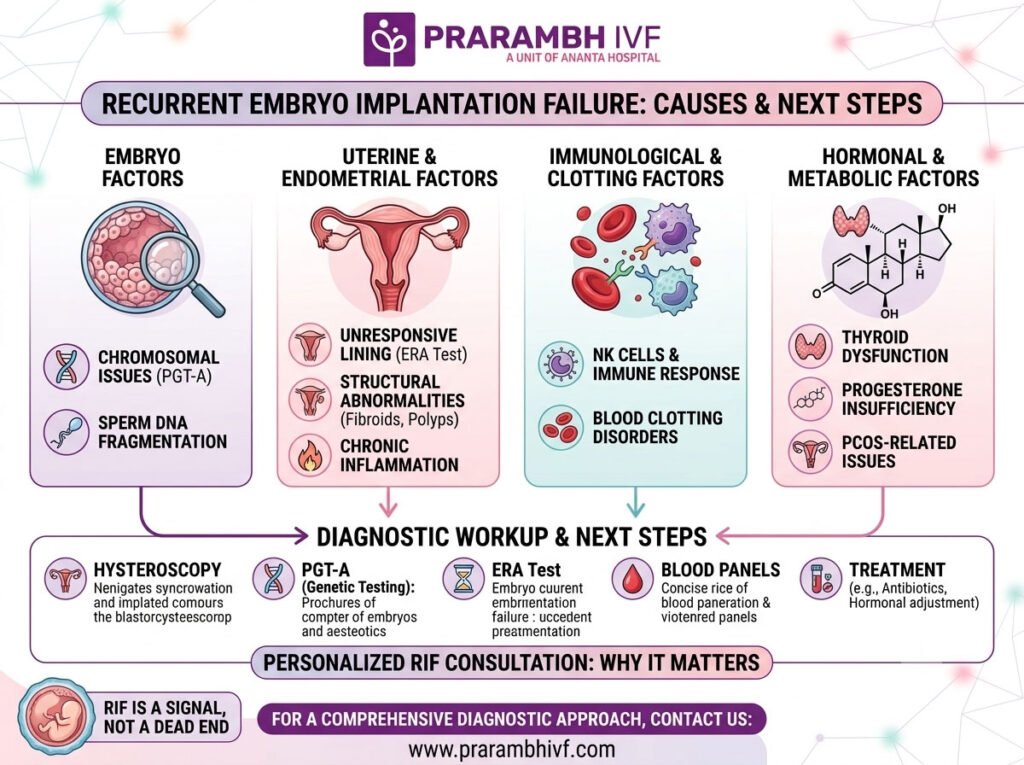
For many couples going through IVF, few experiences are as confusing and emotionally draining as watching a good-quality embryo fail to implant — not once, but multiple times. You did everything right. Your reports looked normal. The embryo graded well. And yet, cycle after cycle, the pregnancy test comes back negative. This pattern is known as Recurrent Implantation Failure (RIF), and it is one of the most complex challenges in modern fertility treatment.
At Prarambh IVF and Women’s Hospital, we see this situation more often than most couples realize. The good news is that RIF is not a dead end — it’s a signal that something specific needs to be investigated, diagnosed, and addressed. This guide breaks down what RIF really means, why it happens, and what your next steps should look like.
What Exactly Is Recurrent Implantation Failure?
Recurrent Implantation Failure is generally defined as the failure of embryos to implant after multiple embryo transfers, despite transferring good-quality embryos into a uterus that appears structurally normal. While definitions vary slightly across clinics, RIF is typically considered after:
- Three or more failed transfers of good-quality embryos, or
- Failure to conceive after transferring a cumulative total of four or more high-grade embryos, across fresh or frozen cycles
It’s important to distinguish RIF from early pregnancy loss. In RIF, the embryo does not implant at all — there’s no rise in beta-hCG, no biochemical pregnancy, nothing detectable. This is different from a chemical pregnancy, where implantation does occur but the pregnancy stops progressing shortly after. If you’re unclear on that distinction, our detailed guide on Chemical Pregnancy vs. Biochemical Pregnancy: What’s the Real Difference? explains it further.
Why Does Implantation Fail Even When Everything Looks Normal?
Successful implantation depends on a precise, well-timed conversation between three factors: the embryo, the uterine lining (endometrium), and the maternal immune environment. When implantation repeatedly fails, the problem usually lies in one — or a combination — of these three areas.
1. Embryo-Related Factors
Even embryos that look perfect under the microscope can carry invisible problems.
Chromosomal abnormalities (aneuploidy): This is the single most common cause of implantation failure, especially in women over 35. An embryo may have a beautiful grade and normal appearance, yet carry an incorrect number of chromosomes that prevents it from developing further. This is why many clinics now recommend Preimplantation Genetic Testing for Aneuploidy (PGT-A) after repeated failures — it allows only chromosomally normal embryos to be selected for transfer. If you’re new to how embryos are evaluated before transfer, our article on What is Embryo Grading & Why It Matters in IVF is a useful starting point.
Sperm DNA fragmentation: Sperm quality isn’t just about count and motility. High levels of DNA fragmentation in sperm can silently compromise embryo development, even when a semen analysis looks otherwise normal. We’ve written extensively about this in Sperm DNA Fragmentation: The Missing Link in Male Infertility.
Embryo development stage: Some clinics find that extending culture to the blastocyst stage (Day 5) rather than transferring on Day 3 improves selection accuracy, since embryos with developmental issues are more likely to arrest before reaching blastocyst.
2. Uterine and Endometrial Factors
The endometrium is far more than a passive landing site — it’s an active, biologically dynamic tissue that needs to be receptive at exactly the right window of time.
Thin or unresponsive endometrium: An endometrial lining that doesn’t thicken adequately, or doesn’t develop the right blood flow, can prevent implantation regardless of embryo quality. We cover this in depth in Thin Endometrium: Can You Still Get Pregnant with IVF?
Structural abnormalities: Uterine fibroids, polyps, adhesions (Asherman’s syndrome), or a septate uterus can all physically or functionally interfere with implantation. A hysteroscopy is often used to detect and correct these issues before further transfers are attempted.
Chronic endometritis: A low-grade, often symptomless infection or inflammation of the endometrial lining can quietly sabotage implantation. It’s frequently missed because it doesn’t cause pain or obvious symptoms, and typically requires endometrial biopsy with specific staining or culture to detect.
Implantation window timing: Every woman has a specific, sometimes narrow, window during which the endometrium is receptive to an embryo. In some cases of RIF, this window is shifted earlier or later than the standard protocol assumes. Tests such as the Endometrial Receptivity Analysis (ERA) are designed to pinpoint this window so that transfers can be personalized.
3. Immunological and Blood Clotting Factors
Implantation requires a delicate immune balancing act — the mother’s immune system must tolerate the embryo (which is genetically half-foreign) rather than reject it.
Elevated Natural Killer (NK) cells: Some women have higher levels of uterine NK cells, which are believed by some specialists to create an environment less favorable for implantation, although this remains an area of ongoing research and debate.
Thrombophilia and clotting disorders: Conditions like antiphospholipid syndrome, Factor V Leiden, or other clotting tendencies can affect blood flow to the developing embryo and are more commonly screened for after repeated failures.
Autoimmune conditions: Undiagnosed autoimmune activity can also play a role and is typically investigated through a panel of blood tests.
4. Hormonal and Metabolic Factors
Thyroid dysfunction: Even subclinical thyroid imbalances can interfere with implantation and early pregnancy maintenance. This connection is often overlooked — read more in Thyroid and Fertility: The Hidden Connection Most Couples Miss.
Progesterone insufficiency: Adequate progesterone support after transfer is essential for maintaining a receptive endometrium. Inadequate luteal phase support is a correctable factor that’s sometimes missed. Our article on Progesterone Support After Embryo Transfer: Why It’s Non-Negotiable explains why this hormone is so critical.
PCOS-related factors: Women with PCOS can face unique implantation challenges related to insulin resistance and hormonal imbalance. See PCOS and IVF: What Changes in Treatment Strategy? for a deeper look.
5. Lifestyle and Unexplained Factors
In a meaningful number of RIF cases, no clear cause is found despite thorough testing. Lifestyle factors — smoking, excess weight, poorly controlled blood sugar, high stress, and poor sleep — are known to influence implantation rates indirectly and are worth addressing regardless of whether a specific diagnosis is made. Our article Why IVF Fails Even When Reports Are Normal explores this “unexplained” category in more detail.
Diagnostic Workup: What Testing Typically Looks Like
If you’ve experienced repeated implantation failure, your fertility specialist will likely recommend a structured evaluation rather than simply repeating the same protocol. A typical RIF workup may include:
- 3D/saline sonohysterography or hysteroscopy to rule out structural uterine issues
- PGT-A testing on future embryos to confirm chromosomal normalcy
- Endometrial Receptivity Analysis (ERA) to check implantation window timing
- Endometrial biopsy to screen for chronic endometritis
- Thyroid and hormonal panels, including prolactin and thyroid antibodies
- Thrombophilia and autoimmune blood panels
- Semen DNA fragmentation testing for the male partner
- Karyotyping of both partners to rule out balanced chromosomal translocations
Not every test is necessary for every couple — your specialist will tailor the workup based on your history, age, and prior treatment details.
What Are the Next Steps After Diagnosis?
Once testing identifies (or narrows down) the likely cause, treatment becomes far more targeted:
- Correcting structural issues — Hysteroscopic removal of polyps, fibroids, or adhesions before the next transfer.
- Treating chronic endometritis — Typically a course of targeted antibiotics, followed by a repeat biopsy to confirm resolution.
- Personalized embryo transfer timing — Using ERA results to shift the timing of progesterone exposure to match your individual receptivity window.
- Selecting chromosomally normal embryos — Through PGT-A testing, prioritizing euploid embryos for transfer.
- Immunological support — In select cases and under specialist guidance, treatments addressing NK cell activity or clotting risk may be considered.
- Optimizing hormonal support — Adjusting progesterone protocols, correcting thyroid function, and managing insulin resistance where relevant.
- Considering assisted hatching — A technique where the embryo’s outer shell is thinned or opened to potentially aid the hatching and implantation process.
- Reviewing male-factor contributions — Addressing sperm DNA fragmentation through antioxidant therapy, lifestyle changes, or advanced sperm selection techniques.
Emotional Wellbeing Matters Too
Repeated implantation failure takes a real emotional toll, and it’s important not to overlook this part of the journey. Many patients describe a cycle of hope and grief that repeats with every failed transfer. Building a support system — whether through counseling, support groups, or simply open conversations with your care team — is not a luxury; it’s part of getting through treatment sustainably. Our article on Coping with IVF: Tips for Emotional Wellbeing offers practical strategies many of our patients have found helpful.
When to Seek a Specialized RIF Consultation
If you’ve had two or more failed transfers with good-quality embryos, it’s worth having a dedicated conversation with your fertility specialist about a structured RIF evaluation rather than simply repeating the same approach. Every additional round of untargeted treatment costs time, money, and emotional energy — a focused diagnostic workup can often identify a correctable factor that changes the outcome.
How Prarambh IVF and Women’s Hospital Approaches RIF Cases
At Prarambh IVF and Women’s Hospital, recurrent implantation failure is treated as a diagnostic puzzle, not a reason to give up. Our approach typically involves a comprehensive review of your treatment history, targeted testing to identify uterine, embryonic, immunological, or hormonal contributors, and a personalized protocol for your next cycle based on what we find. We work closely with both partners, since implantation failure is never solely a “female factor” issue — male-factor contributions like sperm DNA fragmentation are just as important to evaluate.
Explore our related services to learn more about how we support patients through complex fertility journeys:
You can also browse our full blog archive at Prarambh IVF Blog for more evidence-based articles on fertility treatment, IVF preparation, and reproductive health.
Final Thoughts
Recurrent implantation failure can feel like an unanswerable question, but in most cases, it’s answerable — it just requires the right investigation. If you’ve faced repeated failed transfers, don’t lose hope; instead, ask for a structured diagnostic approach that looks beyond embryo grading and into the uterine, immunological, and hormonal factors that could be at play.
If you’d like to discuss your specific history and explore a personalized RIF workup, reach out to our team at Prarambh IVF and Women’s Hospital by visiting www.prarambhivf.com or writing to us at info@prarambhivf.com. Our specialists are here to help you understand what’s really happening — and what comes next.
