
For couples who have been through more than one embryo transfer without success, the experience can feel deeply confusing. You did everything right — a good-quality embryo, a healthy uterine lining on ultrasound, a carefully monitored cycle — and yet the pregnancy test still comes back negative. When this happens more than once, it’s natural to start asking a harder question: is something being missed?
For a meaningful number of patients, the answer isn’t about embryo quality at all. It’s about timing. Specifically, whether the embryo was placed into the uterus during the precise, narrow window when the endometrium (the uterine lining) is actually ready to accept it.
At Prarambh IVF and Women’s Hospital, this is exactly the question the Endometrial Receptivity Analysis (ERA) test is designed to answer. In this guide, we break down what the ERA test is, how it works, who should consider it, and what the evidence says about whether it can genuinely improve your chances of a successful embryo transfer.
1. What Is the “Window of Implantation”?
To understand the ERA test, it helps to first understand a concept called the window of implantation (WOI).
For a successful pregnancy, three things need to align:
- A genetically normal, good-quality embryo
- A structurally healthy uterine cavity
- An endometrium that is receptive — biologically ready to allow the embryo to attach and invade
That third condition only exists for a short period during each cycle — generally believed to fall somewhere within a five-to-seven-day span after ovulation (or after starting progesterone in a hormone-replacement frozen embryo transfer cycle). Outside of this window, the endometrium is either not yet ready (“pre-receptive”) or has already passed its receptive phase (“post-receptive”).
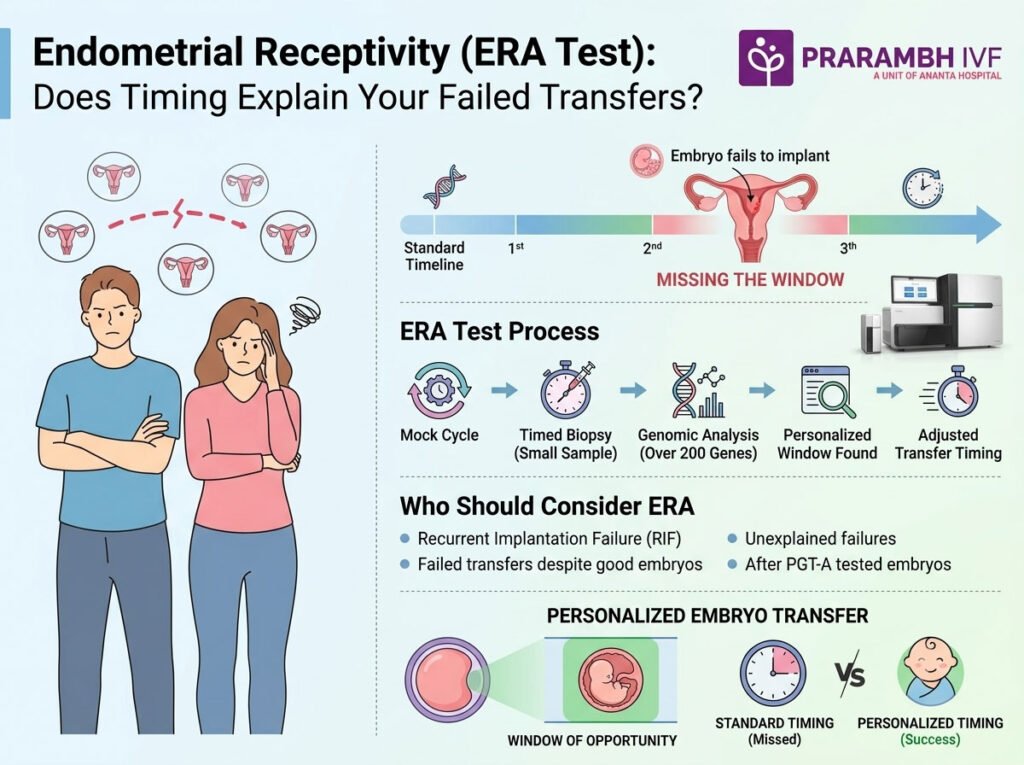
Traditionally, fertility clinics have scheduled embryo transfers based on standardized timing — for example, transferring a day-5 blastocyst exactly 120 hours after starting progesterone supplementation. This standard timing works well for the majority of patients. But for a subset of women, their personal window of implantation is shifted earlier or later than this average — sometimes by as little as 12 to 24 hours. When that happens, even a perfectly healthy embryo transferred with excellent technique may fail to implant, simply because it arrived at the wrong biological moment.
2. What Is the ERA Test?
The Endometrial Receptivity Analysis (ERA) is a diagnostic test that examines the gene expression pattern of the endometrial lining to determine whether it is receptive at the specific time point it was sampled.
Here’s how it works, step by step:
- Mock cycle: Before any embryo transfer is planned, patients undergo a “mock” or trial cycle that mimics the hormonal preparation of a real frozen embryo transfer (FET) cycle — including estrogen priming and progesterone supplementation.
- Endometrial biopsy: At the point in the cycle that would normally correspond to the standard transfer timing, a small tissue sample is taken from the endometrial lining. This is a quick outpatient procedure, generally well tolerated with only mild cramping.
- Genomic analysis: The tissue sample is analyzed for the expression of over 200 genes known to be involved in endometrial receptivity. This analysis classifies the endometrium as receptive, pre-receptive, or post-receptive at that exact sampling time.
- Personalized timing recommendation: Based on the result, your fertility specialist can calculate a personalized window of implantation — essentially, the precise number of hours of progesterone exposure your endometrium needs before it becomes receptive. In your next (real) frozen embryo transfer cycle, the embryo is transferred according to this personalized timing rather than the standard protocol.
In short, the ERA test doesn’t evaluate embryo quality or uterine structure — it answers one specific question: is the transfer happening at the right time for this individual patient’s biology?
3. Who Should Consider an ERA Test?
The ERA test is not recommended as a routine, first-line test for every IVF patient. It’s most valuable — and most likely to change clinical outcomes — for specific patient groups, including:
- Recurrent implantation failure (RIF): Typically defined as the failure of two or more good-quality embryo transfers (especially genetically screened, euploid embryos) to result in a pregnancy. This is the group in which ERA testing has the strongest rationale.
- Unexplained failed transfers despite a normal uterine cavity: When a hysteroscopy or saline sonogram has already ruled out fibroids, polyps, or scar tissue, and the embryo appears chromosomally normal, timing becomes one of the few remaining variables worth investigating.
- Patients undergoing PGT-A tested embryo transfers: Because these embryos have already been screened for chromosomal normality, a failed transfer more strongly points toward implantation-window or uterine receptivity issues rather than embryo-related causes.
- Patients with a history of thin or atypical endometrial response: Some patients with a borderline endometrial lining thickness on ultrasound may also benefit from a receptivity evaluation. (If lining thickness itself is your primary concern, our detailed guide on thin endometrium and IVF outcomes covers that topic separately.)
For patients undergoing their first or second embryo transfer with no prior red flags, standard timing protocols remain appropriate, and ERA testing is generally not necessary.
4. What Does the Evidence Actually Say?
It’s important for couples to have a realistic, evidence-based understanding of ERA testing rather than viewing it as a guaranteed fix.
Some of the original studies on ERA testing reported that a meaningful percentage of patients with recurrent implantation failure — in some datasets, roughly a quarter to a third — had a displaced window of implantation, and that personalizing the transfer timing based on ERA results improved subsequent pregnancy rates in these specific patients.
However, more recent, larger randomized studies in broader IVF populations have produced mixed results, with some showing no significant benefit when ERA testing is applied to unselected patients. This has led most reproductive specialists — including our team at Prarambh IVF and Women’s Hospital — to a more precise conclusion:
ERA testing appears most useful as a targeted diagnostic tool for a specific subgroup (recurrent implantation failure with good-quality embryos and a normal uterine cavity), rather than as a universal test for all IVF patients.
This is why we always contextualize ERA testing within your complete clinical picture — reviewing embryo grading, uterine cavity assessment, hormonal profile, and transfer history — rather than recommending it in isolation.
5. The ERA Test Procedure: What to Expect
If your fertility specialist recommends ERA testing, here is a realistic outline of the process:
- Cycle preparation: You’ll follow a hormone protocol similar to a real frozen embryo transfer cycle — typically oral or transdermal estrogen for lining preparation, followed by progesterone at the point that mimics your planned transfer day.
- Timed biopsy: A thin, flexible catheter is used to collect a small endometrial tissue sample, usually performed in-clinic without anesthesia. Mild cramping similar to a menstrual cramp is common, and the procedure itself takes only a few minutes.
- Laboratory analysis: The sample is sent for genomic analysis, which typically takes one to two weeks for results.
- Result interpretation and planning: Your specialist reviews the report with you. If the result shows the endometrium was receptive at the standard timing, your next transfer proceeds on the usual schedule. If it shows pre-receptive or post-receptive, your next transfer is scheduled with adjusted progesterone timing — often shifted by 12, 24, or more hours to match your personal window.
- Personalized frozen embryo transfer: Your subsequent FET cycle uses this adjusted timing, with the embryo transferred at the point your ERA result identified as receptive.
Because the mock cycle and biopsy don’t involve an actual embryo transfer, this is typically done as a standalone preparatory cycle before your real transfer attempt — adding some time to your overall treatment timeline, which is worth discussing with your specialist upfront.
6. Beyond Timing: Other Reasons Transfers Fail
While a displaced window of implantation can explain some cases of repeated transfer failure, it’s rarely the only factor worth investigating. At Prarambh IVF and Women’s Hospital, a thorough recurrent implantation failure work-up typically also evaluates:
- Embryo quality and genetic status — including whether PGT-A screening would help identify the most viable embryo. Our guide on embryo grading and why it matters explains how embryos are assessed before transfer.
- Uterine cavity abnormalities — fibroids, polyps, adhesions, or a septum, usually assessed via hysteroscopy or saline sonography.
- Endometrial thickness and blood flow — a lining that’s too thin may not support implantation regardless of receptivity timing.
- Immunological and clotting factors — in select cases, conditions affecting blood clotting or immune response at the implantation site are evaluated.
- Chronic endometritis — a low-grade, often symptomless uterine lining infection that can impair implantation and is typically assessed via endometrial biopsy and, when needed, treated with antibiotics before the next transfer.
- Transfer technique itself — including whether a fresh or frozen transfer approach is more suitable for your situation. If you’re weighing that decision, our comparison of frozen embryo transfer versus fresh transfer may be a helpful next read.
This is why ERA testing works best as part of a broader diagnostic strategy rather than a stand-alone solution — timing matters, but it sits alongside several other pieces of the implantation puzzle.
7. How Prarambh IVF and Women’s Hospital Approaches Recurrent Implantation Failure
When a patient comes to us after one or more failed embryo transfers, our approach is never to repeat the same protocol and hope for a different outcome. Instead, we build a structured, individualized evaluation that looks at every contributing factor — embryo, uterus, hormonal environment, and timing — before recommending a next step.
For appropriately selected patients, ERA testing gives us objective, gene-expression-level data about receptivity timing, rather than relying on population averages. Combined with hysteroscopic evaluation of the uterine cavity, embryo assessment, and — where relevant — screening for chronic endometritis, this allows us to build a transfer plan that’s genuinely personalized to your biology rather than a one-size-fits-all protocol.
Frequently Asked Questions
Is the ERA test painful? Most patients describe it as similar to a Pap smear or IUI procedure — brief cramping during the biopsy, resolving quickly afterward. No anesthesia is typically required.
How long before I can do my embryo transfer after an ERA test? Since the ERA biopsy is performed in a mock (non-transfer) cycle, your next cycle can usually be used for the actual personalized embryo transfer, though your specialist will confirm timing based on your individual protocol.
Does a “pre-receptive” or “post-receptive” result mean something is wrong with me? No — it simply means your personal window of implantation falls at a different point than the population average. It’s a timing variation, not a diagnosis of infertility or a uterine abnormality.
Is ERA testing recommended for a first IVF cycle? Generally no. It’s most valuable after one or more unexplained failed transfers with good-quality embryos, not as a routine first-cycle test.
Your Next Step
If you’ve experienced repeated failed embryo transfers despite good-quality embryos, it’s worth having a focused conversation about whether timing — rather than embryo quality — could be part of the explanation. At Prarambh IVF and Women’s Hospital, we combine advanced diagnostics like ERA testing with a complete evaluation of your uterine and hormonal health to give you a clear, personalized path forward.
Explore our full range of IVF and fertility treatment services, browse more articles on our IVF Treatment blog, or visit our blog homepage for more evidence-based fertility guidance.
Ready to talk to a specialist? Visit www.prarambhivf.com to book a confidential consultation, or reach us directly at info@prarambhivf.com.
