
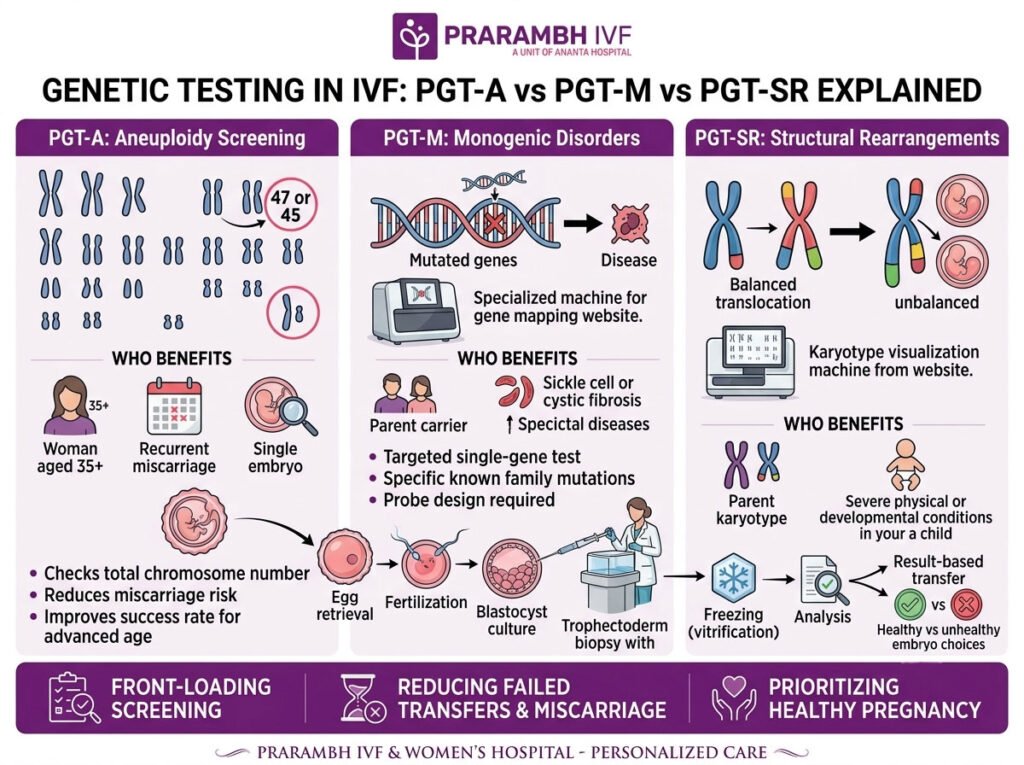
If your fertility specialist has mentioned “genetic testing” as part of your IVF journey, you’ve probably come across a confusing wall of acronyms: PGT-A, PGT-M, PGT-SR. They sound similar, but they check for completely different things — and choosing the right one (or combination) can make a real difference to your chances of a healthy pregnancy.
At Prarambh IVF and Women’s Hospital, we’re often asked the same question in different words: “Do I need genetic testing, and which type?” This guide breaks down each test in plain language, explains who actually benefits from them, and walks through how the results shape your treatment plan.
Why Genetic Testing Matters in IVF
Every embryo created during IVF carries a full set of chromosomes and DNA — a genetic blueprint that determines whether it can develop into a healthy pregnancy. Unfortunately, not every embryo that looks healthy under a microscope actually is healthy on a genetic level.
In fact, as we discussed in our article on common reasons why IVF fails, genetic abnormalities in the embryo are the single biggest reason IVF cycles don’t result in a live birth. Many embryos that appear perfectly graded can carry chromosomal errors invisible to the naked eye — which is exactly the gap that Preimplantation Genetic Testing (PGT) is designed to close.
PGT is performed on embryos created through IVF, typically at the blastocyst stage, before they’re transferred into the uterus. A few cells are carefully biopsied from the embryo (usually from the outer layer that will become the placenta, not the inner cell mass that becomes the baby) and sent for genetic analysis. Based on the results, only embryos with the best genetic profile are selected for transfer.
There are three main types of PGT, and each answers a very different question.
PGT-A: Testing for Chromosome Number (Aneuploidy Screening)
What it checks: Whether an embryo has the correct number of chromosomes (46, in 23 pairs).
PGT-A stands for Preimplantation Genetic Testing for Aneuploidy. “Aneuploidy” simply means having too many or too few chromosomes — for example, an extra copy of chromosome 21 (which causes Down syndrome) or a missing chromosome. These errors usually happen randomly during egg or sperm cell division, or during the very early divisions of the embryo itself.
Aneuploid embryos are a leading cause of:
- Failed implantation
- Early pregnancy loss (chemical pregnancy or miscarriage)
- Embryos that simply stop developing
Who benefits most from PGT-A:
- Women of advanced maternal age (typically 35+), since egg quality — and the rate of chromosomal errors — declines with age
- Couples who’ve experienced recurrent implantation failure despite transferring good-quality embryos
- Couples with a history of recurrent miscarriage
- Couples doing single embryo transfer who want to prioritize the embryo most likely to succeed
- Couples who’ve had a previous pregnancy affected by a chromosomal condition
What the results look like: Embryos are typically classified as euploid (normal chromosome count — the best candidates for transfer), aneuploid (abnormal count — generally not recommended for transfer), or mosaic (a mix of normal and abnormal cells, which may still be considered for transfer in select cases after specialist counseling).
It’s worth noting that PGT-A screens for chromosome number, not for specific inherited diseases. That’s where PGT-M comes in.
PGT-M: Testing for a Specific Known Genetic Disease
What it checks: Whether an embryo has inherited a specific single-gene mutation that one or both parents are known carriers of.
PGT-M stands for Preimplantation Genetic Testing for Monogenic (single-gene) disorders. Unlike PGT-A, which is a general screening test, PGT-M is a targeted test — it’s built specifically around a disease-causing mutation that’s already been identified in the family, usually through prior genetic counseling or carrier screening.
Conditions commonly tested for with PGT-M include:
- Thalassemia and sickle cell disease
- Cystic fibrosis
- Spinal muscular atrophy (SMA)
- Huntington’s disease
- BRCA1/BRCA2 hereditary cancer mutations
- Other inherited single-gene disorders running in the family
Who benefits most from PGT-M:
- Couples where one or both partners are known carriers of a genetic condition
- Couples with a family history of a serious inherited disease
- Couples who’ve already had a child affected by a genetic disorder and want to prevent it in future pregnancies
- Couples identified as carriers through pre-conception genetic carrier screening
How it works in practice: Before starting a PGT-M cycle, a custom genetic probe has to be designed for the family’s specific mutation — this typically requires blood samples from both partners (and sometimes an affected family member) sent to a specialized genetics lab weeks before the IVF cycle begins. This lead time is important to plan for, so if PGT-M is relevant to you, it’s worth discussing with our team early, well before your stimulation cycle starts.
Because PGT-M is disease-specific, it doesn’t automatically screen for chromosomal number issues — which is why PGT-M is very often combined with PGT-A in the same cycle, especially for women of advanced maternal age.
PGT-SR: Testing for Structural Chromosomal Rearrangements
What it checks: Whether an embryo has inherited an unbalanced structural rearrangement of chromosomes, when one or both parents carry a balanced rearrangement.
PGT-SR stands for Preimplantation Genetic Testing for Structural Rearrangements. This applies to couples where one partner carries a chromosomal rearrangement — most commonly a balanced translocation (where pieces of two chromosomes have swapped places) or an inversion (where a segment of a chromosome is flipped).
Here’s the key point: a person who carries a balanced translocation is usually completely healthy, because all their genetic material is present — it’s just rearranged. But when their eggs or sperm are formed, there’s a high chance of producing an unbalanced version, where the embryo ends up with extra or missing genetic material. This significantly raises the risk of:
- Failed implantation
- Recurrent miscarriage
- A child born with physical or developmental conditions caused by the unbalanced genetic material
Who benefits most from PGT-SR:
- Couples where a partner has been identified as a translocation or inversion carrier (often discovered after karyotype testing following recurrent miscarriage)
- Couples with a history of multiple unexplained pregnancy losses
- Couples who already have a child with a chromosomal condition related to a parental rearrangement
How it works: Like PGT-M, PGT-SR requires the specific rearrangement to be mapped in advance through parental karyotyping, so the lab knows exactly what pattern to look for in the embryo’s cells.
PGT-A vs PGT-M vs PGT-SR: A Quick Comparison
| Test | What It Detects | Best For | Requires Custom Pre-Testing? |
|---|---|---|---|
| PGT-A | Abnormal chromosome number (aneuploidy) | Advanced maternal age, recurrent implantation failure, recurrent miscarriage | No |
| PGT-M | A specific known single-gene disorder | Known carriers of an inherited disease | Yes — custom probe for the family mutation |
| PGT-SR | Unbalanced chromosome structure (translocations, inversions) | Known carriers of a balanced chromosomal rearrangement | Yes — parental karyotype mapping |
In many real-world cases, these tests aren’t mutually exclusive. A couple undergoing PGT-M or PGT-SR for a known familial condition will often have PGT-A performed on the same embryo biopsy, since it adds minimal extra cost or delay but provides a much fuller genetic picture.
How the Testing Process Actually Works
Regardless of which PGT type is used, the biopsy and testing process follows a similar path:
- Ovarian stimulation and egg retrieval, as in a standard IVF cycle.
- Fertilization via conventional IVF or ICSI, followed by embryo culture to the blastocyst stage (day 5–6), when embryos have enough cells for a safe biopsy.
- Trophectoderm biopsy — a small number of cells are gently removed from the outer layer of the blastocyst, which is destined to form the placenta, not the fetus itself.
- Vitrification (freezing) — biopsied embryos are typically frozen immediately using vitrification while genetic results are pending, since testing usually takes 1–2 weeks.
- Genetic analysis at a specialized lab using next-generation sequencing (NGS) technology.
- Result-based transfer planning — once results are back, our team selects the embryo(s) with the best genetic profile for a subsequent Frozen Embryo Transfer (FET).
This is one reason genetic testing pairs naturally with a freeze-all approach: it allows the uterine lining to be optimally prepared for transfer without the time pressure of a fresh cycle.
Does PGT Guarantee a Successful Pregnancy?
It’s important to set realistic expectations: PGT significantly improves the odds by helping avoid the transfer of embryos that were very unlikely to succeed — but it isn’t a guarantee. Implantation still depends on factors like uterine receptivity, lining thickness, and overall uterine health. That’s why, for some patients, we also recommend pairing genetic testing with an Endometrial Receptivity Analysis (ERA) to ensure the timing of transfer is precisely aligned with the uterus’s most receptive window.
What PGT does very effectively is reduce the emotional and physical burden of repeated failed transfers and miscarriages by front-loading the genetic screening — so the embryo you transfer has already cleared the biggest known hurdle.
Is Genetic Testing Right for You?
Genetic testing isn’t automatically recommended for every IVF patient — it’s most valuable for specific situations. You may be a good candidate for PGT if:
- You’re 35 or older and undergoing IVF
- You’ve had two or more failed IVF transfers
- You’ve experienced recurrent pregnancy loss
- You or your partner are a known carrier of a genetic condition or chromosomal rearrangement
- You have a family history of an inherited genetic disease
- You’re planning single embryo transfer and want the highest-confidence choice
If none of these apply to you, your fertility specialist may recommend proceeding without PGT and relying on embryo morphology grading alone — you can read more about how that grading process works in our article on embryo grading and why it matters in IVF.
Our Approach at Prarambh IVF and Women’s Hospital
At Prarambh IVF and Women’s Hospital, genetic testing decisions are never made in isolation. Our reproductive endocrinologists review your full history — age, prior cycle outcomes, family genetic background, and any relevant test results — before recommending whether PGT-A, PGT-M, PGT-SR, or a combination is appropriate for your situation. When indicated, we coordinate closely with certified genetics laboratories to ensure accurate, clinically validated results, and our embryology team follows strict protocols for safe, minimally invasive biopsy techniques that don’t compromise embryo viability.
If you’ve experienced sperm DNA fragmentation-related concerns or previous cycles affected by unexplained failure, genetic testing is often one of the most informative next steps we discuss together.
Frequently Asked Questions
Does embryo biopsy harm the embryo? When performed by an experienced embryology team using standard trophectoderm biopsy techniques, the procedure is considered safe and does not reduce the embryo’s implantation potential.
How long do PGT results take? Typically 1–2 weeks, depending on the testing lab and the complexity of the test (PGT-A results are usually faster than PGT-M/PGT-SR, which involve custom probes).
Can PGT tell me the sex of the embryo? Chromosomal analysis does reveal sex chromosomes as part of the process; discuss with your clinical team what information will be shared, in line with applicable regulations.
Is PGT covered under India’s ART regulations? Genetic testing in IVF is performed within the framework of India’s Assisted Reproductive Technology (ART) Act — our team can walk you through what’s permitted and how it applies to your case.
Take the Next Step
Understanding your genetic testing options can feel overwhelming, but you don’t have to figure it out alone. Explore our IVF services or browse more articles on our blog to learn more about the science behind a successful pregnancy.
To find out whether PGT-A, PGT-M, or PGT-SR is right for your specific situation, schedule a consultation with our fertility specialists at Prarambh IVF and Women’s Hospital.
📍 New India Colony, Nikol, Ahmedabad 📧 info@prarambhivf.com 🌐 www.prarambhivf.com
