
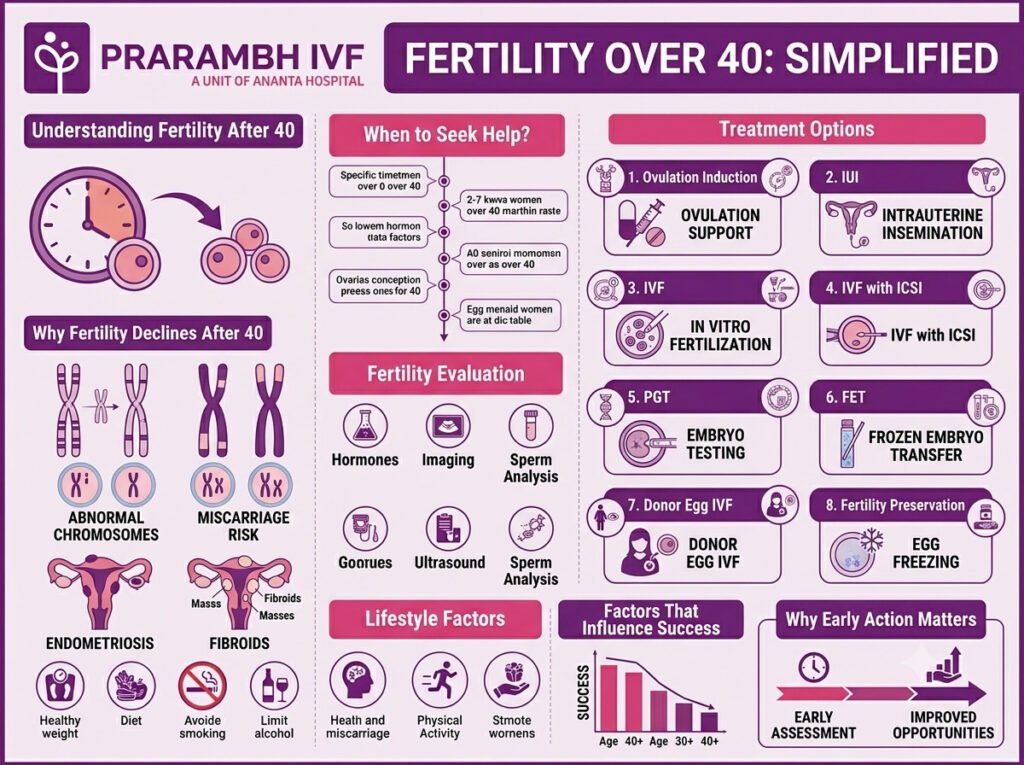
Introduction
In recent years, more women have chosen to start or expand their families later in life due to career goals, financial stability, personal circumstances, or finding the right partner. While many women successfully conceive and deliver healthy babies in their 40s, it is important to understand that fertility naturally declines with age, making conception more challenging than it was in earlier years.
For women over 40 who wish to become pregnant, modern fertility treatments offer a range of solutions that can significantly improve the chances of conception. Advances in reproductive medicine have made parenthood possible for many individuals and couples who may have previously struggled to achieve pregnancy.
At Prarambh IVF, we understand that every fertility journey is unique. Our fertility specialists provide personalized treatment plans designed to help women over 40 explore the most suitable fertility options based on their individual health, reproductive history, and family-building goals.
In this comprehensive guide, we discuss age-related fertility changes, available fertility treatments, success factors, and how women over 40 can make informed decisions about their reproductive future.
Understanding Fertility After 40
Female fertility is closely linked to both the quantity and quality of eggs in the ovaries.
Women are born with all the eggs they will ever have. As they age:
- The number of available eggs decreases.
- Egg quality gradually declines.
- The risk of chromosomal abnormalities increases.
- The chances of natural conception become lower.
While pregnancy after 40 is certainly possible, fertility specialists often recommend early evaluation and timely treatment because reproductive potential tends to decline more rapidly during this stage of life.
Why Fertility Declines After 40
Several biological factors contribute to reduced fertility.
Declining Ovarian Reserve
Ovarian reserve refers to the number of eggs remaining in the ovaries.
By age 40 and beyond:
- Fewer eggs are available.
- Ovaries may respond less effectively to hormonal stimulation.
- Fertility treatment outcomes can be affected.
Reduced Egg Quality
Egg quality becomes increasingly important with age.
Older eggs are more likely to have chromosomal abnormalities, which can contribute to:
- Difficulty conceiving
- Failed implantation
- Miscarriage
- Genetic conditions
Increased Risk of Miscarriage
Women over 40 generally have a higher risk of pregnancy loss due to age-related chromosomal changes in embryos.
Other Reproductive Health Conditions
The likelihood of developing fertility-related conditions also increases with age, including:
- Endometriosis
- Uterine fibroids
- Adenomyosis
- Tubal damage
- Hormonal imbalances
These factors may further affect fertility.
When Should Women Over 40 Seek Fertility Help?
Unlike younger women who may try to conceive naturally for a longer period, women over 40 are generally advised to seek fertility evaluation sooner.
You should consider consulting a fertility specialist if:
- You have been trying to conceive for six months or longer without success.
- You have experienced recurrent miscarriages.
- You have irregular menstrual cycles.
- You have known reproductive health conditions.
- You wish to assess your fertility before attempting pregnancy.
Early assessment can help identify potential issues and improve treatment planning.
Fertility Evaluation for Women Over 40
Before recommending treatment, fertility specialists typically perform a comprehensive evaluation.
Hormone Testing
Blood tests may assess:
- Anti-Müllerian Hormone (AMH)
- Follicle-Stimulating Hormone (FSH)
- Estradiol levels
- Thyroid function
These tests help evaluate ovarian reserve and reproductive health.
Ultrasound Examination
Pelvic ultrasound can help assess:
- Ovarian reserve
- Uterine health
- Fibroids
- Ovarian cysts
Fallopian Tube Assessment
Tests may be performed to determine whether the fallopian tubes are open and functioning properly.
Partner Evaluation
A semen analysis may be recommended to evaluate sperm count, motility, and morphology.
Since infertility can involve both partners, a complete assessment is essential.
Fertility Treatment Options for Women Over 40
Several treatment options are available depending on individual circumstances.
1. Ovulation Induction
For women who are not ovulating regularly, medications may be used to stimulate ovulation.
These medications help:
- Promote egg development
- Improve ovulation timing
- Increase conception opportunities
Ovulation induction is generally most effective when ovulation problems are the primary cause of infertility.
Who May Benefit?
- Women with irregular cycles
- Women with ovulation disorders
- Patients with certain hormonal imbalances
2. Intrauterine Insemination (IUI)
IUI involves placing specially prepared sperm directly into the uterus around ovulation.
The goal is to:
- Increase the number of sperm reaching the egg
- Improve fertilization chances
Is IUI Effective After 40?
IUI may still be considered in selected cases, particularly when:
- Fallopian tubes are open
- Ovarian reserve is reasonable
- Male fertility is normal
However, because fertility declines significantly after 40, IUI success rates are generally lower compared to younger age groups.
Many fertility specialists recommend careful evaluation before pursuing multiple IUI cycles at this age.
3. In Vitro Fertilization (IVF)
IVF is often considered one of the most effective fertility treatments for women over 40.
The process includes:
- Ovarian stimulation
- Egg retrieval
- Fertilization in a laboratory
- Embryo development
- Embryo transfer
Because IVF allows direct observation of fertilization and embryo development, it can overcome many fertility challenges associated with age.
Benefits of IVF for Women Over 40
IVF offers several advantages:
- Higher pregnancy rates than many other treatments
- Better monitoring of embryo development
- Ability to freeze embryos
- Potential use of advanced reproductive technologies
4. IVF with ICSI
Intracytoplasmic Sperm Injection (ICSI) is an advanced IVF technique in which a single sperm is injected directly into an egg.
ICSI may be recommended when:
- Male factor infertility is present
- Previous fertilization problems occurred
- Fertility specialists want to maximize fertilization opportunities
5. Preimplantation Genetic Testing (PGT)
As maternal age increases, so does the likelihood of chromosomal abnormalities in embryos.
Preimplantation Genetic Testing (PGT) may be used during IVF to evaluate embryos before transfer.
Potential benefits include:
- Identifying chromosomally normal embryos
- Supporting informed treatment decisions
- Reducing the risk of transferring embryos with certain chromosomal abnormalities
The decision to use PGT should always be made in consultation with a fertility specialist.
6. Frozen Embryo Transfer (FET)
Embryos created through IVF can often be frozen for future use.
Frozen Embryo Transfer allows:
- Embryo transfer in a later cycle
- Flexibility in treatment planning
- Additional pregnancy opportunities without repeating egg retrieval
7. Donor Egg IVF
For some women over 40, egg quality may significantly impact fertility outcomes.
In such situations, donor egg IVF may be discussed as an option.
The process involves:
- Using eggs from a screened donor
- Fertilizing the eggs in a laboratory
- Transferring resulting embryos to the recipient’s uterus
This option may be considered when ovarian reserve is extremely low or when previous treatments have not been successful.
8. Fertility Preservation Options
Some women may wish to preserve fertility before age-related decline progresses further.
Options may include:
- Egg freezing
- Embryo freezing
While fertility preservation is often most effective at younger ages, it remains an important topic for women considering future family-building plans.
Lifestyle Factors That Support Fertility After 40
While lifestyle changes cannot reverse age-related fertility decline, they can support overall reproductive health.
Maintain a Healthy Weight
Both underweight and overweight conditions can affect fertility.
Achieving a healthy body weight may help support:
- Hormonal balance
- Ovulation
- Pregnancy outcomes
Eat a Nutrient-Rich Diet
A balanced diet should include:
Fruits and Vegetables
Rich in antioxidants and essential nutrients.
Lean Protein Sources
Examples include:
- Fish
- Eggs
- Poultry
- Legumes
Whole Grains
These provide sustained energy and nutritional support.
Healthy Fats
Sources include:
- Nuts
- Seeds
- Avocados
- Olive oil
Avoid Smoking
Smoking has been associated with:
- Reduced ovarian reserve
- Earlier menopause
- Lower fertility
Avoiding tobacco products is strongly recommended.
Limit Alcohol Consumption
Discuss alcohol use with your healthcare provider when planning pregnancy or undergoing fertility treatment.
Stay Physically Active
Regular moderate exercise can support:
- Weight management
- Cardiovascular health
- Stress reduction
Extreme exercise, however, may not be appropriate for everyone.
Emotional Challenges of Fertility Treatment After 40
The fertility journey can be emotionally demanding.
Women may experience:
- Anxiety about age
- Fear of treatment failure
- Stress related to timing
- Financial concerns
- Feelings of uncertainty
Seeking emotional support can be beneficial.
Support options may include:
- Counseling
- Fertility support groups
- Partner communication
- Stress-management programs
Mental well-being is an important part of fertility care.
Factors That Influence Fertility Treatment Success
Success rates vary widely depending on several factors.
Age
Age remains one of the most significant predictors of fertility treatment outcomes.
Ovarian Reserve
The number of available eggs influences treatment planning and response.
Egg Quality
Higher-quality eggs generally have better fertilization and implantation potential.
Uterine Health
Conditions affecting the uterus may influence embryo implantation and pregnancy success.
Sperm Quality
Male fertility plays an important role in conception and treatment outcomes.
Why Early Action Matters
Many women assume they should continue trying naturally for extended periods before seeking help.
However, because fertility declines more rapidly after age 40, delaying evaluation may reduce available treatment options.
Early consultation allows fertility specialists to:
- Assess reproductive potential
- Identify fertility challenges
- Recommend appropriate treatments
- Develop individualized plans
Prompt action often provides more opportunities for successful treatment.
Common Myths About Fertility After 40
Myth 1: Pregnancy After 40 Is Impossible
Many women successfully conceive and deliver healthy babies after 40.
While fertility declines, pregnancy remains possible.
Myth 2: Regular Periods Mean Fertility Is Normal
Regular menstrual cycles do not necessarily indicate normal egg quantity or quality.
A fertility evaluation provides more accurate information.
Myth 3: IVF Guarantees Pregnancy
IVF can significantly improve pregnancy chances, but no fertility treatment can guarantee success.
Treatment outcomes depend on many individual factors.
Myth 4: Age Only Matters for Women
Male fertility also changes with age and can affect conception and pregnancy outcomes.
Why Choose Prarambh IVF?
At Prarambh IVF, we recognize the unique challenges faced by women pursuing pregnancy after 40.
Our fertility center offers:
- Comprehensive fertility evaluations
- Advanced IVF technology
- Personalized treatment plans
- Evidence-based reproductive care
- Compassionate patient support
Our experienced team works closely with each patient to develop a strategy that aligns with their medical needs and reproductive goals.
Conclusion
Women over 40 can still achieve successful pregnancies, but fertility challenges often require specialized evaluation and timely treatment. Age-related changes in egg quantity and quality may make conception more difficult, yet modern fertility treatments offer a variety of effective solutions.
Depending on individual circumstances, treatment options may include ovulation induction, IUI, IVF, IVF with ICSI, genetic testing, frozen embryo transfer, or donor egg IVF. The most appropriate approach depends on factors such as ovarian reserve, reproductive health, fertility history, and family-building goals.
The key is not to delay seeking professional guidance. Early fertility assessment can provide valuable information and help maximize available opportunities.
At Prarambh IVF, we are committed to helping women make informed decisions about their reproductive health through personalized, compassionate, and evidence-based fertility care. To learn more about fertility treatment options or schedule a consultation, visit www.prarambhivf.com today.
