
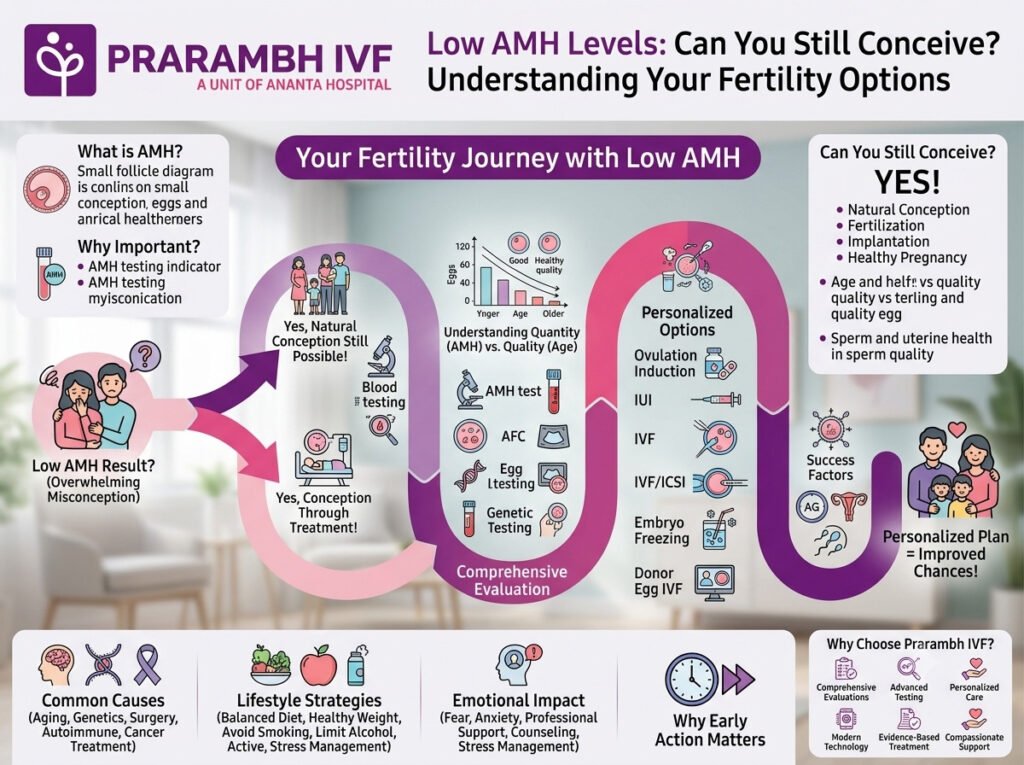
Introduction
Receiving a fertility test result showing low AMH levels can be overwhelming for many women trying to conceive. It is common to feel anxious, discouraged, or even assume that pregnancy is no longer possible. However, one of the biggest misconceptions about fertility is that a low Anti-Müllerian Hormone (AMH) level automatically means you cannot get pregnant.
The reality is far more encouraging. While AMH is an important marker of ovarian reserve, it is only one piece of the fertility puzzle. Many women with low AMH levels have successfully conceived naturally, while others have achieved pregnancy through fertility treatments such as ovulation induction, IUI, or IVF.
At Prarambh IVF, we frequently meet patients who are concerned about low AMH results. With proper evaluation, personalized treatment planning, and timely intervention, many women with diminished ovarian reserve can still pursue their dream of parenthood.
In this comprehensive guide, we explain what AMH is, what low AMH levels mean, how they affect fertility, and what treatment options may be available.
What Is AMH?
Anti-Müllerian Hormone (AMH) is a hormone produced by small follicles within the ovaries.
Because AMH is released by developing follicles, it is commonly used as an indicator of a woman’s ovarian reserve, which refers to the number of eggs remaining in the ovaries.
AMH testing helps fertility specialists estimate:
- Remaining egg supply
- Ovarian response to fertility medications
- Potential fertility treatment strategies
- Reproductive planning options
Unlike some other hormone tests, AMH levels can generally be measured at any point during the menstrual cycle.
Why Is AMH Important?
AMH provides valuable information about fertility potential.
The test can help:
- Assess ovarian reserve
- Predict response to ovarian stimulation
- Support fertility treatment planning
- Identify women who may benefit from earlier intervention
However, AMH does not directly measure egg quality or guarantee whether pregnancy will or will not occur.
What Does a Low AMH Level Mean?
A low AMH level generally suggests that the number of remaining eggs in the ovaries is lower than expected for a woman’s age.
This condition is often referred to as:
- Diminished ovarian reserve
- Reduced ovarian reserve
A lower egg supply may result in:
- Fewer eggs available during fertility treatment
- Reduced ovarian response to medications
- Shorter reproductive timeframes
Importantly, low AMH does not necessarily mean there are no eggs remaining.
Can You Still Conceive With Low AMH?
The Simple Answer: Yes
Many women with low AMH levels successfully become pregnant.
A low AMH result indicates reduced ovarian reserve, but it does not automatically prevent:
- Natural conception
- Fertilization
- Embryo implantation
- Healthy pregnancy
The ability to conceive depends on multiple factors, including:
- Age
- Egg quality
- Ovulation status
- Sperm quality
- Uterine health
- Overall reproductive health
For this reason, AMH should never be interpreted in isolation.
AMH and Egg Quantity vs Egg Quality
One of the most important concepts to understand is the difference between egg quantity and egg quality.
AMH Primarily Reflects Quantity
AMH estimates the number of available eggs.
It does not directly assess:
- Chromosomal health
- Genetic quality
- Fertilization potential
Age Influences Egg Quality
While AMH reflects quantity, age is often a stronger predictor of egg quality.
For example:
Younger Woman With Low AMH
A younger woman may have fewer eggs but still possess good-quality eggs capable of producing healthy pregnancies.
Older Woman With Low AMH
An older woman may experience both reduced egg quantity and age-related declines in egg quality.
This distinction is important when evaluating fertility potential.
Common Causes of Low AMH
Several factors can contribute to reduced ovarian reserve.
Natural Aging
The most common cause of low AMH is age-related decline.
Women naturally lose eggs throughout their lives.
As ovarian reserve decreases:
- AMH levels fall
- Fertility gradually declines
Genetic Factors
Some women are born with a naturally lower ovarian reserve.
Family history may sometimes play a role.
Endometriosis
Endometriosis can affect ovarian tissue and ovarian reserve, potentially reducing AMH levels.
Ovarian Surgery
Surgical treatment involving the ovaries may affect ovarian reserve in certain cases.
Autoimmune Conditions
Some autoimmune disorders may impact ovarian function.
Cancer Treatments
Chemotherapy and radiation therapy can damage ovarian follicles and reduce ovarian reserve.
Symptoms of Low AMH
Low AMH itself typically does not cause symptoms.
Many women only discover low AMH during fertility testing.
However, some may experience:
- Difficulty conceiving
- Reduced fertility treatment response
- Shortened menstrual cycles
- Irregular cycles in certain cases
Because symptoms are often absent, fertility evaluation plays an important role.
How Is Low AMH Diagnosed?
AMH Blood Test
An AMH blood test measures hormone levels associated with ovarian reserve.
This test is widely used during fertility assessments.
Additional Fertility Testing
AMH is usually evaluated alongside other tests.
These may include:
Follicle-Stimulating Hormone (FSH)
Helps assess ovarian function.
Estradiol Testing
Provides additional hormonal information.
Antral Follicle Count (AFC)
Ultrasound is used to count developing follicles in the ovaries.
Pelvic Ultrasound
Evaluates reproductive anatomy and ovarian health.
Together, these tests provide a more complete fertility picture.
Can You Conceive Naturally With Low AMH?
Yes, natural conception remains possible for many women with low AMH.
Pregnancy occurs when:
- Ovulation takes place
- Fertilization occurs
- A healthy embryo implants successfully
Even women with reduced ovarian reserve may continue ovulating regularly.
Natural conception may still occur if:
- Egg quality remains sufficient
- Fallopian tubes are open
- Sperm quality is adequate
- No significant fertility barriers exist
Because fertility potential varies from person to person, individualized evaluation is essential.
When Should You Seek Fertility Help?
Women with low AMH may benefit from earlier fertility consultation.
Consider speaking with a fertility specialist if:
- You are over 35 and have been trying to conceive for six months.
- You are under 35 and have been trying for one year.
- You have a known low AMH diagnosis.
- You have irregular menstrual cycles.
- You have experienced previous fertility challenges.
Early assessment can help maximize available reproductive opportunities.
Fertility Treatment Options for Women With Low AMH
Treatment recommendations depend on age, ovarian reserve, reproductive history, and overall health.
1. Ovulation Monitoring and Timed Intercourse
For women who continue to ovulate regularly, fertility specialists may recommend:
- Cycle monitoring
- Ovulation tracking
- Timed intercourse
This approach may be suitable in selected cases.
2. Ovulation Induction
Certain medications may stimulate ovarian activity and support ovulation.
The goal is to:
- Improve timing
- Increase opportunities for conception
- Support follicular development
Treatment suitability depends on individual circumstances.
3. Intrauterine Insemination (IUI)
IUI involves placing prepared sperm directly into the uterus around ovulation.
This treatment may be considered when:
- Tubes are open
- Male fertility is adequate
- Ovarian reserve remains sufficient
Success rates vary depending on age and fertility factors.
4. In Vitro Fertilization (IVF)
IVF is often one of the most effective treatment options for women with low AMH.
The IVF process includes:
- Ovarian stimulation
- Egg retrieval
- Laboratory fertilization
- Embryo development
- Embryo transfer
Although women with low AMH may produce fewer eggs during stimulation, successful pregnancies can still occur.
Why IVF May Be Recommended Earlier
Because ovarian reserve is limited, fertility specialists may recommend IVF sooner to maximize available opportunities.
Potential advantages include:
- Controlled ovarian stimulation
- Monitoring of egg development
- Embryo selection
- Embryo freezing options
5. IVF With ICSI
Intracytoplasmic Sperm Injection (ICSI) involves injecting a single sperm directly into an egg.
ICSI may be considered when:
- Male factor infertility is present
- Fertilization concerns exist
- Previous IVF cycles showed fertilization difficulties
6. Embryo Freezing
Embryo freezing allows embryos created during IVF to be preserved for future use.
Benefits may include:
- Additional transfer opportunities
- Greater flexibility in treatment planning
7. Donor Egg IVF
For some women with extremely diminished ovarian reserve, donor egg IVF may be discussed.
This treatment uses eggs from a screened donor that are fertilized and transferred into the recipient’s uterus.
Whether donor eggs are appropriate depends entirely on individual circumstances and personal preferences.
Lifestyle Strategies That May Support Fertility
While lifestyle changes cannot increase ovarian reserve, they may support overall reproductive health.
Eat a Balanced Diet
Focus on:
- Fruits
- Vegetables
- Whole grains
- Lean proteins
- Healthy fats
A nutrient-rich diet supports overall wellness.
Maintain a Healthy Weight
Healthy body weight may support:
- Hormonal balance
- Ovulation
- Reproductive function
Avoid Smoking
Smoking has been associated with:
- Reduced ovarian reserve
- Earlier menopause
- Lower fertility
Avoiding tobacco products is strongly recommended.
Limit Alcohol Consumption
Discuss alcohol intake with your healthcare provider while trying to conceive.
Stay Physically Active
Regular moderate exercise can support:
- Cardiovascular health
- Weight management
- Emotional well-being
Manage Stress
Although stress alone does not cause infertility, managing emotional well-being can improve overall quality of life during fertility treatment.
Common Myths About Low AMH
Myth 1: Low AMH Means You Cannot Get Pregnant
This is false.
Many women with low AMH conceive naturally or with fertility treatment.
Myth 2: AMH Predicts Natural Pregnancy Exactly
AMH helps estimate ovarian reserve but does not reliably predict whether natural conception will occur.
Myth 3: A Single AMH Number Tells the Whole Story
Fertility assessment requires multiple factors, including:
- Age
- Ovarian reserve
- Ovulation status
- Uterine health
- Sperm quality
AMH is only one piece of the puzzle.
Myth 4: Low AMH Means Immediate Menopause
While low AMH may indicate reduced ovarian reserve, it does not necessarily mean menopause is imminent.
Many women continue to ovulate and menstruate for years after receiving a low AMH result.
Emotional Impact of a Low AMH Diagnosis
Receiving a low AMH result can be emotionally difficult.
Common reactions include:
- Fear
- Anxiety
- Sadness
- Frustration
- Uncertainty
It is important to remember that AMH is not a prediction of whether you will become a parent.
Professional support, counseling, and guidance from fertility specialists can help patients navigate these emotions while making informed treatment decisions.
Why Early Evaluation Matters
One of the most important lessons regarding low AMH is that time matters.
Seeking fertility evaluation early allows specialists to:
- Assess reproductive potential
- Recommend appropriate treatment strategies
- Discuss fertility preservation when appropriate
- Create personalized care plans
Prompt action may provide more reproductive options.
Why Choose Prarambh IVF?
At Prarambh IVF, we understand that a low AMH diagnosis can raise many questions and concerns. Our experienced fertility specialists provide comprehensive fertility assessments and individualized treatment plans based on each patient’s unique circumstances.
Our approach includes:
- Advanced fertility testing
- Personalized fertility care
- Modern IVF technologies
- Evidence-based treatment strategies
- Compassionate patient support
We are committed to helping patients make informed decisions and explore every suitable path toward parenthood.
Conclusion
A diagnosis of low AMH levels can feel discouraging, but it does not mean pregnancy is impossible. AMH primarily reflects ovarian reserve and should always be interpreted alongside age, egg quality, reproductive health, and other fertility factors.
Many women with low AMH continue to conceive naturally, while others achieve successful pregnancies through fertility treatments such as ovulation induction, IUI, IVF, or other assisted reproductive technologies. The key is obtaining an accurate fertility evaluation and developing a personalized treatment plan without unnecessary delays.
If you have been diagnosed with low AMH or are concerned about your fertility, the experienced team at Prarambh IVF can help you understand your options and determine the most appropriate next steps.
Visit www.prarambhivf.com to schedule a consultation and learn more about personalized fertility solutions designed to support your journey toward parenthood.
