
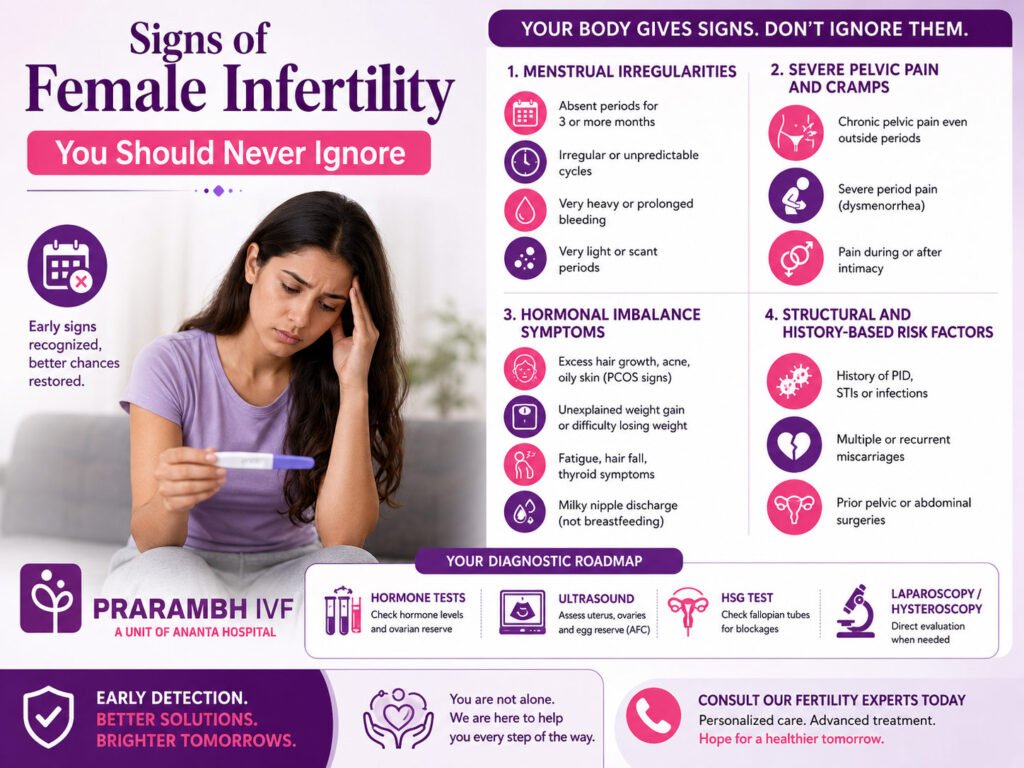
The desire to build a family is one of the most profound human experiences. However, for many individuals and couples, the journey to parenthood does not happen as quickly or smoothly as expected. Infertility is a widespread medical condition, affecting millions of people worldwide. Yet, because reproductive health is frequently treated as a private matter, many women live with subtle warning signs for years without realizing they point toward an underlying fertility challenge.
At Prarambh IVF and Women’s Hospital, our core mission is to replace anxiety with clinical clarity and actionable medical guidance. Recognizing the early signs of female infertility is not about panic; it is about empowerment. By understanding what your body is trying to communicate through its physiological signals, you can seek timely care, prevent reproductive conditions from advancing, and significantly optimize your chances of a healthy pregnancy.
1. Redefining Infertility: When Should You Seek Answers?
Before diving into the specific physical signs, it is vital to establish the medical definition of infertility. In reproductive medicine, fertility specialists benchmark timelines based on maternal age because of its direct correlation with egg quality and quantity.
- Under Age 35: Infertility is clinically defined as the inability to conceive after 12 months of regular, unprotected intercourse.
- Age 35 and Older: The timeline shortens to 6 months of regular, unprotected intercourse.
- Age 40 and Older: Immediate evaluation is recommended for couples planning to conceive, as the natural biological window is narrower.
A Crucial Note from Our Specialists: You do not have to wait for these timelines to expire if you are experiencing pain, severe irregularities, or have a known history of reproductive disorders. Early intervention is always the most protective step you can take for your reproductive future.
2. Menstrual Cycle Irregularities: Your Fertility Barometer
Your menstrual cycle is a direct reflection of your endocrine (hormonal) health. A regular cycle indicates that your brain, ovaries, and uterus are communicating seamlessly to mature and release an egg each month. When this communication breaks down, your period changes.
Complete Absence of Periods (Amenorrhea)
If you are not pregnant, tracking a complete absence of periods for three or more consecutive months is a significant sign that demands medical attention. Except during pregnancy, lactation, or menopause, a missing period typically indicates anovulation—a state where your ovaries are not releasing an egg. Without ovulation, conception is biologically impossible.
Highly Irregular or Unpredictable Cycles
A standard, healthy menstrual cycle typically lasts between 21 and 35 days, with bleeding lasting 3 to 7 days. If your cycles are completely unpredictable—such as 20 days one month, 45 days the next, or missing for two months entirely—it indicates that your body is struggling to maintain a consistent ovulatory pattern.
Abnormally Heavy or Prolonged Bleeding (Menorrhagia)
Soaking through pads or tampons every hour for several hours in a row, passing blood clots larger than a coin, or bleeding for more than 7 consecutive days is not just an inconvenience; it is a clinical symptom. Heavy bleeding can be tied to:
- Uterine fibroids or polyps
- Hormonal imbalances (estrogen dominance)
- Endometrial hyperplasia (thickening of the uterine lining)
Very Light or Scant Periods
While a light period can sometimes be natural, an abruptly short or exceptionally light cycle (lasting only a day or consisting purely of spotting) can indicate a very thin endometrial lining or an inadequate production of estrogen, which can prevent an embryo from successfully implanting.
3. Severe Pelvic Pain and Debilitating Cramps
There is a common, unfortunate misconception that severe pain during a menstrual cycle is simply “part of being a woman.” At Prarambh IVF and Women’s Hospital, we firmly push back against this narrative. While mild, manageable discomfort due to prostaglandins is normal, debilitating pelvic pain is a medical red flag.
Chronic Pelvic Pain (Even Outside Your Period)
Experiencing a dull, structural ache or sharp pains in your lower abdomen or pelvic region throughout the month—independent of your period—can point to chronic pelvic inflammatory disease (PID), pelvic adhesions (scar tissue), or deep-infiltrating endometriosis.
Severe Dysmenorrhea (Painful Periods)
If your menstrual cramps force you to miss work, skip school, or rely heavily on high doses of pain medication just to get through the day, it may be a sign of Endometriosis. This is a condition where tissue similar to the lining of the uterus grows outside the uterine cavity (on the ovaries, fallopian tubes, or pelvic walls). Endometriosis can alter pelvic anatomy, cause blockages in the fallopian tubes, and create a localized inflammatory environment that degrades egg quality.
Pain During Intimacy (Dyspareunia)
Deep pelvic pain during or immediately after intercourse is another frequent, yet underreported, symptom of endometriosis or pelvic scar tissue. If structural abnormalities or inflammation make intimacy painful, it directly impacts both your quality of life and your structural capacity to conceive naturally.
4. Systemic Hormonal Imbalances: Signs Beyond the Uterus
Hormones govern every single phase of the reproductive process. When key glands—such as the hypothalamus, pituitary gland, thyroid, or ovaries—produce too much or too little of a specific hormone, the systemic imbalance manifests through distinct physical symptoms across your entire body.
Polycystic Ovary Syndrome (PCOS) Indicators
PCOS is one of the leading causes of female infertility worldwide. It involves an elevated production of androgens (male hormones) and insulin resistance, which prevents follicles from maturing and releasing eggs properly. Key warning signs include:
- Hirsutism: Sudden or excess hair growth on the face, chin, chest, or abdomen.
- Severe Adult Acne: Persistent cystic acne along the jawline and neck that does not respond to standard skincare routines.
- Acanthosis Nigricans: Patches of darkened, velvety skin, typically found around the neck, armpits, or groin, indicating insulin resistance.
- Unexplained Weight Gain: Difficulty managing weight, particularly around the abdomen, despite a balanced diet and regular physical activity.
Thyroid Dysfunction Symptoms
The thyroid gland regulates your body’s overall metabolism, and its hormones are crucial for maintaining early pregnancies. Both an overactive thyroid (hyperthyroidism) and an underactive thyroid (hypothyroidism) can cause anovulation and increase the risk of early miscarriage.
- Hypothyroidism Signs: Chronic fatigue, unexplained weight gain, feeling constantly cold, dry skin, and constipation.
- Hyperthyroidism Signs: Sudden weight loss, rapid or irregular heart rate, heat intolerance, anxiety, and tremors.
Hyperprolactinemia (Elevated Prolactin Levels)
Prolactin is the hormone responsible for stimulating milk production during lactation. However, if your body produces high levels of prolactin when you are not pregnant or nursing—often due to stress or a small, benign growth on the pituitary gland—it suppresses ovulation. A key symptom to watch for is galactorrhea (milky nipple discharge unrelated to breastfeeding).
5. Structural and History-Based Risk Factors
Some factors that contribute to infertility do not present daily symptoms. Instead, they are deeply rooted in your medical history, structural anatomy, or prior physical conditions.
A History of Pelvic Inflammatory Disease (PID) or STIs
Pelvic Inflammatory Disease is an infection of the female reproductive organs, often tracking back to untreated sexually transmitted infections (STIs) such as chlamydia or gonorrhea. Even if the initial infection happened years ago and was cured, the resulting inflammation can leave behind permanent scar tissue that blocks or damages the fallopian tubes, preventing the sperm from meeting the egg.
Multiple or Recurrent Miscarriages
Conceiving an embryo is only the first step; carrying it to term requires a complex series of biological events. Experiencing two or more consecutive pregnancy losses is clinically classified as Recurrent Pregnancy Loss (RPL). This pattern is a clear sign of an underlying fertility barrier that requires investigation, often related to:
- Chromosomal variations in the embryos
- Uterine structural anomalies (such as a septate or bicornuate uterus)
- Autoimmune or blood-clotting disorders (like Antiphospholipid Syndrome)
- Progesterone deficiencies
Prior Abdominal or Pelvic Surgeries
If you have undergone surgeries for ruptured appendicitis, ovarian cysts, uterine fibroids, or bowel conditions, the natural healing process can sometimes cause pelvic adhesions. These bands of scar tissue can bind pelvic organs together, shifting the fallopian tubes out of place or twisting them, which prevents them from successfully picking up an egg during ovulation.
6. Your Diagnostic Roadmap: What to Expect at the Clinic
If you recognize one or more of these signs in yourself, the next step is seeking a specialized diagnostic evaluation. At Prarambh IVF and Women’s Hospital, we demystify this process. We focus on non-invasive, structured testing to pinpoint the exact root cause of your challenges, ensuring you never have to guess about your reproductive health.
1.Comprehensive Blood Evaluation:Hormonal Foundation.
We map your exact ovarian reserve and endocrine function by measuring baseline hormone levels, including Anti-Müllerian Hormone (AMH), Follicle-Stimulating Hormone (FSH), Thyroid-Stimulating Hormone (TSH), and Prolactin.
2.Advanced Pelvic Ultrasound:Internal Architecture.
Using high-resolution transvaginal ultrasound, our specialists closely examine the uterus for structural anomalies, check the endometrial lining, and perform an Antral Follicle Count (AFC) to visualize your remaining egg reserve.
3.Hysterosalpingography (HSG):Tubal Patency Patrolling.
This specialized, diagnostic X-ray procedure utilizes a gentle, water-soluble contrast dye to confirm whether your fallopian tubes are completely open and clear of structural blockages or adhesions.
4.Diagnostic Hysteroscopy or Laparoscopy:Direct Visual Verification.
If structural abnormalities or endometriosis are suspected, a minimally invasive, thin camera is used to directly look inside the uterus or pelvic cavity, allowing our surgeons to view and treat issues simultaneously.
7. Evidence-Based Interventions: Tailored Pathways to Parenthood
An infertility diagnosis is not a dead end; it is simply the starting point for a highly strategic medical roadmap. Modern reproductive science provides excellent, reliable pathways to help you overcome these challenges.
Medical Management and Ovulation Induction
For women dealing with PCOS or irregular cycles due to hormonal imbalances, lifestyle modifications combined with oral medications (such as letrozole or clomiphene citrate) can stimulate the ovaries to reliably mature and release a healthy egg, frequently leading to natural conception.
Surgical Optimization
When uterine fibroids, endometrial polyps, or severe pelvic scar tissue are identified, advanced minimally invasive surgeries—such as operative hysteroscopy or keyhole laparoscopy—can fully restore your natural pelvic and uterine anatomy, significantly improving your natural fertility or subsequent IVF success rates.
Assisted Reproductive Technologies (ART)
When structural blockages exist in the fallopian tubes, or when severe endometriosis or unexplained infertility factors are present, advanced laboratory protocols provide highly successful solutions:
- Intrauterine Insemination (IUI): Specially prepared, highly motile sperm is placed directly inside the uterus around the time of ovulation.
- In Vitro Fertilization (IVF): Eggs are safely retrieved from the ovaries, fertilized in an advanced embryology laboratory, and the resulting healthy embryo is transferred directly into the prepared uterus, entirely bypassing blocked fallopian tubes or hostile pelvic environments.
Your Next Steps at Prarambh IVF and Women’s Hospital
Listening to your body is the single most proactive step you can take on your path toward parenthood. Symptoms like severe cycle pain, extreme irregularity, or systemic hormonal disruptions are your body’s way of requesting expert care. Ignoring these signs can lead to conditions progressing, making future treatments more complex than necessary.
At Prarambh IVF and Women’s Hospital, we believe that every woman deserves an individualized, scientifically backed, and highly compassionate fertility plan. We combine cutting-edge medical technology and state-of-the-art laboratory infrastructure with a warm, patient-first approach that respects your emotional well-being just as much as your physical care.
You do not have to navigate the confusion or uncertainty of reproductive health alone. Our dedicated team of reproductive endocrinologists, embryologists, and specialized fertility counselors is here to walk alongside you, transforming your questions into clear, confident answers.
Take charge of your reproductive wellness today:
Visit our official website at www.prarambhivf.com to schedule a private, thorough, and highly confidential fertility consultation with our expert team. Let us work together to build the family you dream of.
