
Embarking on the journey to parenthood is a deeply meaningful milestone, but for many couples, the road takes a turn toward assisted reproductive technology (ART). If you are considering In Vitro Fertilization (IVF), one of the first and most critical metrics you will encounter is how female age influences your chances of success.
At Prarambh IVF and Women’s Hospital, we believe that transparency, scientific clarity, and clinical empathy are essential to a successful fertility journey. Understanding the statistics around age helps you manage expectations, make informed timeline decisions, and select the right treatment pathways.
This comprehensive guide breaks down how IVF success rates change by age group, why these changes occur, and how modern medical advancements allow us to optimize your chances of holding a healthy baby in your arms.
1. The Biological Connection: Age, Egg Quantity, and Egg Quality
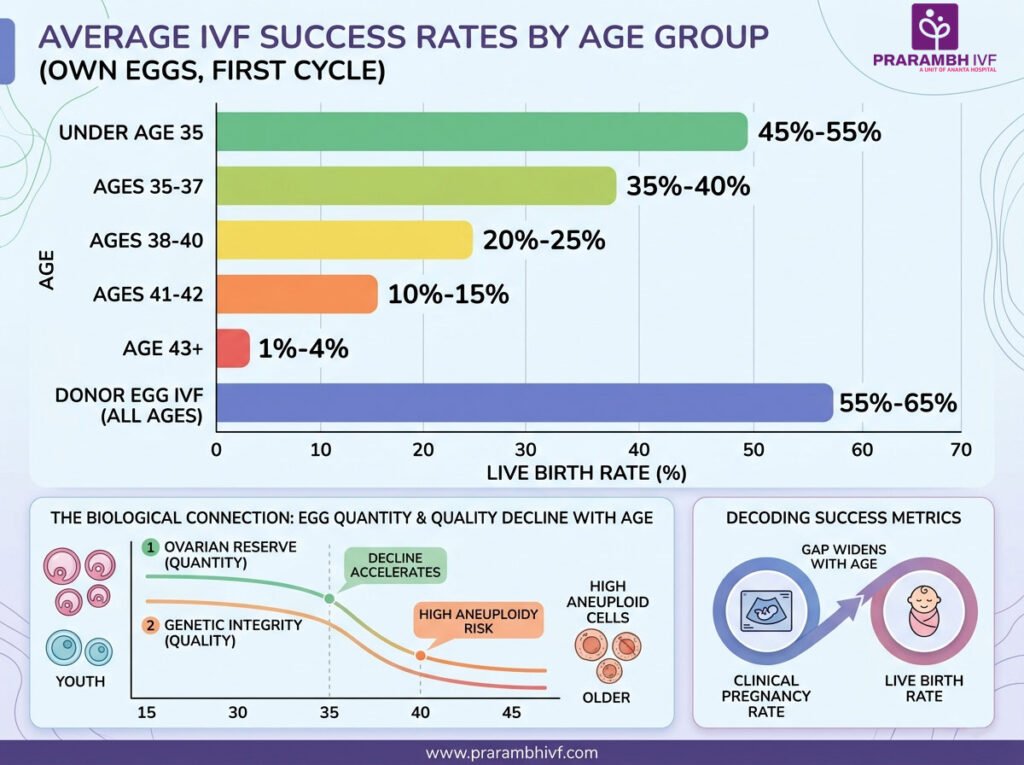
To understand why age is a pivotal factor in IVF success, we must look at fundamental reproductive biology. Unlike men, who produce new sperm continuously throughout their lives, women are born with all the eggs they will ever have—roughly 1 to 2 million at birth.
By puberty, this number drops to around 300,000 to 400,000. From that point forward, a woman’s egg reserve steadily declines with every menstrual cycle. This decline happens in two ways:
- Egg Quantity (Ovarian Reserve): The total number of viable eggs remaining in the ovaries decreases over time.
- Egg Quality (Genetic Integrity): As eggs age inside the ovaries, they become more prone to errors during cell division. This can lead to aneuploidy—a condition where an embryo has an abnormal number of chromosomes. Aneuploid embryos are less likely to implant in the uterus, and if they do, they carry a higher risk of miscarriage.
While overall health, nutrition, and lifestyle can support your general reproductive wellness, they cannot reverse or halt this natural genetic timeline. This is why female age remains the single most reliable predictor of IVF success when using a patient’s own eggs.
2. Decoding IVF Success Metrics: Clinical Pregnancy vs. Live Birth
When researching success rates on fertility websites, it is easy to get overwhelmed by different statistical terms. At Prarambh IVF and Women’s Hospital, we urge couples to understand the difference between two primary metrics:
- Clinical Pregnancy Rate: This confirms that a pregnancy has been established, verified by a visible gestational sac on an ultrasound or a fetal heartbeat at roughly 6 to 7 weeks.
- Live Birth Rate: This represents the true gold standard of fertility care—the percentage of IVF cycles that result in the delivery of a living, healthy baby.
Because miscarriage rates naturally rise with maternal age, the gap between the clinical pregnancy rate and the live birth rate tends to widen as a patient grows older. When planning your treatment, always look at live birth rates for the most realistic picture of your path ahead.
3. IVF Success Rates by Age Group: A Real Look at the Numbers
While individual health profiles vary significantly, broad clinical data provides a benchmark for what couples can expect across different stages of life. Below is a detailed breakdown of average IVF success rates by age group using a patient’s own eggs.
Under Age 35: The Optimal Reproductive Window
For women under 35, both egg quantity and quality are typically at their peak. Ovaries respond robustly to hormonal stimulation, often yielding a healthy number of mature eggs during a single retrieval cycle.
- Average Live Birth Rate per Cycle: 45% to 55%
- What to Know: This age group has the highest probability of success within a single IVF cycle. Because egg quality is generally high, younger patients frequently produce multiple healthy blastocysts (5-day-old embryos). This often allows for extra embryos to be frozen for future use via vitrification (advanced flash-freezing technology), making subsequent sibling journeys easier and more cost-effective.
Ages 35 to 37: The Turning Point
The mid-30s represent a transitional phase where the natural decline in fertility begins to accelerate. While success rates remain strong, time becomes a more vital factor in clinical decision-making.
- Average Live Birth Rate per Cycle: 35% to 40%
- What to Know: Many women in this category still achieve highly successful outcomes. However, a slightly higher percentage of retrieved eggs may show chromosomal abnormalities. If a couple has been trying to conceive naturally for more than six months in this age bracket, our specialists at Prarambh IVF and Women’s Hospital recommend scheduling a fertility assessment to avoid unnecessary delays.
Ages 38 to 40: Navigating the Accelerated Decline
By the late 30s, the decline in both ovarian reserve and egg quality moves at a faster pace. The percentage of genetically normal embryos drops, which means it may take more effort to find a healthy embryo for transfer.
- Average Live Birth Rate per Cycle: 20% to 25%
- What to Know: Achieving a successful pregnancy is absolutely possible, but it may require tailored clinical protocols. Couples in this age group often benefit from specific medical interventions, such as Preimplantation Genetic Testing (PGT-A), to screen embryos for chromosomal health before they are transferred to the uterus.
Ages 41 to 42: A Challenging but Viable Path
Past the age of 40, the biological landscape shifts significantly. A larger percentage of a woman’s remaining eggs will carry chromosomal variations, making the selection of a healthy embryo more difficult.
- Average Live Birth Rate per Cycle: 10% to 15%
- What to Know: Patience and advanced clinical expertise are key in this age range. It is not uncommon for patients aged 41 to 42 to undergo more than one egg retrieval cycle—a process known as embryo pooling—to accumulate enough viable embryos to achieve a healthy pregnancy.
Age 43 and Above: Exploring All Pathways
Statistically, undergoing IVF with your own eggs past the age of 43 yields a live birth rate of less than 5% per cycle.
- Average Live Birth Rate per Cycle: 1% to 4%
- What to Know: While individual exceptions exist, couples in this group are often encouraged to explore third-party reproduction, such as donor egg IVF. Using healthy, high-quality eggs from a young donor immediately resets the success rate to match that of a woman under 35, bypassing the age-related limitations of the ovaries while allowing the intended mother to carry and experience the pregnancy.
4. Key Factors Beyond Age That Influence Your Success
While age is an incredibly important piece of the puzzle, it is never the only factor. A successful pregnancy relies on a delicate balance of multiple biological systems.
Male Factor Fertility
Fertility is a shared journey. Roughly 40% of all infertility cases involve a male factor, such as low sperm count, poor motility (movement), or abnormal morphology (shape). Advanced paternal age can also impact sperm DNA integrity. At Prarambh IVF and Women’s Hospital, we perform extensive semen analyses alongside female evaluations to ensure we address the complete picture from day one.
Uterine Health and Receptivity
An embryo needs a healthy environment to plant its roots. Structural issues like uterine fibroids, endometrial polyps, scar tissue, or a thin endometrial lining can impede implantation, regardless of egg quality. Ensuring the uterus is fully prepared and receptive is a cornerstone of our transfer preparation.
Lifestyle and Environmental Factors
Your daily habits can influence how your body responds to fertility medications. Factors that can impact your overall reproductive response include:
- Smoking and Alcohol Consumption: Both can noticeably degrade egg and sperm quality.
- Body Mass Index (BMI): Being significantly under or over an optimal weight range can cause hormonal imbalances that affect ovulation and uterine receptivity.
- Chronic Stress: While stress doesn’t directly cause infertility, managing it effectively helps your body cope with the physical demands of treatment.
5. Advanced Clinical Strategies to Overcome Age-Related Infertility
Modern reproductive science has changed what is possible in fertility medicine. At Prarambh IVF and Women’s Hospital, we use advanced laboratory techniques to improve success rates for couples facing age-related fertility challenges.
Preimplantation Genetic Testing (PGT-A)
PGT-A is a breakthrough technology that allows embryologists to safely screen embryos for chromosomal abnormalities before transfer. By identifying and selecting only euploid (chromosomally normal) embryos, we can:
- Significantly increase the implantation success rate per transfer.
- Substantially lower the risk of miscarriage.
- Reduce the time it takes to achieve a successful pregnancy.
Tailored Ovarian Stimulation Protocols
No two bodies are identical. For patients with a diminished ovarian reserve, standard medication doses may not be effective. Our specialists design customized, mild, or antagonist stimulation protocols aimed at maximizing egg quality rather than just quantity, ensuring your ovaries are supported gently and effectively.
Blastocyst Culture and Single Embryo Transfer (eSET)
Growing embryos in our advanced incubators until the blastocyst stage (day 5 or 6) allows us to naturally identify the strongest, most resilient embryos. Transferring a single, high-quality blastocyst gives you an optimal chance of pregnancy while avoiding the high-risk complications associated with carrying twins or triplets.
Egg Freezing (Social or Medical Oocyte Cryopreservation)
If you are currently under 35 but know you want to delay building a family for career, personal, or medical reasons, egg freezing offers a way to pause your biological clock. Freezing your eggs preserves their current quality, allowing you to become your own donor later in life with the success rates of your younger self.
6. Navigating Your Fertility Journey: A Guided Checklist
If you are feeling ready to take the next step, breaking the process down into actionable stages can make the path forward feel clearer and more manageable.
1.Initial Consultation and Testing: Weeks 1-2.
Schedule a comprehensive evaluation including blood work (AMH levels to assess egg reserve) and a detailed semen analysis for your partner.
2.Personalized Protocol Design: Week 3.
Meet with your fertility specialist to review your test results and map out a customized IVF or treatment timeline tailored to your age and anatomy.
3.Ovarian Stimulation & Monitoring: Weeks 4-5.
Begin a 10-to-12-day course of fertility medications, supported by regular ultrasounds and blood checks to monitor follicle development.
4.Egg Retrieval and Fertilization: Week 6.
Undergo a brief, minor procedure under light sedation to collect mature eggs, which are then immediately fertilized in our laboratory using ICSI if needed.
5.Genetic Screening and Selection: Week 7 (Optional).
If choosing PGT-A screening, embryos are safely biopsied and frozen while genetic insights are analyzed to identify the healthiest option for transfer.
6.Embryo Transfer and Two-Week Wait: Week 8.
Place the selected embryo gently into the prepared uterus, followed by a 10-to-12-day waiting period before a definitive blood pregnancy test.
Your Next Steps at Prarambh IVF and Women’s Hospital
Statistics and percentages offer valuable guidance, but they are only part of your story. Every couple’s biology is unique, and a lower statistical percentage does not mean your dream of parenthood is out of reach—it simply means you need an experienced, dedicated clinical team to chart the right path forward.
At Prarambh IVF and Women’s Hospital, we combine world-class medical infrastructure with deeply compassionate, patient-centered care. Our goal is to demystify fertility science, minimize your stress, and give you the absolute highest chance of building the family you dream of.
If you are ready to explore your options, clarify your fertility health, or learn more about customized treatment pathways, we are here to support you every step of the way.
Connect with our fertility experts today:
Visit our official website at www.prarambhivf.com to book a personalized, confidential consultation. Let’s take this beautiful step toward your future together.
