
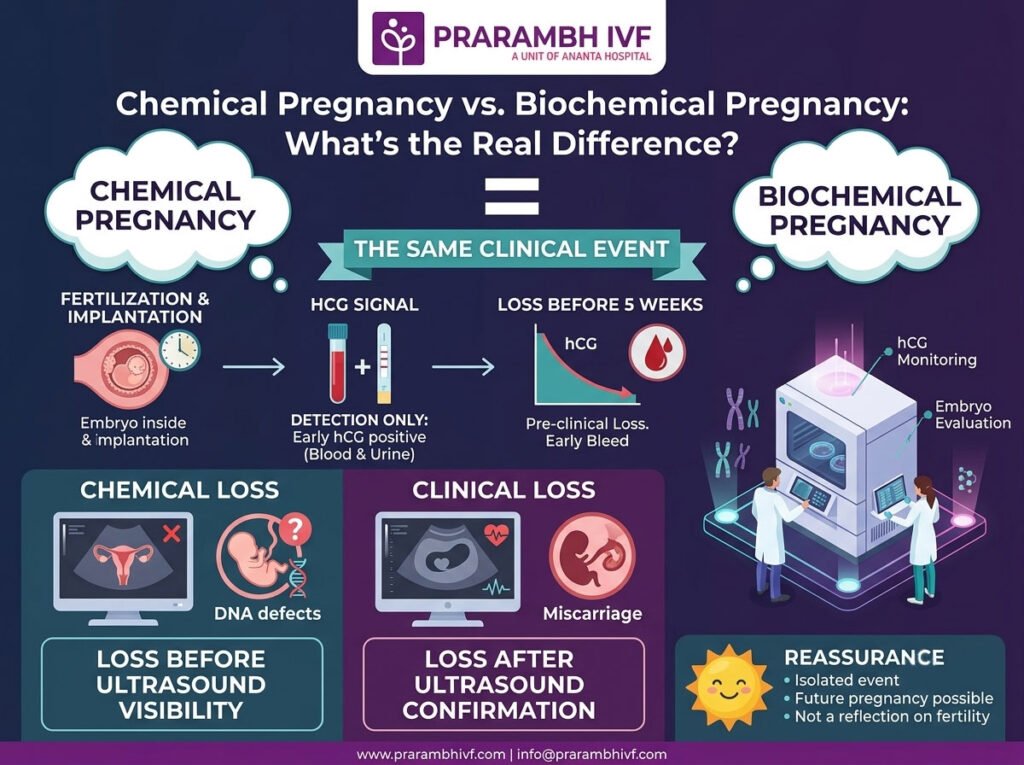
If you’ve been searching for answers after a positive pregnancy test followed by an unexpected period, you’ve likely come across two confusing terms: chemical pregnancy and biochemical pregnancy. Many people searching for this information assume these are two different conditions — but here’s the short answer: they are the same thing.
At Prarambh IVF and Women’s Hospital, we speak with patients almost every week who are unsure whether their experience was “just a late period,” a miscarriage, or something else entirely. This guide breaks down exactly what a chemical/biochemical pregnancy is, why it happens, how it’s diagnosed, and what it means for your future fertility treatment — including IVF and IUI cycles.
Chemical Pregnancy and Biochemical Pregnancy: Same Term, Different Names
Let’s clear up the confusion right away: a chemical pregnancy and a biochemical pregnancy are identical medical events. “Biochemical pregnancy” is the clinical term used in medical literature, while “chemical pregnancy” is the more commonly used everyday term. Doctors, embryologists, and fertility specialists use both interchangeably.
So if you’ve been searching for a difference between the two, the real answer is: there isn’t one. The confusion usually comes from people trying to compare a chemical pregnancy to a clinical pregnancy or a clinical miscarriage — and that comparison is where the meaningful differences actually lie.
What Is a Chemical (Biochemical) Pregnancy?
A chemical pregnancy is a very early pregnancy loss that occurs shortly after implantation — usually before the fifth week of pregnancy, and often before an ultrasound would even be able to detect a gestational sac. It’s called “chemical” because the only evidence of the pregnancy is a chemical signal: a detectable rise in the hormone hCG (human chorionic gonadotropin), picked up by a blood test or a home urine pregnancy test.
Here’s what typically happens:
- Fertilization occurs, and the embryo begins developing.
- The embryo implants in the uterine lining, and the body starts producing hCG.
- A pregnancy test (urine or blood) detects this hCG and returns a positive result.
- Before the pregnancy can progress further, development stops — usually because the embryo had a chromosomal abnormality incompatible with survival.
- hCG levels fall, and a period-like bleed follows, often just a few days later than expected.
Because this all happens before a gestational sac is visible on ultrasound, a chemical pregnancy is sometimes called a “pre-clinical” loss — it never progresses to the stage where it would be classified as a clinical pregnancy.
Chemical Pregnancy vs. Clinical Pregnancy: Where the Real Difference Lies
This is the comparison that actually matters, and it’s worth understanding clearly:
| Feature | Chemical (Biochemical) Pregnancy | Clinical Pregnancy |
|---|---|---|
| hCG detected | Yes | Yes |
| Gestational sac visible on ultrasound | No | Yes |
| Fetal heartbeat detected | No | Usually, by 6–7 weeks |
| Timing of loss (if it occurs) | Before week 5, often around the expected period | After ultrasound confirmation |
| Classified medically as | Biochemical loss | Clinical miscarriage (if loss occurs) |
A clinical pregnancy is confirmed once an ultrasound can visualize a gestational sac — typically around 5.5 to 6 weeks. If a loss happens after that point, it’s classified as a clinical miscarriage, not a chemical pregnancy. This distinction matters for medical record-keeping, for how your doctor counts your pregnancy history, and for how future treatment plans (including any IVF protocol adjustments) are approached.
How Common Are Chemical Pregnancies?
Chemical pregnancies are far more common than most people realize — they’re simply underreported because many happen before a person even knows they’re pregnant. Research suggests that:
- Chemical pregnancies may account for 50–75% of all pregnancy losses, including those that occur so early the person never tests positive at all.
- Among people actively trying to conceive and testing early (including many IVF and IUI patients who test days after transfer), chemical pregnancies are detected far more frequently than in the general population — simply because early, sensitive testing catches losses that would otherwise go unnoticed.
- The likelihood increases with maternal age, primarily due to a higher rate of chromosomal abnormalities in eggs as women get older.
If you’ve experienced one chemical pregnancy, it does not mean you’re at significantly higher risk for another, or that something is fundamentally wrong with your fertility. In most cases, it’s simply your body correctly recognizing and not carrying forward an embryo that wasn’t going to develop successfully.
What Causes a Chemical Pregnancy?
1. Chromosomal Abnormalities (the most common cause)
The overwhelming majority of chemical pregnancies happen because the embryo has a chromosomal abnormality that makes continued development impossible. This is a random, one-time genetic event in most cases — not usually a sign of a hereditary condition or a problem that will repeat in future cycles.
2. Implantation Issues
Sometimes the embryo is chromosomally normal, but the uterine lining isn’t optimally receptive, or implantation itself is incomplete. Conditions like a thin endometrium can affect how securely an embryo implants and whether early pregnancy hormone support is sufficient to sustain it.
3. Hormonal Imbalances
Inadequate progesterone support after ovulation or embryo transfer can prevent the uterine lining from maintaining a pregnancy in its earliest days. This is one reason fertility specialists closely monitor hormone levels in the days following an IUI or IVF procedure.
4. Underlying Reproductive Conditions
Conditions such as PCOS, uterine abnormalities, or clotting disorders can occasionally contribute to early implantation failure. If you have PCOS, your fertility specialist may recommend specific monitoring or medication adjustments to reduce this risk in future cycles.
5. Age-Related Egg Quality
As egg quality naturally declines with age, the chance of an embryo carrying a chromosomal abnormality rises — making chemical pregnancy somewhat more common in patients over 35.
6. Embryo Quality in IVF Cycles
In IVF, embryo grading can offer some insight into developmental potential, though even well-graded embryos can occasionally result in a chemical pregnancy due to underlying chromosomal issues not visible under a microscope. Understanding how embryo grading works can help set realistic expectations for any given transfer.
Symptoms of a Chemical Pregnancy
Because a chemical pregnancy resolves so early, symptoms are often subtle — and many people experience no distinct symptoms beyond a positive test followed by a period:
- A positive home pregnancy test, followed within days by bleeding
- A period that arrives slightly later than expected, sometimes heavier or with more cramping than usual
- Mild pregnancy symptoms (breast tenderness, fatigue) that disappear quickly
- A positive blood hCG test that fails to rise appropriately on repeat testing, then declines
If you’re undergoing fertility treatment and testing hCG levels via blood draw (as is standard after IVF embryo transfer), your clinical team will typically notice this pattern — an initial positive result followed by hCG levels that plateau or fall — before you experience any bleeding at all.
How Is a Chemical Pregnancy Diagnosed?
Diagnosis usually involves:
- An initial positive pregnancy test — urine-based or, more precisely, a blood hCG test.
- Serial hCG monitoring — in a healthy, progressing pregnancy, hCG levels roughly double every 48–72 hours in early weeks. In a chemical pregnancy, levels rise slowly, plateau, or begin dropping.
- Absence of ultrasound findings — because the loss occurs before a gestational sac would be visible, no ultrasound-based miscarriage diagnosis is made; the diagnosis is based on hormone patterns alone.
This is one of the key reasons why fertility clinics, including Prarambh IVF and Women’s Hospital, use blood-based hCG testing rather than relying solely on home urine tests after treatment cycles — it allows the care team to track trends precisely and provide clear answers, rather than leaving patients guessing.
Does a Chemical Pregnancy Mean Something Is Wrong With Me?
This is, understandably, the question we hear most often — and for most patients, the answer is reassuring: no.
A single chemical pregnancy is usually an isolated, random genetic event — evidence, in fact, that fertilization and implantation are possible for you, which is itself meaningful information. It does not automatically indicate:
- A hormonal disorder
- Poor egg or sperm quality overall
- A structural problem with the uterus
- Reduced future fertility
However, if chemical pregnancies happen repeatedly (generally defined as two or more), it’s worth a deeper fertility workup to rule out recurring causes such as thin endometrial lining, clotting disorders, chronic endometritis, or hormonal insufficiencies — many of which are treatable once identified. This is also when specialists may look more closely at findings that don’t show up on standard reports, similar to the deeper investigation discussed in our guide on why IVF can fail even when test reports look normal.
Chemical Pregnancy After IUI or IVF: What Patients Should Know
Because fertility patients test earlier and more frequently than the general population, chemical pregnancies are detected — and experienced — more often during treatment. A few important points if this happens during your journey:
- It doesn’t mean the cycle “failed” in a meaningless way. A chemical pregnancy confirms that fertilization, embryo development, and at least partial implantation occurred — each a meaningful data point for your care team.
- It doesn’t necessarily change your prognosis. Many patients go on to have a successful pregnancy in a subsequent cycle, sometimes without any protocol changes at all.
- Your specialist may review your protocol. Depending on your history, your doctor might adjust progesterone support, review your frozen embryo transfer versus fresh transfer approach, or recommend additional testing before your next cycle.
- Emotional support matters. Even an early loss can be emotionally difficult, especially after the effort involved in fertility treatment. Give yourself permission to grieve, and don’t hesitate to lean on your care team or a counselor for support.
Can You Prevent a Chemical Pregnancy?
Because most chemical pregnancies result from random chromosomal abnormalities, they usually can’t be entirely prevented. That said, several strategies can help optimize your chances of a healthy, progressing pregnancy:
- Optimizing uterine lining health before transfer or insemination
- Adequate progesterone support in the luteal phase and early pregnancy
- Managing underlying conditions like PCOS, thyroid imbalances, or clotting disorders
- Considering embryo testing (PGT-A) in IVF cycles, particularly for patients with recurrent early losses or advanced maternal age, to help identify chromosomally normal embryos before transfer
- Maintaining overall health — balanced nutrition, healthy weight, and avoiding smoking or excessive alcohol, all of which support egg and sperm quality
When to See a Fertility Specialist
Consider scheduling a consultation if:
- You’ve experienced two or more chemical pregnancies
- You’re over 35 and have experienced any early pregnancy loss
- You have a known condition such as PCOS, endometriosis, or thyroid dysfunction
- You’ve been trying to conceive for over a year (six months if over 35) without success
At Prarambh IVF and Women’s Hospital, our specialists take a thorough, individualized approach — reviewing hormonal patterns, uterine health, and where relevant, embryo quality — to understand what happened and to build a clear plan going forward, whether that involves natural conception support, IUI, or IVF.
Frequently Asked Questions
Is a chemical pregnancy the same as a miscarriage? Medically, yes — it is classified as a very early pregnancy loss. However, because it occurs before clinical confirmation (before a gestational sac is visible on ultrasound), it’s categorized separately from a clinical miscarriage in medical records and statistics.
How soon after a chemical pregnancy can I try again? Most doctors advise waiting until after your next full menstrual cycle, both to allow your hCG levels to return to zero and to give your body time to reset. Your fertility specialist can advise on timing specific to your treatment plan.
Does a chemical pregnancy affect my IVF success rate in future cycles? Not typically. A single chemical pregnancy is not generally considered a predictor of future IVF outcomes. If it recurs, your specialist may recommend additional testing to look for an underlying, correctable cause.
Can stress cause a chemical pregnancy? There’s no strong scientific evidence that everyday stress directly causes a chemical pregnancy. The overwhelming majority are linked to chromosomal factors in the embryo, not lifestyle stress.
Do I need treatment after a chemical pregnancy? Usually not, unless it recurs. A single chemical pregnancy typically requires no specific treatment — just time before trying again. Recurrent chemical pregnancies warrant a fertility evaluation.
Final Thoughts
A chemical pregnancy and a biochemical pregnancy are simply two names for the same early pregnancy event — and while the experience can be emotionally difficult, it’s rarely a sign of a serious underlying problem, especially when it happens just once. Understanding what’s actually happening in your body can make a confusing, upsetting experience feel a little more manageable.
If you’ve experienced a chemical pregnancy — whether naturally or during fertility treatment — and have questions about what it means for your journey, the team at Prarambh IVF and Women’s Hospital is here to help.
📍 Visit us: www.prarambhivf.com 📧 Email: info@prarambhivf.com 📖 Explore more fertility guides on our Blog
Related Services:
- In Vitro Fertilization (IVF)
- Intrauterine Insemination (IUI)
- Female Infertility Treatments
- Ovulation Induction
Related Reads:
- Thin Endometrium: Can You Still Get Pregnant with IVF?
- Why IVF Fails Even When Reports Are Normal
- What Is Embryo Grading & Why It Matters in IVF
- Frozen Embryo Transfer (FET) vs. Fresh Transfer: Which Works Better?
- PCOS and IVF: What Changes in Treatment Strategy?
Book your consultation with Prarambh IVF and Women’s Hospital today — take the first step toward answers and a clear path forward.
