
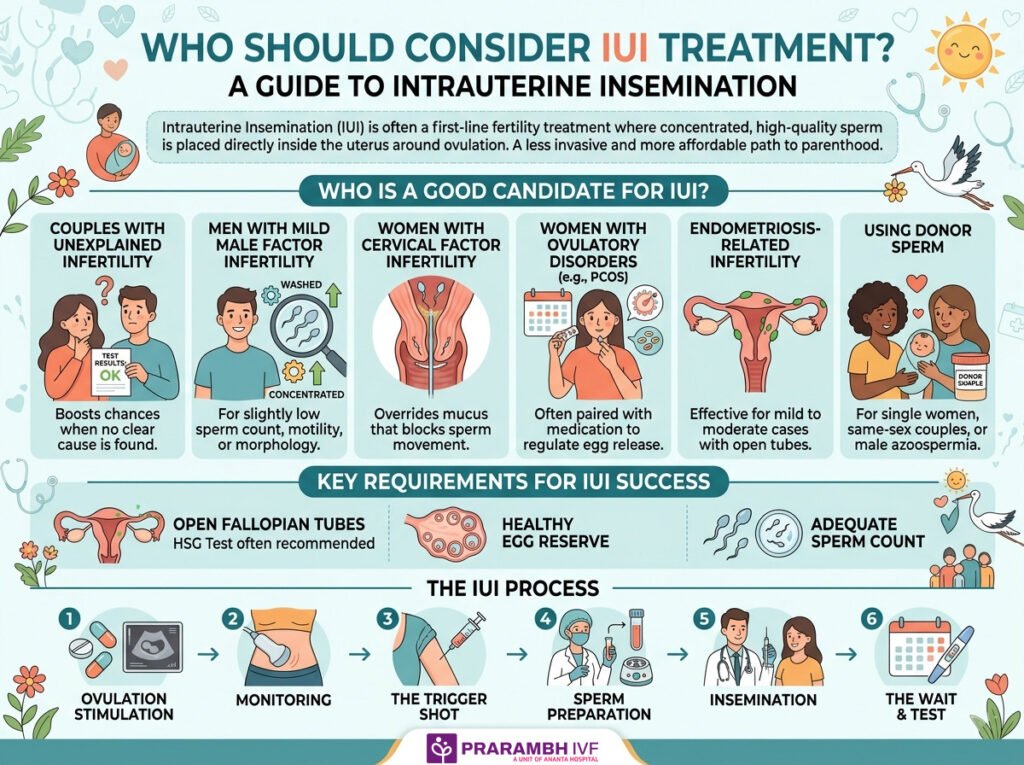
Intrauterine Insemination (IUI) is often the first step many couples and individuals take on their journey toward parenthood. It is a less invasive and more affordable fertility treatment compared to In Vitro Fertilization (IVF), making it a popular choice for addressing various reproductive challenges.
At Prarambh IVF, we believe that understanding your options is the first step toward success. This comprehensive guide explores who should consider IUI, how the process works, and what factors contribute to a successful outcome.
Understanding IUI: The Basics
Intrauterine Insemination (IUI) is a fertility procedure where high-quality, concentrated sperm is placed directly inside a woman’s uterus around the time of ovulation. The goal is to increase the number of sperm that reach the fallopian tubes, thereby increasing the chance of fertilization.
Unlike IVF, where fertilization happens in a lab, IUI relies on the natural ability of the sperm to reach and fertilize the egg within the body.
Who is a Good Candidate for IUI?
IUI is a versatile treatment that can address several different fertility issues. You might consider IUI if you fall into any of the following categories:
1. Couples with Unexplained Infertility
Many couples undergo extensive testing only to find no clear reason why they aren’t conceiving. This is known as “unexplained infertility.” IUI, often combined with ovulation-inducing medication, is frequently the first line of treatment in these cases as it boosts the “odds” of a successful meeting between egg and sperm.
2. Men with Mild Male Factor Infertility
If a semen analysis shows slightly below-average sperm concentration, moderate issues with sperm movement (motility), or minor abnormalities in size and shape (morphology), IUI can help. The process of “washing” the sperm in the lab concentrates the healthiest, most active sperm into a small volume for injection.
3. Women with Cervical Factor Infertility
The cervix sits at the opening of the uterus. Normally, it produces mucus that helps sperm travel from the vagina to the fallopian tubes. However, if the mucus is too thick or contains “antisperm” antibodies, it can block the sperm’s path. IUI bypasses the cervix entirely, placing the sperm directly into the uterine cavity.
4. Women with Ovulatory Disorders
For women who do not ovulate regularly or at all (such as those with Polycystic Ovary Syndrome – PCOS), IUI is often paired with ovulation induction. Medications like Clomiphene Citrate or Letrozole are used to stimulate the ovaries to produce one or more mature eggs, and the IUI is timed precisely to match the release of those eggs.
5. Endometriosis-Related Infertility
For women with mild to moderate endometriosis, IUI is often the first treatment approach. While severe endometriosis may require surgery or IVF, IUI can be highly effective when the fallopian tubes are not blocked and the pelvic environment is relatively healthy.
6. Using Donor Sperm
For single women, same-sex female couples, or couples where the male partner has a complete absence of sperm (azoospermia), IUI with donor sperm is the standard method of achieving pregnancy.
Key Requirements for IUI Success
While IUI is a great option for many, it is not suitable for everyone. For the procedure to work, certain biological “prerequisites” must be met:
- Open Fallopian Tubes: At least one fallopian tube must be open and healthy. Since fertilization happens in the tube, a blockage would prevent the egg and sperm from meeting. An HSG (Hysterosalpingogram) test is usually performed beforehand to confirm this.
- Healthy Egg Reserve: The woman must have a sufficient supply of healthy eggs.
- Adequate Sperm Count: While IUI helps with mild male factor issues, there must be a certain threshold of healthy sperm after the “washing” process for the procedure to have a high chance of success.
The IUI Process: Step-by-Step
Understanding the timeline can help reduce the anxiety associated with fertility treatments.
- Ovulation Stimulation: While IUI can be done during a natural cycle, doctors often prescribe medications to stimulate the growth of multiple follicles.
- Monitoring: We use ultrasounds and blood tests to monitor the growth of the follicles and determine the perfect timing for insemination.
- The Trigger Shot: Once the follicles reach the ideal size, an injection of hCG (the “trigger shot”) is given to induce ovulation.
- Sperm Preparation: On the day of the procedure, the male partner provides a sample (or donor sperm is thawed). The lab “washes” the sample to remove impurities and concentrate the strongest sperm.
- Insemination: This is a quick procedure, similar to a pap smear. A thin, flexible catheter is inserted through the cervix to inject the sperm into the uterus.
- The Wait: A pregnancy test is typically taken two weeks after the procedure.
Success Rates and Expectations
It is important to have realistic expectations. The success rate for IUI varies based on age, the cause of infertility, and whether fertility drugs were used. Generally, success rates range from 10% to 20% per cycle. Many couples find success within 3 to 6 cycles of IUI before considering moving on to IVF.
Why Choose Prarambh IVF?
At Prarambh IVF, we understand that every fertility journey is unique. Our team of specialists uses the latest diagnostic tools to determine if IUI is the right path for you. We focus on personalized care, ensuring that you feel supported and informed at every stage.
If you have been trying to conceive for over a year (or six months if you are over 35), it may be time to consult with a specialist. IUI could be the simple, effective solution you need to start your family.
Contact Prarambh IVF today to schedule your consultation and take the first step toward parenthood.
