
For couples going through IVF, few experiences are harder than doing everything right — good embryos, a well-timed transfer, a hopeful two-week wait — only to face another negative result. When this happens more than once, it’s known as Recurrent Implantation Failure (RIF), and it’s one of the most emotionally and medically complex challenges in fertility treatment.
The good news: RIF is not a dead end. In most cases, it’s a signal that something specific — and often treatable — needs to be identified. At Prarambh IVF & Fertility Center, we work with patients to investigate these underlying causes systematically rather than simply repeating the same protocol and hoping for a different result.
This guide breaks down what RIF actually means, why it happens, how it’s diagnosed, and what your options look like going forward.
What Exactly Is Recurrent Implantation Failure?
There’s no single, universally agreed-upon definition, but RIF is generally described as the failure of good-quality embryos to implant after multiple embryo transfers — typically three or more transfers of good-quality embryos, or the transfer of a cumulative total of four or more embryos, without achieving a clinical pregnancy.
The key phrase here is “good-quality embryos.” If the embryos themselves were poor quality, that’s a different clinical picture (often related to egg or sperm quality). RIF specifically refers to situations where the embryo appeared capable of implanting, but pregnancy didn’t occur — which shifts the investigation toward the uterine environment, the embryo’s genetic health, or the interaction between the two.
Why Does Implantation Fail? The Three Broad Categories
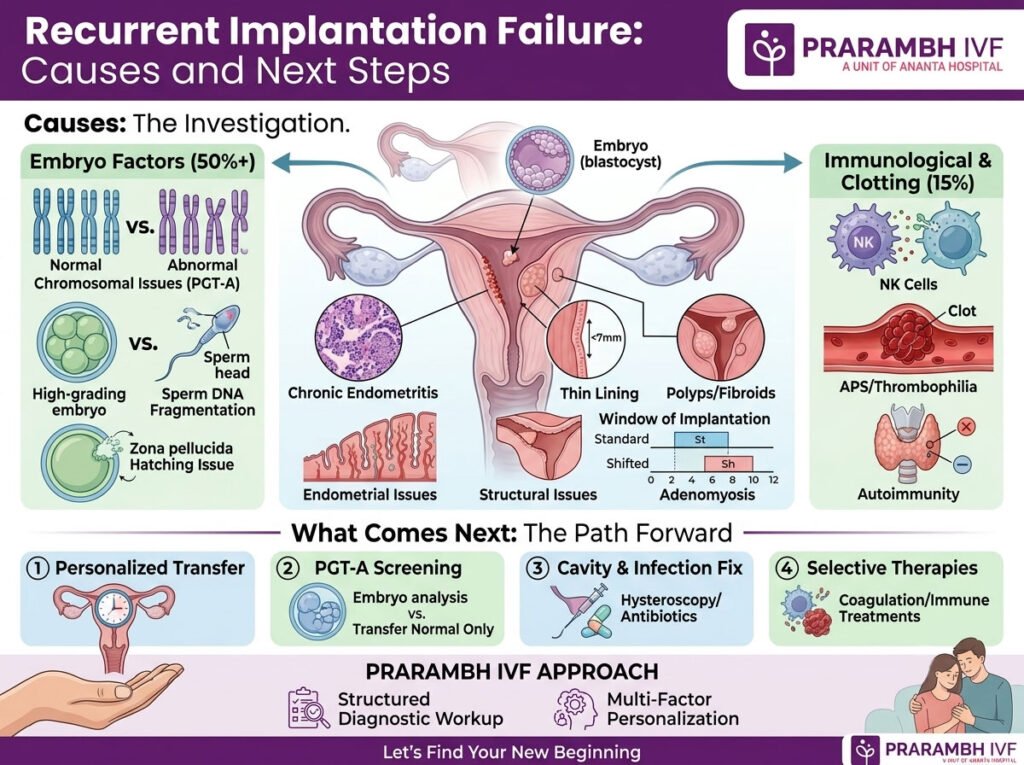
Implantation is a precise, two-way biological event — it requires a healthy, chromosomally normal embryo and a uterus that is receptive at exactly the right moment. When implantation repeatedly fails, the cause usually falls into one (or more) of three categories:
1. Embryo-Related Factors
Even embryos that look good under the microscope can carry chromosomal abnormalities invisible to standard grading. This is one of the most common — and most overlooked — contributors to RIF, particularly in women over 35, where the rate of chromosomally abnormal embryos rises sharply.
Other embryo-related issues include:
- Poor embryo development potential despite normal appearance
- Sperm DNA fragmentation, which can compromise embryo quality even when sperm count and motility look normal on a standard semen analysis
- Zona pellucida (the embryo’s outer shell) abnormalities that interfere with hatching and attachment
2. Uterine and Endometrial Factors
The uterus has to be “ready” for an embryo during a specific window — the window of implantation. Several structural and functional issues can disrupt this:
- Thin or unresponsive endometrium — an endometrial lining that doesn’t thicken adequately can significantly reduce implantation chances. (Read more: Thin Endometrium: Can You Still Get Pregnant with IVF?)
- Uterine fibroids or polyps — particularly those that distort the uterine cavity
- Chronic endometritis — a low-grade, often symptomless uterine infection that can quietly interfere with implantation
- Uterine septum or other congenital abnormalities
- Adenomyosis — where uterine lining tissue grows into the muscular wall, affecting uterine function
- Intrauterine adhesions (Asherman’s syndrome), often from prior surgery
3. Displaced Window of Implantation
Even with a healthy embryo and a structurally normal uterus, timing matters enormously. In some patients, the endometrium’s “receptive window” — the narrow period during which it will accept an embryo — is shifted earlier or later than standard protocols assume. This is one of the more subtle causes of RIF and is often missed unless specifically tested for.
4. Immunological and Blood Clotting Factors
In a smaller subset of cases, the immune system or blood clotting factors play a role:
- Elevated natural killer (NK) cell activity in the uterine lining
- Antiphospholipid syndrome and other clotting disorders that affect blood flow to the developing implantation site
- Autoimmune conditions affecting the uterine environment
5. Other Contributing Factors
- Untreated or undertreated thyroid dysfunction
- Uncontrolled blood sugar or insulin resistance (common in PCOS) (Read more: PCOS and IVF: What Changes in Treatment Strategy?)
- Lifestyle factors — smoking, significant weight fluctuations, chronic stress
- Advanced maternal age affecting both egg quality and uterine receptivity (Read more: How Age Really Affects IVF Success)
How Is Recurrent Implantation Failure Diagnosed?
A thorough RIF workup typically moves through several layers of investigation rather than jumping straight to another transfer:
1. Uterine cavity evaluation
A hysteroscopy or saline sonohysterogram checks for polyps, fibroids, adhesions, or a septum that could be interfering mechanically with implantation.
2. Endometrial receptivity testing
Tests such as the Endometrial Receptivity Array (ERA) assess whether the embryo transfer is being timed correctly for that individual patient’s implantation window — some patients need their transfer shifted by several hours or even a day or two.
3. Genetic screening of embryos
Preimplantation Genetic Testing for Aneuploidy (PGT-A) can identify chromosomally normal embryos before transfer, removing one major variable from the equation. (Read more: What Is Embryo Grading & Why It Matters in IVF)
4. Immunological and clotting workup
Blood tests can identify antiphospholipid antibodies, thrombophilia, or abnormal NK cell activity when clinically indicated.
5. Endometrial infection screening
Testing for chronic endometritis, often via endometrial biopsy, can uncover a silent infection that’s easily treatable once identified.
6. Sperm DNA fragmentation testing
Especially relevant when male-factor infertility hasn’t been fully ruled out through standard semen analysis. (Read more: Sperm DNA Fragmentation: The Missing Link in Male Infertility)
7. Hormonal and metabolic panel
Thyroid function, prolactin levels, and blood sugar/insulin markers are reviewed, since imbalances here can quietly undermine implantation.
What Comes Next: Treatment Options After RIF
Once a specific cause (or combination of causes) is identified, treatment becomes far more targeted than simply repeating the same cycle.
Addressing the Uterine Environment
- Hysteroscopic removal of polyps, fibroids, adhesions, or septum
- Antibiotic treatment for chronic endometritis
- Endometrial preparation protocol adjustments to improve lining thickness and quality
Personalizing the Transfer Timing
If ERA testing shows a displaced implantation window, future transfers can be timed to match the patient’s actual receptive window rather than a standard protocol — a simple adjustment that can make a meaningful difference for some patients.
Improving Embryo Selection
- PGT-A to transfer only chromosomally normal embryos
- Extended culture to the blastocyst stage, which allows embryologists to select embryos with stronger developmental potential
- ICSI with careful sperm selection techniques when sperm DNA fragmentation is a factor
Managing Immunological or Clotting Factors
When indicated by testing, treatments may include low-dose aspirin, heparin, or other targeted therapies under close medical supervision — these are used selectively, not as a blanket approach, since not every RIF patient has an immune or clotting component.
Frozen Embryo Transfer (FET) Considerations
Many clinics find that a frozen, hormonally-prepared cycle offers more control over endometrial timing than a fresh transfer, particularly after RIF. (Read more: Frozen Embryo Transfer (FET) vs. Fresh Transfer: Which Works Better?)
Lifestyle and Metabolic Optimization
Correcting thyroid dysfunction, improving insulin sensitivity, achieving a healthier weight range, and reducing smoking or alcohol use are all steps that support a more receptive uterine environment — often used alongside, not instead of, medical treatment.
Donor Options
In select cases — such as consistently poor embryo quality despite optimization, or advanced maternal age with limited ovarian reserve — donor eggs, donor sperm, or donor embryos may be discussed as a path forward.
The Emotional Side of RIF
It’s worth saying plainly: repeated implantation failure is one of the most difficult parts of the fertility journey, not just physically but emotionally. Many patients describe a cycle of hope and grief that repeats with each failed transfer. Working with a clinic that takes the time to investigate why — rather than simply trying again — can make a real difference, both in outcomes and in feeling like you understand what’s actually happening in your own body. (Read more: Why IVF Fails Even When Reports Are Normal and Common Reasons Why IVF Fails and What Comes Next)
How Prarambh IVF & Fertility Center Approaches RIF
At Prarambh IVF & Fertility Center, patients who have experienced repeated implantation failure go through a structured diagnostic workup rather than a repeat of the same protocol. Our approach typically includes:
- A detailed review of prior cycle history, embryo grading, and transfer protocols
- Hysteroscopic evaluation of the uterine cavity
- Endometrial receptivity and infection testing where indicated
- Genetic testing of embryos (PGT-A) for eligible patients
- Immunological and clotting panels when clinically relevant
- A personalized treatment plan built around the specific findings — not a one-size-fits-all next cycle
Explore our related services to learn more:
Or browse more patient guides on our blog.
Frequently Asked Questions
How many failed transfers before it’s considered RIF?
Most clinical definitions use three or more transfers of good-quality embryos, or four or more embryos transferred cumulatively, without a clinical pregnancy — though the exact threshold can vary by clinic and patient circumstances.
Can RIF be treated successfully?
Yes, in many cases. Once the underlying cause is identified — whether uterine, embryonic, immunological, or timing-related — targeted treatment often improves outcomes in subsequent cycles.
Does RIF mean IVF won’t work for me?
No. RIF means the current approach hasn’t worked yet — it doesn’t mean IVF itself isn’t viable. A proper diagnostic workup frequently uncovers a specific, addressable factor.
Is ERA testing necessary for everyone with RIF?
Not necessarily for every patient, but it’s commonly recommended after repeated failures with good-quality embryos, since a displaced implantation window is a well-documented and treatable cause.
Final Thoughts
Recurrent implantation failure is frustrating precisely because it doesn’t come with an obvious explanation — but that doesn’t mean there isn’t one. A structured, individualized investigation into embryo quality, uterine health, timing, and other contributing factors gives most patients a clearer, more actionable path forward.
If you’ve experienced multiple failed transfers, the team at Prarambh IVF & Fertility Center can help you understand what’s happening and build a plan tailored to your specific findings.
Contact us:
Website: https://www.prarambhivf.com/
Email: info@prarambhivf.com
