
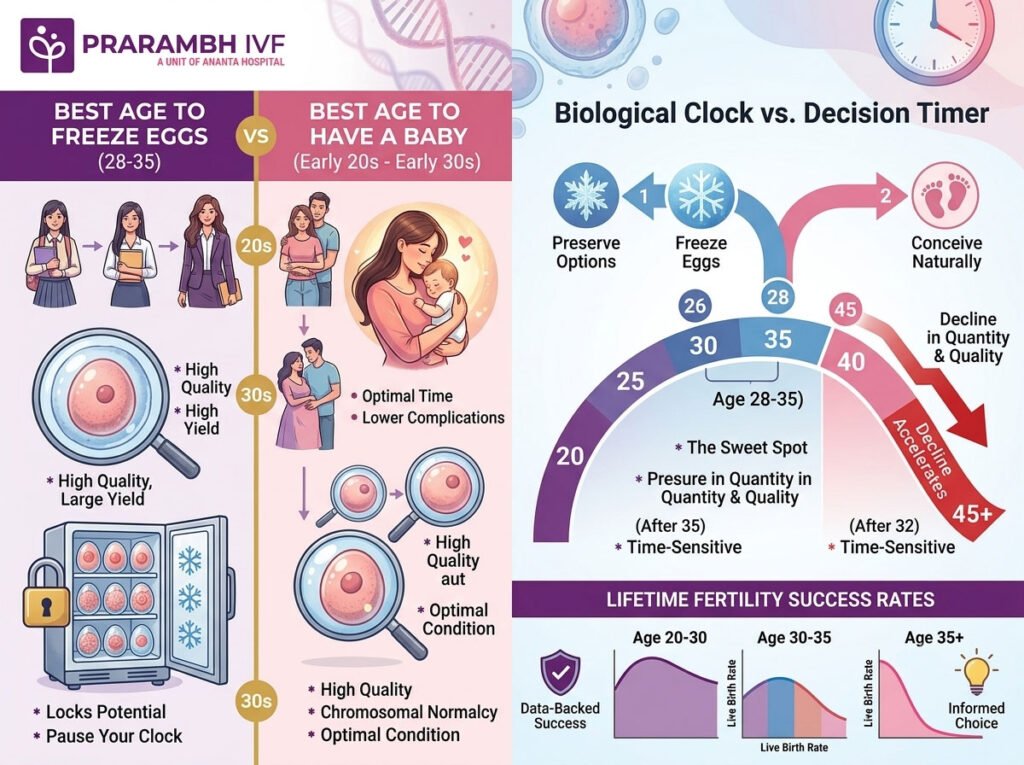
Every woman today faces a question her mother and grandmother never had to think about in quite the same way: should I have a baby now, or should I freeze my eggs and wait? Career timelines, financial stability, relationship status, and personal readiness all factor into this decision — but underneath all of it lies a biological clock that doesn’t negotiate.
The good news is that we no longer have to make this decision blindly. Decades of fertility research now give us real, data-backed answers about the best age to freeze eggs versus the best age to conceive naturally. This guide breaks down what the numbers actually say, so you can make an informed choice rather than a fearful one.
Why Age Matters So Much in Fertility
A woman is born with all the eggs she will ever have — roughly 1–2 million at birth. By puberty, that number has already dropped to around 300,000–400,000. From there, egg quantity and egg quality decline steadily, and the decline accelerates sharply after age 35.
This is different from most other aspects of health, where lifestyle and medical care can significantly slow deterioration. Ovarian aging is largely governed by chronological age. A woman who exercises daily, eats perfectly, and has no medical conditions will still experience the same fundamental decline in egg quantity and quality as any other woman her age. This is precisely why understanding the timeline matters so much — because unlike many health decisions, this one is time-sensitive in a way that can’t be reversed later.
Two things decline with age: the number of eggs remaining (ovarian reserve) and the quality of those eggs (chromosomal normalcy). Quality is the more important factor for actually achieving a healthy pregnancy, and it’s the one that most people underestimate.
The Real Data: Fertility by Age
Let’s look at what large-scale fertility studies actually show about natural conception rates per cycle:
- Age 20–24: Roughly 25–30% chance of conception per cycle
- Age 25–29: Roughly 20–25% chance per cycle
- Age 30–34: Roughly 15–20% chance per cycle, with early signs of decline
- Age 35–39: Drops to roughly 10–15% per cycle, decline noticeably accelerates
- Age 40–42: Roughly 5% or lower per cycle
- Age 43 and above: Often below 1–2% per cycle using own eggs
These aren’t scare numbers — they’re averages drawn from population-level fertility research, and individual variation is real. Some women in their late 30s have excellent ovarian reserve; some in their late 20s have diminished reserve. But the population trend is undeniable: fertility declines gradually until the mid-30s, then drops more steeply.
The same age-related decline also affects miscarriage rates, largely because of chromosomal abnormalities in older eggs:
- Miscarriage risk at age 25: around 10%
- Miscarriage risk at age 35: around 20%
- Miscarriage risk at age 40: around 35–40%
- Miscarriage risk at age 45: over 50%
This is the biological reality behind why doctors emphasize earlier family planning when possible — and why egg freezing has become such an important option for women who aren’t ready to conceive yet but want to protect their future fertility.
The Best Age to Have a Baby (Biologically)
From a purely biological standpoint, the “ideal” window for natural conception is the early-to-mid 20s through early 30s, when egg quantity is higher and egg quality is at its best. Pregnancy complications like gestational diabetes, hypertension, and chromosomal abnormalities are also statistically lower in this age range.
That said, biology is only one part of the picture. Most people don’t plan their family purely around ovarian statistics — financial readiness, partnership stability, career stage, and emotional preparedness all matter too. This is exactly the gap that egg freezing was designed to address.
The Best Age to Freeze Your Eggs
If natural conception timing doesn’t align with your life circumstances, egg freezing lets you “pause” your biological clock by preserving eggs at a younger, healthier stage for future use.
Based on fertility research and clinical outcomes, the data points to a clear sweet spot:
Best age range to freeze eggs: 28–35 years old
Here’s why this window matters:
- Egg quality is still high. Chromosomally normal eggs are more common before your mid-30s, which means frozen eggs from this period have a better chance of resulting in a healthy pregnancy later.
- Egg yield per cycle is better. Younger ovaries typically respond more robustly to stimulation medications, producing more mature eggs per retrieval cycle — which matters because not every retrieved egg survives freezing, fertilization, and development.
- Fewer retrieval cycles needed. Freezing at a younger age often means achieving your target number of eggs (usually 15–20 eggs is recommended for a reasonable chance of one live birth) in fewer cycles, which is both more affordable and less physically taxing.
Freezing after age 35 is still possible and can still be worthwhile — many women successfully freeze in their late 30s and even early 40s — but the average number of eggs retrieved tends to be lower, and a higher proportion of those eggs may be chromosomally abnormal. This often means needing more retrieval cycles to bank an adequate number of usable eggs.
Freezing before age 28, while biologically optimal in terms of egg quality, is less common simply because most women aren’t yet thinking about future fertility planning at that stage of life — though for those with a family history of early menopause, endometriosis, or other reserve-affecting conditions, earlier freezing can be a smart proactive step.
Egg Freezing vs. Waiting: What the Data Says About Success Rates
Success rates for frozen eggs depend heavily on the age at which they were frozen — not the age at which they’re eventually used. This is the entire point of egg freezing: it locks in the biological potential of your eggs at the age of retrieval.
Approximate live birth rates per frozen egg thawed and used:
- Eggs frozen before age 35: often associated with meaningfully higher live birth rates per egg used
- Eggs frozen between 35–37: moderate success rates, still generally favorable
- Eggs frozen after 38: success rates decline, and more eggs are typically needed to achieve one live birth
This is why fertility specialists often recommend that women who anticipate delaying childbearing past their early-to-mid 30s at least consider a fertility consultation and AMH (Anti-Müllerian Hormone) testing well before that point — to understand their individual ovarian reserve and make a timely, informed decision.
Common Questions Women Ask About This Decision
“I’m 32 and not ready for kids yet — should I freeze my eggs now or wait a few years?”
If you’re not planning to conceive within the next 3–5 years, freezing now rather than waiting typically means better egg quality and potentially fewer cycles needed. Waiting until your mid-to-late 30s to decide often means facing a steeper decline right when you’re making the choice.
“Is egg freezing a guarantee I’ll have a baby later?”
No fertility treatment offers a guarantee. Egg freezing significantly improves your future options and odds, particularly when done at a younger age, but success still depends on egg quality at retrieval, the number of eggs frozen, and uterine health at the time of use.
“What if I get pregnant naturally before I ever need my frozen eggs?”
That’s a common and completely fine outcome. Many women who freeze eggs as a safety net never end up needing them — and that’s not a wasted effort. It’s peace of mind and preserved optionality, not a commitment to use them.
“Does freezing eggs delay menopause or affect my current fertility?”
No. Egg freezing retrieves eggs that would otherwise be lost in that cycle’s natural process — it does not accelerate or affect your remaining natural fertility or the timing of menopause.
Making the Decision That’s Right for You
There’s no single “correct” age to have a baby or freeze your eggs — the right choice depends on your health, life circumstances, and personal goals. What the data does make clear is this: egg quantity and quality decline with age, and earlier action — whether that’s conceiving or freezing — generally means better odds and fewer treatment cycles.
If you’re unsure where you currently stand, the most useful first step isn’t guessing based on age alone — it’s getting real information about your own ovarian reserve through proper testing.
How Prarambh IVF & Fertility Center Can Help
At Prarambh IVF & Fertility Center, we help women understand their fertility timeline through comprehensive testing and personalized counseling — not generic age charts. Whether you’re exploring egg freezing to preserve your options, trying to understand your current fertility status, or ready to begin family planning, our specialists guide you through every step with data-driven, individualized care.
Explore our related services:
You may also find these related articles helpful:
- IVF Success Rates by Age: What Couples Should Know
- Low AMH Levels: Can You Still Conceive?
- Signs of Female Infertility You Should Never Ignore
Visit our blog for more fertility insights, or reach out directly to schedule a consultation.
📍 Website: www.prarambhivf.com
📧 Email: info@prarambhivf.com
This article is for informational purposes only and does not replace personalized medical advice. Please consult a fertility specialist at Prarambh IVF & Fertility Center for guidance specific to your health profile.
