
For couples navigating the emotionally and physically demanding world of assisted reproductive technology, In Vitro Fertilization (IVF) stands as a beacon of immense hope. Walking into a fertility clinic requires a profound amount of vulnerability, courage, and investment. Because of this, experiencing an unsuccessful IVF cycle—whether it manifests as a negative pregnancy test, a failure of embryos to implant, or an early miscarriage—can be an incredibly heartbreaking experience.
If you are currently processing a failed cycle, the first and most critical thing to know is this: An unsuccessful cycle is not a definitive dead end, nor is it a personal failure.
At Prarambh IVF and Women’s Hospital, we view a failed IVF cycle not as a final verdict, but as a critical, diagnostic window. The data gathered during a cycle provides our clinical team with invaluable, personalized insights into your unique reproductive biology. This comprehensive guide details the scientifically backed reasons behind IVF failure and outlines the strategic, advanced steps we take to turn a past setback into a future success.
1. Demystifying IVF Failure: The Two Primary Types
When analyzing why a cycle did not result in a live birth, reproductive endocrinologists look at where the process paused. IVF failure generally falls into two distinct biological categories:
Embryo Implantation Failure
This occurs when high-quality or seemingly healthy embryos are transferred into the uterus but fail to attach to the endometrial lining. Implantation is a complex biochemical “dialogue” between the embryo and the uterine wall. If this dialogue is disrupted, a clinical pregnancy cannot establish.
Recurrent Implantation Failure (RIF)
RIF is a specific clinical designation. It is diagnosed when a patient has undergone multiple IVF cycles—typically transferring a total of three or more high-quality cleavage-stage embryos or blastocysts across several transfers—without achieving a clinical pregnancy. RIF requires highly specialized, targeted diagnostic investigations.
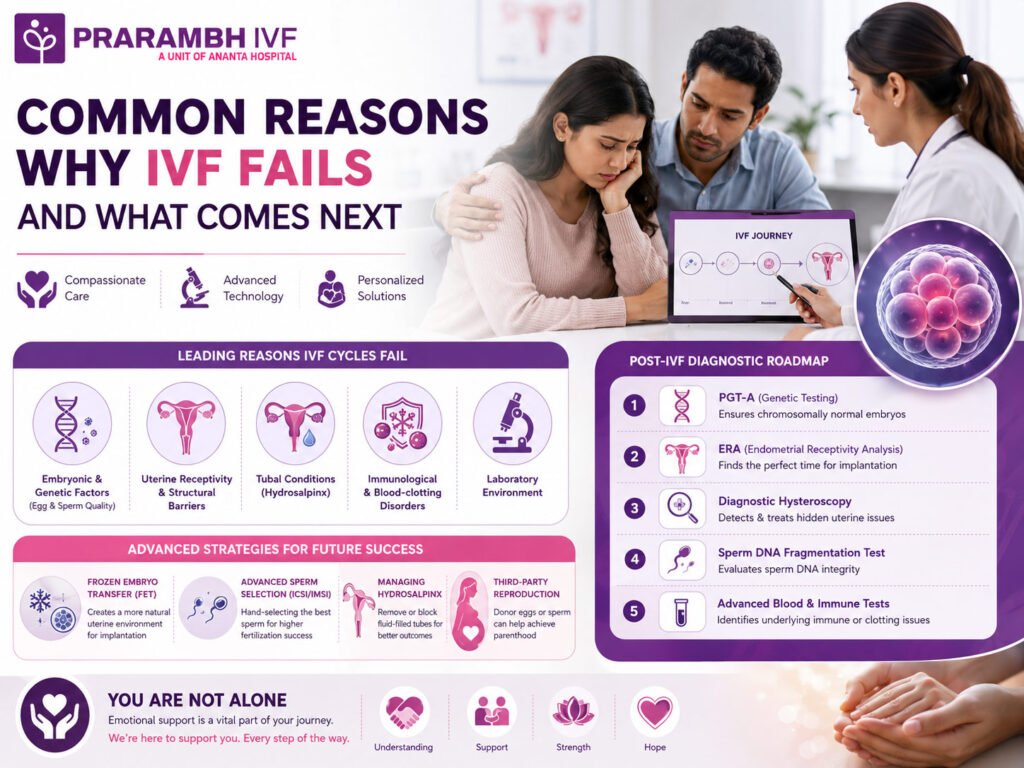
2. The Leading Reasons Why IVF Cycles Fail
A successful pregnancy relies on a flawless convergence of cellular health, structural integrity, and hormonal timing. When an IVF cycle drops below optimal thresholds, it is usually due to one or more of the following key factors.
A. Embryonic and Genetic Factors (Egg and Sperm Quality)
By far, the most common reason an IVF cycle fails is the genetic health of the embryo. Even an embryo that looks structurally perfect under a high-powered laboratory microscope can possess internal genetic variations.
- Aneuploidy (Chromosomal Abnormalities): As cells divide during fertilization, errors can occur, resulting in an embryo having too many or too few chromosomes. Aneuploid embryos frequently stop growing naturally, fail to implant, or lead to an early chemical pregnancy or miscarriage.
- Maternal Age and Egg Quality: As a woman matures, her remaining egg reserve naturally experiences a decline in genetic integrity. While a woman under 35 may produce a high percentage of chromosomally normal embryos, this percentage naturally shifts in the late 30s and early 40s.
- Sperm DNA Fragmentation: Infertility is a shared biological journey. High levels of DNA damage or fragmentation in sperm cells can compromise embryo development past day 3, leading to poor blastocyst formation and subsequent transfer failure.
B. Uterine Receptivity and Structural Barriers
Even the most genetically perfect embryo cannot thrive if the environment into which it is placed is not fully prepared or receptive.
- The Implantation Window Mismatch: The endometrium (uterine lining) is only receptive to an embryo for a very specific, brief window of time during the menstrual cycle, typically governed by progesterone production. In some women, this “window of implantation” is naturally shifted earlier or later than standard protocols assume.
- Structural Anomalies: Physical barriers inside the uterine cavity can mechanically block an embryo from embedding safely. These include uterine fibroids (especially submucosal fibroids that project into the cavity), endometrial polyps, intrauterine scar tissue (Asherman’s Syndrome), or congenital uterine septums.
- Thin Endometrial Lining: For optimal implantation, the uterine lining typically needs to reach a thickness of at least 7mm to 8mm, showing a healthy “triple-line” pattern on an ultrasound. A lining that remains persistently thin lacks the vascular density required to sustain an embedding embryo.
C. Tubal Conditions: The Danger of Hydrosalpinx
A frequently overlooked culprit in IVF failure is the presence of a hydrosalpinx. This is a condition where a fallopian tube is completely blocked, usually due to a past pelvic infection or endometriosis, and fills with a watery, toxic fluid.
Because the tube is blocked at the far end, this toxic fluid leaks backward directly into the uterine cavity. This fluid creates a hostile environment that can physically flush out a transferred embryo or act as a localized toxin that prevents implantation entirely.
D. Advanced Immunological and Blood-Clotting Disorders
In a tiny percentage of couples experiencing unexplained or recurrent IVF failures, the immune system may play a role. Conditions like Antiphospholipid Syndrome (APS) or specific autoimmune profile elevations can cause microscopic blood clots to form at the site of the developing placenta, cutting off the embryo’s vital blood and oxygen supply before it can establish a strong hold.
3. The Role of the Laboratory Environment
The quality of an IVF clinic’s embryology laboratory is the invisible backbone of reproductive medicine. Embryos are incredibly fragile; they require absolute environmental stability to grow.
Minor fluctuations in air purity, ambient temperature, humidity levels, or gas mixtures inside an incubator can induce cellular stress on developing blastocysts, degrading their viability. At Prarambh IVF and Women’s Hospital, our laboratory operates under strict, advanced cleanroom standards with continuous digital monitoring to mirror the natural conditions of the human fallopian tubes as closely as possible.
4. What Comes Next? Your Comprehensive Post-IVF Diagnostic Roadmap
When a cycle fails, our clinical team at Prarambh IVF and Women’s Hospital conducts an exhaustive, multi-disciplinary review of your cycle history. We evaluate medication responses, fertilization rates, embryo cleavage patterns, and transfer dynamics.
To chart a more accurate path forward, we utilize an array of advanced, evidence-based diagnostic tools:
1.Preimplantation Genetic Testing (PGT-A):Genetic Clarity.
If embryo quality or maternal age is a primary factor, we perform PGT-A on future embryos. This allows us to screen cells for correct chromosomal numbers, ensuring only genetically viable embryos are selected for transfer.
2.Endometrial Receptivity Analysis (ERA):Timing Precision.
To address potential implantation window mismatches, an ERA biopsy takes a microscopic molecular sample of your lining to determine the exact hour your uterus becomes fully receptive, allowing for a personalized embryo transfer (pET).
3.Diagnostic Hysteroscopy:Visual Optimization.
We pass a thin, lighted camera through the cervix into the uterus to directly visualize the cavity. This allows us to find and immediately remove hidden polyps, micro-fibroids, or scar tissue that might disrupt implantation.
4.Sperm DNA Fragmentation Index (DFI):Male Factor Deep-Dive.
Beyond a standard semen analysis, a DFI test measures the percentage of damaged DNA within a sperm sample. If levels are elevated, specific lifestyle adjustments, antioxidant therapies, or advanced selection techniques are introduced.
5. Advanced Clinical Strategies for Subsequent Cycles
Armed with clear diagnostic data from your previous cycle, our fertility specialists reformulate your treatment strategy. Modern reproductive medicine offers a variety of advanced protocols designed to directly overcome previous failures.
Switching from Fresh to Frozen Embryo Transfers (FET)
During a fresh IVF cycle, high doses of stimulation hormones can create an altered endocrine environment in the uterus. By choosing to freeze high-quality blastocysts via vitrification and transferring them during a subsequent, natural or gently prepared cycle, we allow your hormone levels to return to baseline. This creates a far more natural, receptive uterine environment for implantation.
Advanced Sperm Selection Techniques (ICSI and IMSI)
If sperm DNA fragmentation or poor morphology is a factor, standard fertilization is elevated. We use Intrauterine Cytoplasmic Sperm Injection (ICSI) or Intracytoplasmic Morphologically Selected Sperm Injection (IMSI)—which uses ultra-high-magnification lenses—to hand-select a single, structurally optimal sperm cell for direct micro-injection into each mature egg.
Managing Hydrosalpinx Prior to Transfer
If a fluid-filled fallopian tube is discovered during our post-cycle review, we recommend a minimally invasive laparoscopic procedure to either remove the affected tube (salpingectomy) or safely clip it near the uterus. This permanently blocks the toxic fluid from entering the uterine cavity, immediately restoring normal implantation potential.
Third-Party Reproduction: Donor Egg or Sperm IVF
When severe, irreversible age-related decline in egg quality is present, or when repeated cycles yield zero genetically normal embryos, exploring third-party reproduction offers a highly successful path. Utilizing healthy, rigorously screened donor eggs or donor sperm resets your success rates to optimal baselines, bypassing genetic barriers while allowing you to experience the beauty of pregnancy and childbirth.
6. The Critical Importance of Emotional and Psychological Support
The impact of an unsuccessful IVF cycle is not confined to physical anatomy; it takes a profound toll on your mental and emotional well-being. It is entirely normal to experience waves of grief, frustration, anxiety, or marital strain after a failed cycle.
Managing stress and allowing yourself time to process emotional grief is an essential component of comprehensive fertility care. At Prarambh IVF and Women’s Hospital, we integrate professional fertility counseling into our treatment frameworks. We encourage couples to take an intentional, brief hiatus between cycles if needed, ensuring they feel mentally resilient, supported, and emotionally ready before embarking on their next steps.
Your Path Forward with Prarambh IVF and Women’s Hospital
An unsuccessful IVF cycle is a deeply challenging milestone, but it is often just a chapter in your larger journey to parenthood, not the conclusion. Many couples who celebrate the birth of a healthy baby do so after adjusting their treatment plans based on the lessons learned from a previous, failed cycle.
At Prarambh IVF and Women’s Hospital, we stand firmly beside you through every single phase of your fertility journey—celebrating your victories and providing deep, scientific, and compassionate guidance through your setbacks. We combine world-class medical infrastructure, cutting-edge embryology technologies, and deeply personalized clinical expertise to turn uncertainty into a clear, focused roadmap forward.
You do not have to carry the weight of reproductive challenges alone. Our dedicated team of reproductive endocrinologists, highly skilled embryologists, and empathetic support staff is ready to help you analyze your history, optimize your care, and open up new possibilities.
Let’s build your tomorrow together:
Visit our official website at www.prarambhivf.com to schedule a comprehensive, highly confidential post-IVF review with our expert specialists. Your dream of building a family is worth every strategic, dedicated step.
