
Introduction
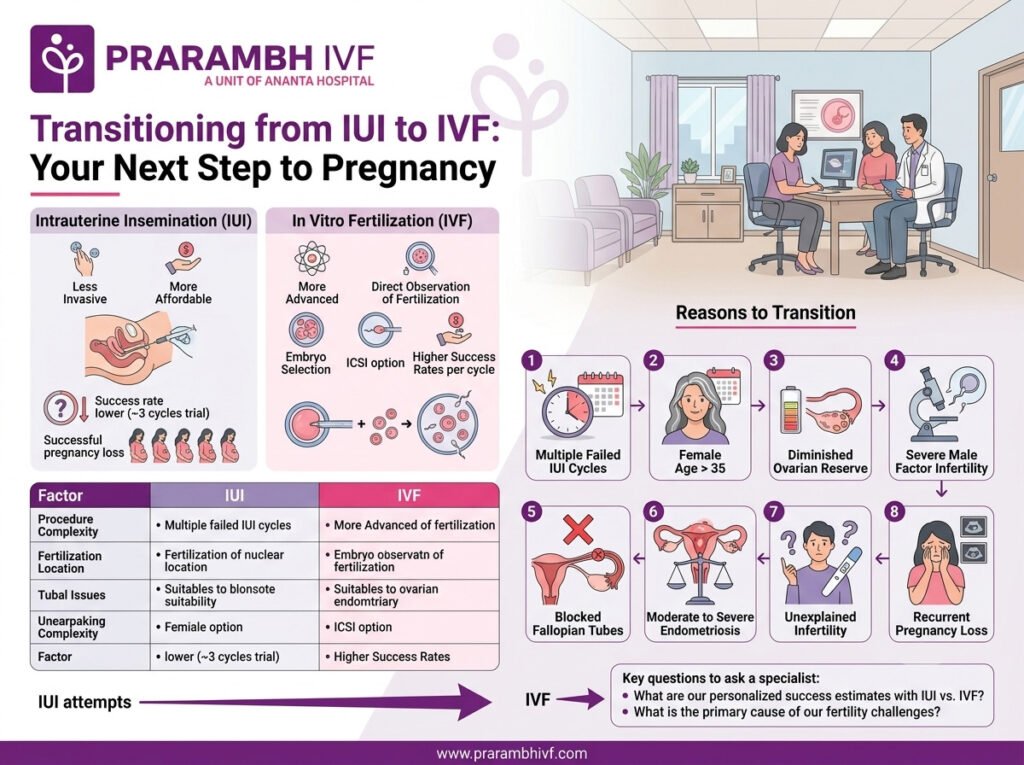
For many couples struggling with infertility, fertility treatment is a journey that progresses through different stages. One of the most common questions fertility specialists hear is: “How many IUI cycles should we try before moving to IVF?”
Both Intrauterine Insemination (IUI) and In Vitro Fertilization (IVF) are effective fertility treatments, but they differ significantly in terms of procedure, success rates, cost, and suitability for specific fertility conditions. While IUI is often recommended as a first-line treatment due to its simplicity and affordability, IVF may become the better option when IUI is unsuccessful or when certain fertility factors are present.
Understanding when to transition from IUI to IVF can help couples avoid unnecessary delays and improve their chances of achieving a successful pregnancy.
At Prarambh IVF, we believe that every fertility journey deserves a personalized approach. In this guide, we’ll explore the differences between IUI and IVF, factors that influence treatment decisions, and the signs that it may be time to move from IUI to IVF.
Understanding IUI and IVF
Before discussing when to transition from one treatment to another, it is important to understand how each procedure works.
What Is IUI?
Intrauterine Insemination (IUI) is a fertility treatment in which specially prepared sperm is placed directly into the uterus around the time of ovulation.
The goal of IUI is to:
- Increase the number of sperm reaching the egg
- Improve the chances of fertilization
- Overcome mild fertility issues
IUI is less invasive than IVF and is often used as an initial fertility treatment.
What Is IVF?
In Vitro Fertilization (IVF) is a more advanced assisted reproductive technology (ART) procedure.
The IVF process involves:
- Ovarian stimulation
- Egg retrieval
- Fertilization in a laboratory
- Embryo development
- Embryo transfer into the uterus
Because fertilization occurs outside the body, IVF can overcome many fertility challenges that IUI cannot address.
Why Doctors Usually Recommend IUI First
For certain fertility conditions, IUI is often the first treatment option because it is:
- Less invasive
- More affordable
- Relatively simple
- Requires fewer medications
- Involves minimal recovery time
Couples with mild fertility issues may achieve pregnancy through IUI without needing IVF.
However, IUI is not the ideal solution for every infertility diagnosis.
Success Rates: IUI vs IVF
Success rates vary depending on factors such as:
- Female age
- Egg quality
- Sperm quality
- Underlying fertility conditions
- Lifestyle factors
Generally, IVF offers higher pregnancy rates than IUI because it bypasses several natural barriers to fertilization.
While IUI may work well for selected patients, IVF often provides significantly better outcomes, especially for couples facing complex fertility challenges.
How Many IUI Cycles Should You Try Before IVF?
There is no universal answer, but many fertility specialists recommend considering IVF after:
- 3 unsuccessful IUI cycles
- 3–6 IUI attempts depending on age and diagnosis
Research has shown that most successful IUI pregnancies occur within the first few treatment cycles.
If pregnancy has not occurred after multiple well-timed IUIs, moving to IVF may offer a better chance of success.
Signs It May Be Time to Move from IUI to IVF
1. Multiple Failed IUI Cycles
One of the clearest indicators is repeated unsuccessful IUI treatments.
If you have undergone several properly timed IUI cycles without conception, continuing the same approach may not significantly improve your chances.
Reasons may include:
- Poor fertilization
- Implantation issues
- Egg quality concerns
- Undiagnosed fertility factors
IVF allows fertility specialists to gain more information about what may be preventing pregnancy.
2. Female Age Is Over 35
Age plays a major role in fertility.
As women age:
- Egg quantity decreases
- Egg quality declines
- Pregnancy rates decrease
- Miscarriage risk increases
For women over 35, especially over 38, spending too much time on repeated IUI cycles may reduce overall pregnancy chances.
In many cases, fertility specialists recommend moving to IVF sooner to maximize success opportunities.
3. Diminished Ovarian Reserve
Ovarian reserve refers to the number and quality of remaining eggs.
Signs of diminished ovarian reserve may include:
- Low AMH levels
- Elevated FSH levels
- Reduced antral follicle count
When ovarian reserve is declining, time becomes an important factor.
IVF often provides a more effective strategy because it allows doctors to retrieve multiple eggs in a single cycle.
4. Severe Male Factor Infertility
IUI may be helpful for mild male fertility issues, but severe sperm abnormalities often require more advanced treatment.
Examples include:
- Very low sperm count
- Poor sperm motility
- Significant sperm morphology abnormalities
In such situations, IVF with Intracytoplasmic Sperm Injection (ICSI) can dramatically improve fertilization rates.
5. Blocked Fallopian Tubes
For natural conception and IUI to work, at least one healthy fallopian tube is generally needed.
If both tubes are blocked:
- Egg and sperm cannot meet naturally
- IUI becomes ineffective
Because IVF bypasses the fallopian tubes entirely, it is often the preferred treatment.
6. Endometriosis
Endometriosis can affect fertility in several ways:
- Distorting pelvic anatomy
- Damaging eggs
- Affecting implantation
- Creating inflammation
Mild cases may respond to IUI, but moderate to severe endometriosis often has better outcomes with IVF.
7. Unexplained Infertility
Sometimes all fertility tests appear normal, yet pregnancy does not occur.
This condition is known as unexplained infertility.
After several unsuccessful IUI cycles, IVF may help because it provides:
- Better monitoring
- Direct observation of fertilization
- Embryo quality assessment
- Increased pregnancy rates
8. Recurrent Pregnancy Loss
Repeated miscarriages may warrant more advanced fertility evaluation and treatment.
IVF can provide additional options such as:
- Embryo monitoring
- Genetic testing of embryos
- Improved embryo selection
These approaches may help identify potential causes and improve pregnancy outcomes.
9. Poor Response to Fertility Medications
Some women do not respond optimally to ovulation-inducing medications used during IUI cycles.
This can result in:
- Limited follicle development
- Reduced egg production
- Lower pregnancy rates
IVF protocols offer more control over ovarian stimulation and egg retrieval.
10. Desire for Higher Pregnancy Rates
Many couples choose IVF because it generally offers a higher chance of pregnancy per treatment cycle.
This can be especially important for:
- Older patients
- Patients with limited fertility time
- Couples who have already experienced years of infertility
Comparing IUI and IVF
| Factor | IUI | IVF |
|---|---|---|
| Procedure Complexity | Simple | Advanced |
| Fertilization Location | Inside body | Laboratory |
| Success Rates | Lower | Higher |
| Male Factor Infertility | Limited effectiveness | Highly effective |
| Tubal Issues | Usually not suitable | Excellent option |
| Embryo Selection | Not possible | Possible |
| Genetic Testing | Not available | Available |
| Time to Pregnancy | May require multiple cycles | Often faster for selected patients |
Emotional Considerations When Transitioning to IVF
The decision to move from IUI to IVF is not only medical but also emotional.
Many couples experience:
- Anxiety
- Financial concerns
- Fear of injections
- Concerns about success rates
- Emotional exhaustion after failed treatments
These feelings are completely normal.
Open communication with your fertility specialist can help you understand the benefits, risks, and expectations associated with IVF.
Advantages of Moving to IVF at the Right Time
Transitioning to IVF when medically appropriate can offer several benefits.
Higher Pregnancy Rates
IVF often provides better success rates than repeated IUI attempts.
Better Understanding of Fertility Challenges
The IVF process allows doctors to evaluate:
- Egg quality
- Fertilization rates
- Embryo development
This information can be valuable for treatment planning.
More Treatment Options
IVF may include advanced techniques such as:
- ICSI
- Blastocyst transfer
- Frozen embryo transfer
- Genetic testing
These options can improve outcomes for selected patients.
Efficient Use of Time
For patients with age-related fertility decline, moving to IVF earlier may increase the likelihood of achieving pregnancy before fertility decreases further.
Situations Where Continuing IUI May Still Make Sense
Not every patient needs to move immediately to IVF.
IUI may still be reasonable when:
- The woman is under 35
- Fertility issues are mild
- Tubes are open
- Sperm quality is adequate
- Previous IUI cycles were limited
- Financial considerations are significant
A fertility specialist can determine whether additional IUI attempts remain appropriate.
Questions to Ask Your Fertility Specialist
If you are considering moving from IUI to IVF, ask:
What is the likely cause of our infertility?
Understanding the diagnosis helps guide treatment decisions.
What are our chances with another IUI cycle?
Your doctor can provide individualized success estimates.
What are our chances with IVF?
Success rates vary depending on age and fertility factors.
How much time should we continue IUI?
The answer depends on your medical situation and fertility goals.
Would IVF improve our chances significantly?
In many cases, IVF offers a substantial increase in success probability.
Preparing for IVF After IUI
If you decide to proceed with IVF, preparation may include:
Fertility Testing
Updated testing may be required, including:
- Hormone evaluation
- Ultrasound examination
- Semen analysis
- Infectious disease screening
Lifestyle Improvements
Healthy habits can support reproductive health.
Recommended practices include:
- Maintaining a healthy weight
- Eating a balanced diet
- Avoiding smoking
- Limiting alcohol
- Managing stress
- Following medical recommendations
Financial Planning
Understanding treatment costs in advance can reduce stress and help couples make informed decisions.
The Importance of Personalized Fertility Care
Every fertility journey is unique.
The ideal time to transition from IUI to IVF depends on several factors, including:
- Age
- Fertility diagnosis
- Ovarian reserve
- Previous treatment history
- Family-building goals
A personalized treatment strategy ensures that decisions are based on medical evidence and individual circumstances rather than a one-size-fits-all approach.
Why Choose Prarambh IVF?
At Prarambh IVF, we understand that fertility treatment involves both medical expertise and emotional support.
Our experienced fertility specialists provide:
- Comprehensive fertility evaluations
- Advanced IVF treatment options
- Individualized treatment plans
- Modern reproductive technology
- Compassionate patient-centered care
We work closely with every patient to determine the most effective path toward achieving a successful pregnancy.
Conclusion
Knowing when to move from IUI to IVF is one of the most important decisions in a fertility journey. While IUI can be an effective first-line treatment for many couples, repeated unsuccessful cycles, advancing maternal age, diminished ovarian reserve, male factor infertility, endometriosis, blocked fallopian tubes, and other fertility challenges may indicate that IVF is the more appropriate next step.
Rather than continuing treatments with declining chances of success, transitioning to IVF at the right time can improve pregnancy outcomes and provide valuable insights into underlying fertility issues.
If you have experienced multiple failed IUI cycles or are unsure about the next step in your fertility journey, consulting with an experienced fertility specialist can help you make an informed decision.
At Prarambh IVF, our team is committed to providing evidence-based fertility care tailored to your unique needs. To learn more about fertility treatment options or schedule a consultation, visit www.prarambhivf.com today.
