
If you have been trying to conceive for a while, your doctor may suggest a handful of tests to understand how your ovaries are working. One of the most useful is the AFC test, short for antral follicle count. It is a simple ultrasound scan, it takes only a few minutes, and the result helps your fertility specialist plan treatment that fits you.
At Prarambh IVF and Women’s Hospital, we use antral follicle count in many first consultations. This guide explains what AFC is, how it is measured, what the numbers mean, and what to do with the result.
What Is Antral Follicle Count (AFC)?
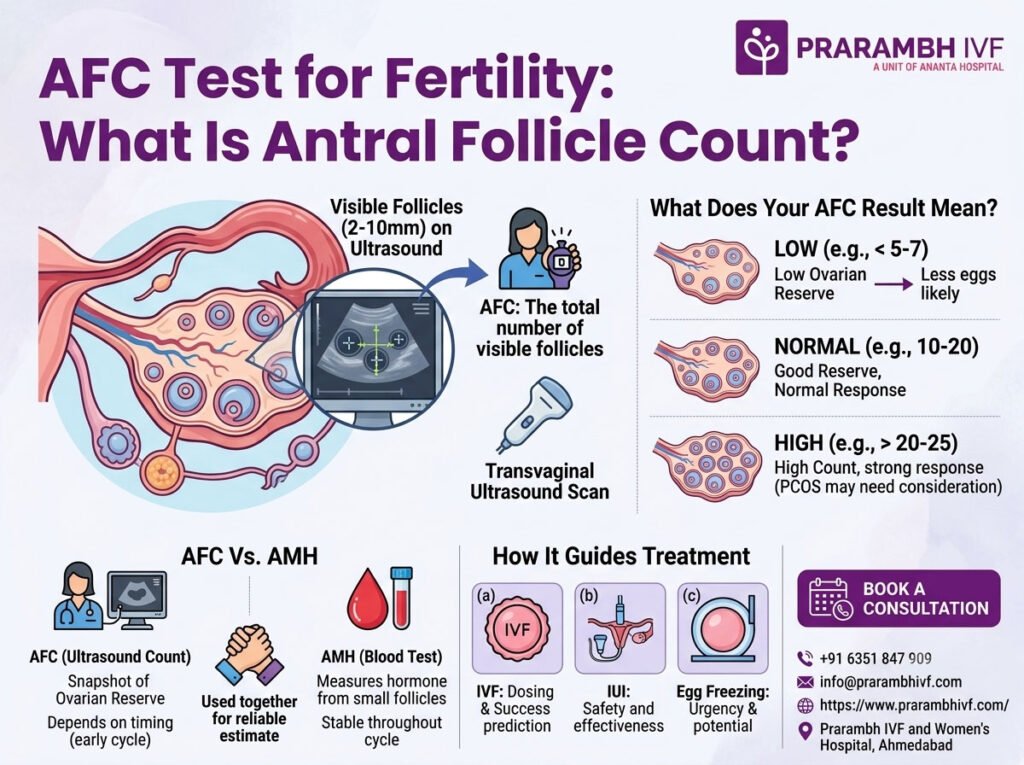
Your ovaries contain thousands of microscopic structures called follicles, and each one holds an immature egg. In every menstrual cycle, a small group of these follicles becomes visible on ultrasound. These are called antral follicles, and they measure roughly 2 to 10 millimetres across.
The antral follicle count is the total number of these small follicles seen in both ovaries at the start of your cycle. It gives a snapshot of your ovarian reserve, the pool of eggs still available for recruitment.
A higher count generally suggests a larger reserve, and a lower count suggests a smaller one. It is a guide to egg quantity, not a verdict on whether you can get pregnant.
Why Is the AFC Test Important in Fertility Evaluation?
AFC helps your doctor answer practical questions:
- How is your body likely to respond to fertility medicines?
- Is a gentler or a stronger stimulation protocol more suitable?
- Is there a risk of over-response (OHSS) or under-response?
- Should you consider treatment sooner rather than later?
- Is egg freezing worth discussing?
It is used in basic fertility work-ups, IVF planning, ovulation induction, and when someone is thinking about egg freezing.
How Is the AFC Test Done?
The AFC test is a transvaginal ultrasound. It is quick and does not need anaesthesia.
Step-by-Step Process
- Timing: the scan is usually done in the early follicular phase, around day 2 to day 5 of your period, when the follicle count is easiest to assess.
- Preparation: no fasting is needed. You may be asked to empty your bladder first.
- The scan: a slim ultrasound probe is gently placed in the vagina. The doctor looks at each ovary and counts the small follicles.
- Recording: follicles of about 2 to 10 mm are counted in both ovaries, and the total is your AFC.
- Result: you usually get the number straight away, and your doctor explains what it means for you.
The scan is generally painless, though some women feel mild pressure.
What Is a Normal AFC? Understanding the Numbers
Reference ranges differ slightly between clinics and guidelines, so treat the figures below as general guidance, not a diagnosis. Your doctor interprets them together with your age, history and other tests.
| Total AFC (both ovaries) | General interpretation |
|---|---|
| Fewer than about 5 to 7 | Low ovarian reserve; a lower response to stimulation is likely |
| About 7 to 10 | Borderline or reduced |
| About 10 to 20 | Generally considered a normal, good response range |
| More than about 20 to 25 | High count; a strong response is likely, and PCOS may need to be considered |
Low AFC
A low count suggests fewer eggs are available in that cycle. It can be linked to age, previous ovarian surgery, endometriosis, certain treatments or genetic factors. In some women, the cause is unclear.
A low AFC does not mean pregnancy is impossible. It may mean that treatment decisions should be made without delay. Our article on low AMH levels and whether you can still conceive covers a closely related situation.
Normal AFC
A count in the normal range suggests an average response to stimulation. It does not guarantee fertility, because egg quality, tubes, uterine health and sperm all matter.
High AFC
A high count means many follicles are available. This can be normal in younger women, but it is also common in polycystic ovary syndrome (PCOS). A high count raises the chance of an over-response to fertility drugs, so protocols are chosen carefully to reduce the risk of OHSS. Read more in PCOS and IVF: What Changes in Treatment Strategy?
AFC and Age: What Is the Connection?
Egg quantity naturally declines with age, so AFC usually falls over time. The pace differs from woman to woman. Some women in their early thirties have a low count, and some in their late thirties have a healthy one.
Age affects more than the number of eggs. It also affects egg quality, and AFC cannot measure quality. That is why doctors never rely on AFC alone. To understand how age shapes treatment outcomes, see How Age Really Affects IVF Success and IVF Success Rates by Age: What Couples Should Know.
AFC vs AMH: What Is the Difference?
Both tests assess ovarian reserve, but they work differently.
| Feature | AFC | AMH |
|---|---|---|
| What it is | Ultrasound count of small follicles | Blood test measuring a hormone made by small follicles |
| Timing | Early in the cycle (day 2 to 5) | Can usually be done on any day |
| Strength | Direct visual assessment | Stable across the cycle |
| Limitations | Depends on scan quality and operator skill | Levels vary between labs and can be affected by some medicines |
The two tests often agree. When they do, they strengthen the picture. When they differ, your doctor looks at the bigger picture rather than trusting one number. Many fertility specialists use both together for a more reliable estimate.
What AFC Can and Cannot Tell You
What AFC can tell you
- an estimate of your ovarian reserve
- how you may respond to ovarian stimulation
- whether over-response or under-response is more likely
- whether time-sensitive options such as egg freezing deserve a conversation
What AFC cannot tell you
- Egg quality. Healthy eggs can exist even with a low count.
- Whether you will conceive naturally. Other factors play major roles.
- Your exact chance of IVF success. Age, embryo quality and uterine health all matter.
- Tubal health or uterine problems. Separate tests assess these.
This is why we never judge fertility on a single number.
Factors That Can Affect Your AFC Result
Several things can influence the count on the day of the scan:
- Cycle timing: scanning outside the early follicular phase can change the count.
- Hormonal medicines: birth control pills and some other hormonal treatments can temporarily lower follicle numbers.
- Operator experience and equipment: a skilled sonographer with good machines gives more reliable counts.
- Ovarian conditions: PCOS, endometriosis, cysts or previous ovarian surgery can change the picture.
- Lifestyle: smoking and long-term stress are associated with reduced ovarian reserve.
If your count looks unexpectedly low, your doctor may repeat it in another cycle before drawing conclusions.
How AFC Guides Your Treatment Plan
Your AFC helps shape the plan.
In IVF
- Low AFC: the specialist may choose a stronger or more customised protocol, set realistic expectations about egg numbers, and consider starting sooner.
- Normal AFC: a standard protocol is usually suitable, with the dose adjusted to your weight, age and hormone levels.
- High AFC: a gentler, carefully monitored protocol and a safer trigger approach may be used to reduce OHSS risk.
To learn what the stimulation process involves, read our guide to ovarian stimulation and egg retrieval and how to prepare your body for IVF.
In IUI and ovulation induction
AFC helps predict how many follicles may develop on mild stimulation, which supports safer dosing. If you are considering these options, see What Is IUI Treatment?, What Is Ovulation Induction? and IUI vs IVF: Which Is Right for You?
In egg freezing
A good AFC supports the case for freezing eggs while the reserve is healthy, and a low AFC adds urgency. Our egg freezing service can help you plan.
Can You Improve Your AFC?
Honestly, you cannot create new eggs or reverse the age-related decline in follicle numbers. But you can protect your reproductive health:
- Stop smoking. It is linked to earlier decline in ovarian reserve.
- Maintain a healthy weight and eat a balanced diet.
- Manage stress with sleep, exercise and counselling.
- Treat underlying conditions such as thyroid problems, endometriosis or PCOS.
- Avoid unproven “ovarian booster” claims. No supplement has been shown to reliably raise AFC. Discuss any supplement with your doctor first.
- Do not delay if you are over 35 or your count is low. Time often matters more than any lifestyle change.
When Should You Get an AFC Test?
Consider asking your doctor about an AFC test if:
- you have been trying to conceive for 12 months (6 months if you are over 35)
- you are 35 or older and planning a pregnancy
- you have irregular, very short or very light periods
- you have a family history of early menopause
- you have had ovarian surgery, chemotherapy or radiotherapy
- you have endometriosis or suspected PCOS
- you are planning IVF, IUI or egg freezing
Recognising early warning signs also helps. Read Signs of Female Infertility You Should Never Ignore for more.
Emotional Side of a Low AFC Result
A low number can be upsetting, especially if you were not expecting it. Please remember:
- AFC reflects egg quantity, not your worth or your chances of becoming a parent.
- Many women with a low count conceive, with or without treatment.
- A clear plan, made early, can make a big difference.
Talk openly with your partner and your doctor. Many couples find counselling helpful during evaluation and treatment.
Why Choose Prarambh IVF and Women’s Hospital for Your Fertility Evaluation?
At Prarambh IVF and Women’s Hospital in Nikol, Ahmedabad, we treat each result as part of your whole story. An AFC scan at our centre is combined with your history, AMH and other investigations to give you a clear, honest picture. We do not use one number to decide your future.
What you can expect from us:
- clear explanations in simple language
- personalised treatment protocols based on your ovarian reserve
- advanced ultrasound diagnostics and an in-house embryology laboratory
- a supportive, respectful team who answer all your questions
Explore our services:
IVF · IUI · Egg Freezing · Ovulation Induction · Female Infertility Treatments · Male Infertility Treatments · Semen Analysis
New to IVF? Start with What Is IVF? The Ultimate Step-by-Step Guide, or browse more articles in our IVF Treatment category and on the Prarambh IVF blog. Looking for care nearby? Visit our IVF centre in Nikol, Ahmedabad.
Frequently Asked Questions (FAQs)
1. What does AFC stand for in fertility?
AFC stands for antral follicle count. It is the number of small follicles, about 2 to 10 mm, seen on an ultrasound at the start of the menstrual cycle. It helps estimate ovarian reserve.
2. What is a good AFC for pregnancy?
Counts of roughly 10 to 20 across both ovaries are generally considered normal. But pregnancy depends on many factors, including egg quality, tubal health, uterine health and sperm quality, so a “good” AFC does not guarantee conception.
3. Is the AFC test painful?
No. It is a transvaginal ultrasound that takes a few minutes. Most women feel nothing more than mild pressure.
4. On which day should AFC be checked?
Usually on day 2 to day 5 of your period, in the early follicular phase.
5. Can AFC change from month to month?
Yes, it can vary slightly between cycles. If a result is unexpected, your doctor may repeat it before making decisions.
6. Is a low AFC the same as low AMH?
No, but they often point the same way. AFC is an ultrasound count and AMH is a blood hormone level. Doctors frequently use both together.
7. Can I get pregnant naturally with a low AFC?
Yes, many women do, especially if egg quality is good. But a low count can mean fewer chances each month, so a timely fertility consultation is wise.
8. Does a high AFC always mean PCOS?
No. High counts can be normal in younger women. PCOS is diagnosed using a combination of symptoms, hormone tests and ultrasound findings.
9. Can birth control pills affect my AFC?
Yes. Hormonal contraceptives can temporarily lower follicle counts. Tell your doctor if you recently stopped them.
10. Does AFC tell me my egg quality?
No. AFC reflects quantity only. Age is the strongest indicator of egg quality.
Final Thoughts
The AFC test for fertility is a quick, painless and valuable tool. It shows your doctor how many eggs your ovaries may be ready to release, how you might respond to treatment, and whether time-sensitive decisions need to be made. It does not define your fertility. Combined with age, AMH, hormone profile and your own history, it helps your specialist build the plan that gives you the best chance.
If you are wondering about your ovarian reserve, do not wait and worry. Get the facts and make a plan.
👉 Book a consultation with our fertility specialists
Prarambh IVF and Women’s Hospital
2nd Floor, Ananta Hospital, New India Colony, Nikol, Ahmedabad, Gujarat 380049
📞 +91 6351 847 909
✉ info@prarambhivf.com
🌐 https://www.prarambhivf.com/
Disclaimer: This article is for general education and does not replace personal medical advice. Reference ranges vary between clinics, and your results should be interpreted by a qualified fertility specialist in the context of your full medical history.
